Экономические науки
Старший
преподаватель Рябикина Е.В., студент Покуль А.Н.
Ростовский
Государственный Экономический Университет, Россия
Changes in China’s Economic
In recent decades, many of Asia’s economies have
boomed.
Asia has made unprecedented strides in reducing
poverty and improving broad development indicators. The poverty rate fell from
55% in 1990 to 21% in 2010, while education and health outcomes have improved
significantly. Hundreds of millions of lives have been improved in the process.
And, looking ahead, Asia is expected to continue to grow at an average annual
rate of 5%, leading global economic expansion.
But today, the region is facing challenging new
economic conditions. With growth in advanced economies tepid, risk aversion
increasing in global financial markets, and the commodity super-cycle coming to
an end, the world economy is providing little impetus to Asian growth.
At the same time, China is moving toward a more
sustainable growth model that implies slower expansion. Given the growing links
between China and the rest of the world, particularly Asia, the spillover
effects are significant. Indeed, China is now the top trading partner of most
major regional economies, particularly in East Asia and ASEAN. New research by
the International Monetary Fund, to be published in next month’s Regional
Economic Outlook for Asia and the Pacific, suggests that the median Asian
country’s economic sensitivity to China’s GDP has doubled in the last couple of
decades. So China’s slowdown means a slower pace of growth across Asia.
Asia’s achievements in recent decades attest to the
hard work of the region’s people, as well as to the soundness of the policies
that many Asian governments have adopted since the late 1990s, including
improved monetary-policy and exchange-rate frameworks, increased international
reserve buffers, and stronger financial sector regulation and supervision.
Against this backdrop, the region attracted vast amounts of foreign direct
investment.
As trade links expanded, a sophisticated network of
integrated supply chains emerged, creating the conditions for Asia to become a
manufacturing powerhouse and, increasingly, an exporter of services as well.
More recently, thanks to strong policies and ample reserves, the region quickly
recovered from the global financial crisis. Asia also benefited during these
years from strong global tailwinds, including favorable external financing
conditions and the rapid expansion of the Chinese economy.
Amid this new testing reality now dawning in Asia, we
must not lose sight of the deep, and long term, structural challenges facing
the region. Populations are rapidly aging and even declining in countries like
Japan, Korea, Singapore, and Thailand, dragging down potential growth and
putting pressure on fiscal balances.
Income inequality is a further challenge. While
inequality has remained stable or declined in Malaysia, Thailand, and the
Philippines, it is rising in many parts of the region, most notably in India
and China (as well as other parts of East Asia). In many emerging markets and
developing countries, widespread infrastructure gaps persist, notably in power
and transport. And, elsewhere in the region – the small Pacific islands in
particular – vulnerability to the effects of climate change is increasing.
This shifting landscape calls for bold action on
several fronts. While the response will certainly need to be tailored to each
country’s specific circumstances, some recommendations could be helpful for
most countries:
· Because inflation remains low across most of the
region, monetary policy should remain supportive of growth in case downside
risks materialize.
· Exchange-rate flexibility and targeted
macroprudential policies should be part of the risk-management toolkit.
· Countries need to deepen their financial systems to
channel the large pool of domestic and regional savings toward financing their
development needs; closing the region’s infrastructure gaps, for example,
remains critical.
· Structural reforms, aided by fiscal policy, should
support the economic transitions and rebalancing, while boosting potential
growth and alleviating poverty.
The good news is that Asia, as demonstrated by its
strong performance in recent years, can meet these challenges and continue to
build upon the significant achievements of the past two decades. It has the
resources and the people; it has the buffers and resilience; and it has ample
opportunities for further trade and financial integration.
To discuss these challenges, the government of India
and the IMF are organizing the Advancing Asia conference in New Delhi on March
11-13, bringing together regional policymakers and thinkers. India, a bright
spot among emerging markets in these difficult times – indeed, the world’s
fastest growing major economy – is an auspicious place to hold this gathering.
Our mutual aim in convening with Asian policymakers is
clear and critical, for Asia and for the global economy: to ensure that growth
in Asia continues to be robust, sustainable, and inclusive, so that the region
remains a powerful locomotive for global growth.
Reaching the goal of 6.5-7% GDP growth will require
either a fudging of the figures or investment in projects of dubious worth. A
second train line to remote and mountainous Tibet is planned. Banks are being
leant on to juice up the economy. Credit is growing at twice the rate of
nominal GDP, in a country already overburdened by private debt. A big increase
in the money supply will put downward pressure on China’s currency, which in
turn will lead either to a rapid rundown in foreign-exchange reserves or a
devaluation.
In theory, China’s capital controls can ease the
pressure, by making it harder for money to leave the country. And the latest
figures suggest they are becoming more effective. Reserves dropped by just $29
billion in February, to $3.2 trillion, after three months of heavier falls. But
even if China can successfully police its financial borders, rapid credit
growth will fuel asset prices at home. Wary of the stockmarket, investors with
cash to spare see property as the safest bet. Unregulated online lenders are
helping them pile on leverage, skirting rules requiring minimum down-payments
on homes. There are worrying signs of a bubble in several big cities: house
prices in Shenzhen have risen by 53% in the past year.
Supporting a sagging economy with cheap money and tax
cuts is sensible. But China also needs to put in place the structural reforms
that will make such stimulus both more effective and less destabilising.
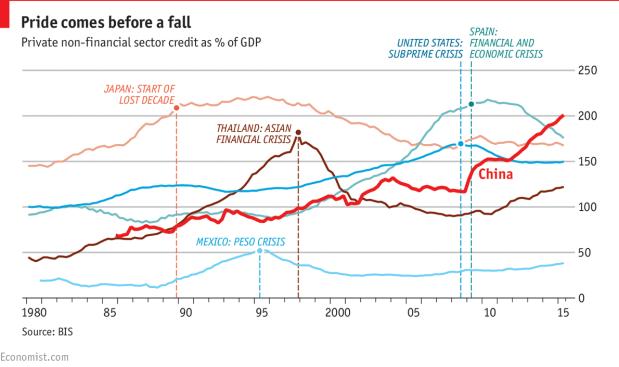
DEBT in China is piling up fast. Private debt, at 200% of GDP, is only
slightly lower than it was in Japan at the onset of its lost decades, in 1991,
and well above the level in America on the eve of the financial crisis of
2007-08. China’s binging borrowers seem to have run out of good investments.
The value of non-performing loans in China rose from 1.2% of GDP in December
2014 to 1.9% a year later. Some big firms are earning too little to service
their debts; instead, they are making up the difference by borrowing yet more.
The IMF reckons that
surging credit is “the single best predictor of financial instability”, but
China might be able to avoid a crisis. Very little of its debt is owed to
foreigners, and the government has room to borrow to cushion the economy
against loan defaults and failing banks. Yet when Chinese firms eventually flip
from borrowing to repaying their loans, growth will probably slow sharply. That could make
for difficult times for people in China, and in the rest of the world as well.
List of literature
2. http://www.ft.com/home/asia
3. Options, Futures, and
Other Derivatives (9th Edition) 9th Edition by John C. Hull