Bakytzhan Assyl
Student of Sheffield
Hallam University
Sheffield
Business School MBA
Joint SHU / IAB MBA
CAIXABANK: ANALISYS OF THE ACTIVITY
CaixaBank is a leading
financial group in the banking sector in Spain that provides banking and
insurance operations and undertaking investments in leading service sector
companies and international banks[1].
The key activities of CaixaBank are Business, Personal and Private Banking as
well as Small and Medium-Sized Enterprises (SMEs) Banking.
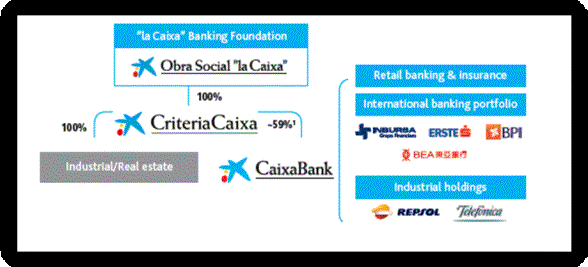
Figure 4.1 Structure of
“La Caixa” Group after restructuring, December 2014.
Source:
www.caixabank.com/informacioncorporativa/quienessomos_en.html
The main purpose of “La
Caixa” Group's is “its level of implication and unswerving commitment to
society. CaixaBank is committed to banking based on corporate values of
quality, confidence and social commitment”[2].
CaixaBank is considered to be the main banking institution for 1 out of 4
banking customers in Spain and it has 14 million people customer base, which is
considered to be the largest one. CaixaBanks’ network is one of the most
extensive ones in Spain, as it counts over 5,000 branches and more than 9,500
ATMs (See Figure 4.2). The bank provides high-quality mobile and online banking
service to its customers.

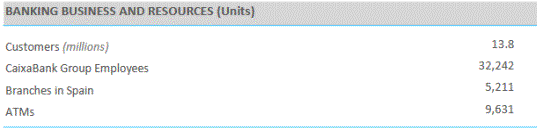
Figure 4.2. Key figures
of banking business and resources of CaixaBank, 2015
Source: Business Activity and Results Report of
CaixaBank, 2015:3
In terms of capitalization, CaixaBank is in Top 10 largest banks in the
European Union Zone. Reuters.com (2016) says that “it is engaged in investment
in companies involved in water treatment and sewage, energy or
telecommunications sectors, such as Repsol YPF SA, Telefonica SA and Sociedad
Aguas de Barcelona SA, among others. On October 31, 2013, the Company
formalized the sale of the Real Estate Management Business of Servihabitat
Gestion Inmobiliaria SL to Servihabitat Servicios Inmobiliarios SL”[3].
Before this, CaixaBank had acquired a 100% stake in Servihabitat Gestion
Inmobiliaria SL. In 2013 it had also acquired 5.01% of Sociedad Holding de
Mercados y Sistemas Financieros SA (BME) and Bolsas y Mercados Espanoles.
CaixaBank: Positioning and Shareholders
CaixaBank focuses on
consolidating the Caixa Group's position to be the main financial leader in
Spain and the company strives to be recognized for its corporate social
responsibility (CSR) approach, the quality of services it offers, the financial
strength and leading position in implementing innovations, which has always
characterized CaixaBank. Moreover, CaixaBank attempts to consolidate the image
of a committed and socially responsible bank in terms of profound corporate
governance.
In 2015 the company had several successful takeovers such as Banco de
Valencia and Banca Cívica as well as in 2014 it purchased retail and business banking operations of
Barclay’s in Spain. By these deals CaixaBank remained the financial leader on
the Spanish financial market.
CaixaBank began its history far back in 1904, when there was founded the
Caja de Pensiones para la Vejez y de Ahorros de Cataluña y Baleares, ”la
Caixa”. The company started its operations with managing family savings and
later it began offering pension insurance to its customers. Such kind of type
of social benefit had been offered by “la Caixa” far before this was
established.
In 2011 CaixaBank took the financial business transfer from ”la Caixa”.
Later, in 2014, according to the Savings Banks and Banking Foundations Law (27
December 2013), “la Caixa” was renamed to Fundación Bancaria Caixa
d’Estalvis i Pensions de Barcelona, ”la Caixa”[4].
Since that time, the Banking Foundation “la Caixa” has managed the Welfare
Projects which had identified and characterized the Caixa Group. Also the
Group's investment portfolio is managed by “la Caixa” using CriteriaCaixa
service. In accordance with the information from this portfolio, CriteriaCaixa
ownes a 58.9% stake in CaixaBank, and stakes in other companies from various
economic sectors, which provide important community services. they include Gas
Natural Fenosa (energy distribution), Abertis (transportation and
telecommunications infrastructure management), Saba (car park and logistics
park management) and Suez Environnement (water and waste management)[5].
In addition, “la Caixa” Banking Foundation is considered to be the largest
charitable foundation in Europe and ranks the third worldwide. Welfare Projects
that Foundation implements comprise social and charitable initiatives that
offer solutions to needs and challenges for today’s society. Therefore, a
number of these initiatives aim at meeting the needs and requirements of
marginalized persons and those people who are facing greater risks of social
exclusion. In 2015, “the Welfare Projects budget remained stable, at €500
million”[6].
Financial
Analysis of CaixaBank
According to Financial
Results Report of CaixaBank (2015), the year of 2014 was quite successful and
the company showed results of stable growth[7].
The Spanish economy began to transfer to the recovery mood and the banking
sector was also strengthening its positions. The GDP indicators were gaining
recovery speed, the process of restructuring of the banking sector was almost
finished and CaixaBank remained the leader in Eurozone Banking Union.
However, there were some
drawbacks such as the consequences of the financial crisis, loan growth
remained tenuous, low rates had a significant impact on asset yields and
finally, the regulatory environment was not stable enough.
As the Business Activity
and Results Report (2015) states, CaixaBank’s total assets amounted € 344,255
million in 2015. Customer funds counted €296,599 million, annual growth was
marked at the point of € 24,841 million (which was +9.1% compared to the
previous year) and up 2.5% in Q4 of 2015 (See Figure 4.2).
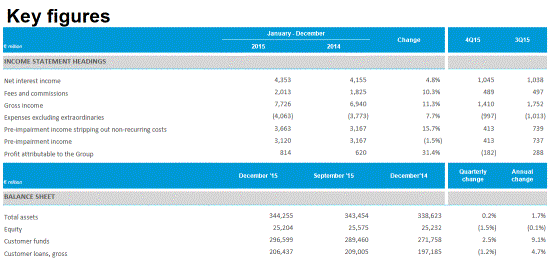
Figure
4.2. Key figures of financial analysis of CaixaBank, 2015
Source: Business Activity and Results Report of
CaixaBank, 2015:4
Gross customer lending totaled € 206,437
million. The annual change in 2015 stood at +4.7% (which was +7.7% for the
performing portfolio of ex-real estate developers). Lending showed a slight decline of 1.2%
in Q4 of 2015 (-0.3% for
the performing loan
portfolio of the ex-real estate
developers)[8]. Gross
income amounted
€ 7,726 million, which is by 11,3% higher than
in previous year (See Appendix 1, Appendix 2 and Appendix 3 for more detailed
financial figures of CaixaBank performance in 2015).
CaixaBank’s liquidity in 2015 totaled € 59, 090
million that comprised 15,7% of total assets (See Figure 4.3).
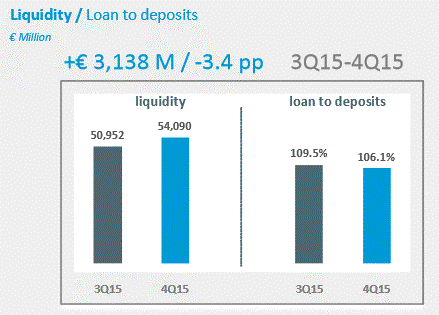
Figure 4.3 CaixaBank liquidity / Loan to
deposits, 2015
Source: Business Activity and Results Report of
CaixaBank, 2015:3
The general overview of
the major financial indicators has showed that CaixaBank has recovered from the
financial crisis of 2008-2009 and it has been showing the constant economic
growth.
Acquisition
of Catalunya Banc and Barclay’s
As it is known, not all
banks in Spain could overcome the peak of the financial crisis without any
losses. Many Spanish banks were focusing on attempting to get revenues lost
during the global economic decline, including the way of winning over borrowers
and depositors. While several major financial institutions of Spain finally
survived, many banks ceased their activities or had been nationalized. The
latter may be addressed to Catalunya Banc.
The fact is that
CaixaBank, which is much more successful than Catalunya Banc, showed interest
to this bank. For some time, rumour had it that Caixa management was
considering of purchasing Catalunya Banc. In May, 2015, Isidro Fainé,
the President of CaixaBank, confirmed that there is a strong intention to make
such an acquisition. Moreover, the Caixa management had already decided on the
initial amount of money that had been prepared to pay for the purchase.
Experts say that the
reason for the nationalization of Catalunya Banc was the deplorable financial
situation of the institution, which was on the verge of bankruptcy.
As Fainé said in
his interview with a Catalan newspaper “El Diario”, Caixa management had plans
to acquire Bank of Catalunya for a long time, and the management “would do
everything possible in order for this acquisition to be completed successfully”[9].
Many people were worried
about the issue that if not such successful Catalan bank were really bought by
this financial giant, what would happen to its branches? After all, many of
them were in the immediate connection with the Caixa branches. Considering this
issue the President said that “in each case, the issue will be addressed
individually”[10]. The result
was unsuccessful. As Reuters.com (2014) claimed, “The Barcelona-based lender
recently missed out on a chance to buy a local rival, state-owned Catalunya
Banc, which was snapped up by BBVA (BBVA.MC) in an auction.”[11]
Rumor also had it that
in 2014 CaixaBank planned to acquire Barclay’s branches that was having activities
and was operating on the territory of Spain. However, according to
Fainé, at that time the Caixa management had not even considered this
issue. So, at that time the information about the intentions of such a
successful financial institution as CaixaBank to make another big deal had
remained just rumors.
However, in September,
2014, there appeared the information that the British bank Barclays was going
to sells its business in Spain Caixabank Catalan for 800 million euros[12].
Spanish branch of Barclay’s was engaged not only in retail banking, but also in
providing banking service to huge corporations and wealthy clients. Bloomberg
(2014) states that “CaixaBank SA agreed to buy Barclays Plc’s banking
operations in the country for about 800 million Euros ($1.1 billion) in cash to
expand its business as economic growth picks up”[13].
This outsourcing purchase added around 270 branches to CaixaBank’s existing
network and the customer base of CaixaBank rose up to almost 14.5 million. The
representatives of a Spanish investment bank N+1 Francisco Riquel and Rodrigo
Vazquez said that although this deal was quite small for the CaixaBank, but the
Caixa management highly valued this purchase. According to them, “this
transaction adds affluent clients and boosts CaixaBank’s presence in Madrid”[14].
Barclay’s kept its division of investment
banking in Spain, and the Barclay’s merger with Caixabank did not touch credit
card operations of Barclay’s in Spain (White 2014).
Caixabank management
pointed out that the final price that it could pay for the Barclay’s assets
would directly depend on the value of Barclays Bank’s net assets in Spain by
the end of 2014, just when the acquisition was due to close.
Taking all the opinions
of financial experts about this deal of CaixaBank, it may be concluded that
Barclay’s escape from Spain was the first step of the claimed British company's
strategy to deescalate operations in continental Europe. The new Head of
Barclays Anthony Jenkins suggested the strategy to strengthen bank’s positions
on the national market (the UK) and further on the US market. “I am pleased to
be announcing further progress on Barclays non-core asset reductions through
the transactions,” Jenkins said in the statement. “We remain on track to
rebalance Barclays as part of our strategy to deliver sustainable returns for
our shareholders.”[15]
According to Bloomberg
(2014), Barclays’s assets in 2011-2013 in Spain had dropped at about 23 percent
and reached the bottom of 22.6 billion Euros (Penty and Munoz 2014). Barclays’s
combined losses in 2013 in Spain counted 742 million Euros.
Gonzalo Gortazar, the
CEO of CaixaBank, pointed out that in Spain Barclay’s business has a
“significant efficiency issue.” (Penty and Munoz 2014). “It is a matter of
scale, and in CaixaBank we have scale,” he said. “We are the largest bank so we
can actually, in a very simple transaction, integrate the businesses and keep
the very positive things Barclays have to offer and make it more efficient.”[16]
Subject to regulatory approval, the transaction between CaixaBank and Barclay’s
was scheduled to be fully completed by the end of 2014.
It would be meaningful
to point out that CaixaBank, the third-largest credit institution in Spain, has
survived the financial crisis relatively easy, and for the last three years has
been actively buying assets in Spain. Its complements strategy of Barclay’s
acquisition has resulted in improving company’s competitive position in key
market segments and regions; it has generated ROIC by 10% by 2016; and as the transaction
closed in the beginning of 2015, it would definitely influence the major
financials of CaixaBank in 2016.
Moreover, the Business
Activity and Results Report of CaixaBank (2015) shows that the acquisition of
Barclay’s Bank has had a positive impact on annual change by generation of +25
points in capital[17].
All these deals led to forming and implementing the business process
outsourcing (BPO) by CaixaBank.
Discussion of
BPO in CaixaBank Activities
Spain is considered to be one of the champions
of Europe in the number of bank branches per capita. The crisis of 2008 forced
financial institutions across Europe to begin the process of optimization of
the costs and services, including actively develop internet banking and using
business process outsourcing (BPO). Such kind of business reorganization
happened with CaixaBank.
Use of
Electronic Data Systems
For instance, using outsourcing contracts,
CaixaBank passed the computer science department of 21 branches of the bank
under the control of the American company Electronic Data Systems (EDS) for a
period of 8 years. The main purpose of the transfer was to avoid the issue of
short-term hiring and firing of employees to solve complex financial problems
of the bank. Namely, it was necessary for 3 years to switch to the euro in
their direct payments. In a regular situation, this fact would require
increasing the staffing composition of employees by 2 times, that could
adversely affect the competitiveness of the bank. Consequently, the transfer of
the bank's branches in the outsourcing company EDS has not helped the increase
of the bank's staff, but to focus on the main core competencies.
CaixaBank has created
"data pool" on the basis of Oracle technologies. The new
infrastructure is already being used to improve the bank's service and soon
will be used to optimize various business processes. The successful experience
of the bank to work with big data formed the basis for a European center of
expertise on Big Data, created by Oracle Corporation in Barcelona.
As it has already been
mentioned, customer base of CaixaBank, one of the leading banks in Spain, has
more than 14 million customers. The Bank has 6 thousand offices, and its
history of more than 100 years. «La Caixa» Group, which includes CaixaBank, has
set a goal of strong growth in Spain and outside its borders. In this case the
emphasis is on innovation and high quality customer service. Implementing the
strategy, in December 2013 the bank launched a project for the integration and
analysis of large data[18].
Use of Oracle
Big Data Application
In summer, 2014, CaixaBank together with Oracle
in record short period of time completed the first stage of a strategic project
for working with large data, in which the infrastructure for central data
repository was deployed. This unified, flexible, powerful and secure “data
pool” is able to quickly respond to any requests for information, quickly find
the data and extract the most relevant information for the business. By
implementing this infrastructure on Oracle technologies, which include including
Oracle Exadata and Oracle Big Data Appliance, the bank has integrated into a
single repository of all the information before the environment associated with
the customer relationship, risk management, the formation of regulatory
reporting, etc. The project enabled the bank to gain access to aggregate
information and analyze it with greater historical depth.
Analysis of big data allows the bank to improve
its services and improve business results. Integration of information from
various sources (such as the Internet, branch network, call centers, ATMs)
makes it possible to obtain a very detailed picture of each customer. Now
CaixaBank is considering the use of big data for financial reporting, risk
management, streamline business processes; reduce time to market of new
products, anti-fraud, and a number of other tasks.
“Infrastructure of Big
Data that was launched was aimed at obtaining the most complete knowledge of
the needs of CaixaBank’s customers and finding ways to improve our services. In
this sense, technology is fully in line with the vision of the Bank of how to
develop the bank and our services to achieve the highest standards”, - said
Juan María Nin, Vice-President and CEO of the group “la Caixa”[19].
To disseminate the
accumulated experience, CaixaBank and Oracle decided to set up Big Data
Expertise Center in Barcelona. It will be involved in the development in the
field of big data solutions to organizations across Europe. The center will
provide educational services to train specialists according to Oracle,
CaixaBank and other private and public organizations. There will be created a new
application solutions based on Oracle technology for large data for a variety
of industries, including the financial sector. Competence Centre will serve as
best practice of such decisions.
Experience of successful
implementation of the new infrastructure in CaixaBank will help to make the
place of concentration of experience with big data from all over Europe from
Center. The center will be a place for the joint search for new business
applications for big data technologies. Center in Barcelona will collaborate
with universities, public and non-profit organizations and private companies to
promote big data technologies and promote their development.
Mobile
Banking Service of Petra Financial
CaixaBank uses the mobile banking from Petra
Financial technology as an additional service to its own payment platform for
third-party banks and corporate clients.
MPS (Managed Payment
Service) from CaixaBank, which brings together various banking transactions,
multi-bank and the full integration of data, and is now added an additional
software module called Petra Financial's Touchstone Mobile Banking.
As stated by the
representative of CaixaBank, Juan María Nin, the novelty will enable
clients (heads of financial departments, corporate executives, etc.) to manage
cash flow, track conduct transactions, etc. the easiest and most convenient
way.
Thus, the bank already
uses Vortex application of Petra as part of its payment MPS platform to verify
compliance with the national clearing codes BIC and IBAN before confirming payment.
It would be reasonable to note that continuing investment in MPS reflects an
emerging trend in the market of outsourced payment services.
The current economic
situation has forced many banks to come to the conclusion that it is no longer
effective to own and manage every component in the operating processing. This
leads to the need to find financial partners specialized institutions that are
trusted and that can offer a custom solution.
Banking
Operations Services with Hewlett Packard
Since 1996, HP has been providing services of IT
and BPO operations to CaixaBank. A collaboration framework between HP and
CaixaBank is an integral part of this relationship as it encourages HP
innovations. This enables CaixaBank achieve banking service excellence with the
help of continued improvement, as well as meet aims and targets that have been
already set by CaixaBank in Strategic Plan.
CaixaBank and HP have
agreed to a step-by-step approach to implement the innovation program, by
gradually transitioning services that were previously managed by all bank
employees. The innovation program comprises the following important elements:
·
Implementation of CCN, the
so-called Business Control Center. Its aim is to collect real time data from
various disparate systems of the bank. “It provides a flight deck for
CaixaBank, showing at any time the status of the banking operations relevant to
each user and tracking over 500 KPIs”[20].
·
Process
Automation solutions are developed by HP and applied by CaixaBank to
every single business process (e.g. Credit Management, National and
International Payments of Public Institutions). It is useful “to eliminate
manual processing, while improving operational control and adapting to
regulatory requirements”[21].
·
Digitization. This is the so-called electronic management of
all documents and full image recognition.
The results of such BPO
are obvious. Since beginning to use HP business process outsourcing solutions
in 2006, CaixaBank has delegated more work to HP. It led to improving in
cutting costs in the bank and giving HP opportunity to find new and innovative
ways of refining business processes. CaixaBank expects 3% savings every year
and hopes that HP technology advantage will help the bank management find
efficiencies.
IT
Outsourcing Deal with IBM
In Designing a Sustainable Digital Bank Report
the IBM Company formulated the concept of the digital bank. According to the
corporation, it is not just the introduction of a mobile application or
abandonment of offices.
IBM believes that the digital bank like
CaixaBank, SA should provide the majority of their products and services in
digital form. Thus, its clients are using digital channels for their everyday
banking activities. The infrastructure of this bank is optimized for digital
interactions in real time, and internal culture implies a high rate of change
in digital technology.
According to the Report, CaixaBank is Model A,
the so-called digital banking brand. Classic banks like CaixaBank with lots of
legacy-systems and business processes are constantly trying to get closer to
the new “advanced” user, who wants brand to be more digital and meet the new demands[22].
Often, rather than scare away the existing customer base of innovations, such
banks open new brands with unique offers and products created especially for
the younger generation and, as a rule, these brands use the existing banking
infrastructure.
La Caixa decided to use
IBM outsourcing solutions relying on five main differentiators.
• “Efficiency: The bank felt that with
its expansion strategy, sourcing many of its IT functions to IBM would create
efficiencies that would increase internal productivity.
• Reduction of operational costs: The
bank believed that the € 400 million it expected to save over the term of the
agreement would enable it to invest that capital in growth.
• International expansion: With no IT
presence outside of Spain, La Caixa believed that a global technology provider
such as IBM would offer the international presence and expertise that would
help it realize its international expansion goals.
• Innovation: The bank knew that IBM
could deliver the innovative social, mobile, cloud and analytics technologies
that had long been among the bank’s key differentiators.
• A true alliance: La Caixa believed
that by teaming with IBM, not only would the proficiency and effectiveness of
the bank’s internal IT department improve and evolve, but a culture of
innovation would be created that would ensure that it remained a technology
leader in the industry”[23].
A critical
factor of success for CaixaBank is possibility to effectively scaling. The
second most important factor in the success of the digital banking organization
at IBM is the opportunity for CaixaBank to create the required user experience
for the target consumer. The third factor of success as IBM report mentions is
the possibility of expanding beyond basic deposit products to the wider
proposals, including a monthly fee, even taking into account the fact that some
of these products can be quite difficult for their sales exclusively through
digital channels.