A.
P. Saliuk, postgraduate student
Simon Kuznets Kharkiv
National University of Economics
Sponsorship as a tool of branding
Last
decades there is a rapid growth of companies, which choose branding their
products. According to this competition in branding also grows up and companies
searching for new ways of consolidating their brand in in consciousness of consumers. One of the main roles
occupies sponsorship. Therefore, development of recommendations regarding the use sponsorship in
branding is very actual task. Hereupon, in
order to assist strategic managers, a wide variety of tools and techniques have
been developed.
Sponsorship
is extremely important for building a strong brand, because it allows you to link an idea of the
company to a certain group of consumers.
There
are a lot of scientific works of famous economists devoted to the problem of
managing the communicational policy of the enterprise and its impact on the
efficiency of the organization, namely Antrpova E., Bush, Foster J., Kosenkov
S., Strelnikova O., Wieser T. and others. Considering the works of Ukrainian
scientists, sponsorships have become the object of research not so long ago -
less than a decade. Nevertheless, in their works, sponsorships in branding at
the enterprise haven’t been formulated distinctly yet. That is the reason, why
subject of this article is vitally pertinent.
The
aim of the article is to define the basic use of sponsorship branding to
achieve the goals of the organization.
Sponsorships
- contributions in cash or in kind made to people or organizations with the
expectation of achieving corporate goals and in return for prominent public
recognition of this support. There are several forms of sponsorship which
include support for the world of sports, the arts and other relevant areas of
society. The recipients of sponsorships and the sponsors enter a contractual
business relationship which precisely determines the level of the sponsorship
and the expected benefits, e. g. wearing the logos or brand signs of the
sponsors on their sports equipment, mentioning the sponsorship activities in
their newsletters, brochures and advertisements as well as on the tickets for
the sponsored events. The sponsors, for their part, can highlight the support
they give in their own advertisements (e. g. sponsorship of the top national
football league or a title sponsorship of a cup final). The essential principle
of sponsorship is that of “give and take” [1].
There
is a fundamental distinction between sponsorship and charitable donations which
do not carry any expectations of public recognition.
Unlike
donations and philanthropic patronage, sponsorships are devised as a tool of
the marketing communications mix [5].
There are top errors that should be avoided in product placement:
-
the same brands appears too often in
the shot or the time during which a product is displayed in sequence seems
unnecessarily long, at least from a viewer’s point of view;
-
the placement of the products in the
shot is blatantly obvious;
-
the link between the actors and the
brand is exaggerated and felt to be engineered;
-
the brand is arbitrarily integrated
into the plot; it interrupts the course of action and looks unrealistic or
unsuitable;
-
there is an overkill of product
placements in the film [4].
The
sponsorship of sports events, which seeks to profit from the positive image of
the sponsored event or of the sportsmen to be sponsored, is seen as an
opportunity of image transfer by means of marketing. The question as to if and
how this positive image can be transferred from the sports arenas to the
sponsoring companies is the crucial criterion in choosing a sponsoring partner.
When they support sportsmen, sponsors always risk being affected by sudden
popularity swings caused by or related to the recipients of the sponsorship (e.
g. footballers, clubs, and fashionable sports).
In
order to protect themselves from the negative marketing and media leverage
caused by performance lows of individual athletes or from the affairs of sports
idols, some sponsors concentrate their activities on sports events and on the
promotion of (hopefully) exemplary teams. Currently they are also focusing on
junior teams such as the one established and promoted by General Motors in
Germany (i. e. Opel). A special risk involved in sports sponsorship derives
from its growing attractiveness. This has led to such extensive sponsoring
activities in sports that achieve high media leverage such as alpine skiing and
car racing that it has become difficult to identify individual sponsorship
measures. The sponsorship of such high profile sports only recommends itself to
companies whose products are household names or which are fully committed to
these sports [2].
Cultural
sponsorships include all arts and all forms of cultural expression be they
locally important or of international renown. This form of sponsorship, which
has recently gained in importance, can be of interest for SMEs in the
business-to-business sectors if these companies wish to build up a positive
image in their local communities. They can accomplish this by promoting
theatres of some local standing, or culture and arts societies. Museums that
include substantial technological exhibits or technological museums also
constitute interesting locations for producers of capital goods.
Environmental
sponsorships is designed to highlight a corporation’s stakeholder orientation
which is beginning to play a more important part in view of the growing
sensitivity that communities are developing for ecological issues. The related
social sponsorships allows companies to demonstrate their interest in societal
problems and their willingness to contribute to their mitigation or solution. By
these means, sponsorship becomes an instrument of community orientation in
marketing. The advantages of social or environmental sponsoring lie mainly in
the fact that companies do not depend so much on certain events or persons but
are able to commit themselves to solving social problems that are considered to
be important for their communities at large [6].
Marketing
needs to clarify to what extent the solution of ecological and social problems
can be aligned with the corporate philosophy. Social and ecological commitment
can be integrated successfully in corporate strategies if the sponsors are in
some way linked with the area they are sponsoring.
Local
and regional involvement can derive from the company’s major field of activity.
The wood processing industry, for instance, might like to sponsor projects for
the protection of the forests; manufacturers of solar equipment might launch an
environmentally-oriented competition on energy- saving. Moreover, such
relationships can be built up with targeted customers, especially between
companies that supply consumer goods.
They
might, for instance, define young people as target groups and offer support for
their training and further education programs. Producers of industrial goods might sponsor projects for their target customers in
the
processing industries, suppliers of plastic articles
might support joint recycling programs with their communities.
The
sponsorship of social, cultural and sports events can be viewed critically if
the members of a community suspect that the sponsors intend to exert their
influence in these areas. This risk obviously exists and, in sponsorship
practice, there are numerous examples that sustain such claims.
If
companies consider their sponsorship activities to form part of their community
image building strategy, they can easily defuse such arguments by choosing the recipients of their sponsorship accordingly. If sponsorship is intended
to create a community-friendly corporate image it should always seek to be
highly credible and sufficiently independent of short-term economic aspects.
A
relatively novel field which has been largely overlooked until now is the
sponsorship of the scientific projects which offers interesting perspectives to
SMEs as well as major corporations operating in capital markets [2].
Scientific
sponsorship can assist universities in raising funds, a prospect which will be
of increasing importance in view of the budget shortages in the sector of
higher education. Companies may benefit from this form of sponsorship by
supporting research projects that will give them the competitive edge over
their competitors. Hermanns & Suckrow maintain in their study on this issue
[1] that companies that sponsor institutions of higher education are facing
objections which primarily concern the independence of scientific research and
academic teaching. Universities, on the one hand, need to overcome their
reservations about unjustifiable interference by the sponsoring corporations, companies,
on the other hand, need to reconsider their view of universities as a drag on
industry’s resources and see them as research partners, who are able to
transfer considerable knowledge to businesses in practice.
Sponsoring
addresses a fairly broad target group and is, therefore, unsuitable for
business-to-business enterprises that serve a small and limited market segment.
However, it may be worth the consideration of the major players in the
industrial sector, such as the truck producers Iveco Magirus and the producers
of construction materials Raab Karcher which have repeatedly provided
sponsorship for sports. This form of sponsoring is certainly also advisable for
companies which wish to reach a large number of medium-sized producers or
service providers on a nationwide basis.
As
sponsorships aims to achieve long-term image effects, it seems extremely
difficult to monitor and evaluate its success. Evaluation requires a systematic
planning process which is founded on an image-related situational analysis. The
planners would have to specify exactly which factors determine the image and to
what extent they should be changed and by when. The overall sponsorship aims
would be derived from this analysis.
It
is not possible to meet economically quantifiable and measurable short term objectives such as increase in the sales volume, the market share
or a company’s competitive position by offering sponsorships. Sponsorships will
only be able to make a contribution to these objectives over time and in
combination with all the other communications and marketing tools. The
definition of the target group, too, is a significant aspect in defining the
sponsorship aims. The target customers should be defined just as precisely as
is the case with advertising and marketing as a whole. On the basis of these
aims and in relation to the specified target group, a sponsorship strategy is
formulated. It contains the central issues of the company’s commitment which
regards in particular the area to be sponsored. The necessary sponsorship
budget is then allocated in line with the formulated strategy and the
sponsoring measures to be taken are determined accordingly. Subsequently,
contacts are established with the prospective recipients of the sponsorship and
a sponsorship agreement is drawn up.
Seen
from the perspective of integrated communications, intermeshing a company’s
sponsorship activities with its other communication instruments is of specific
significance. The diversity of communication measures in general and the
variety of sponsorship opportunities in particular require this interlinking in
order to ensure the synergetic enhancement of the overall impact of marketing
communications. Sponsorship planning as detailed above is charted in Fig. 1.
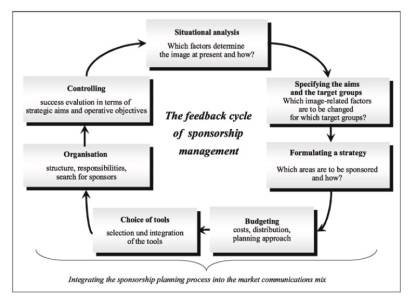
Fig.
1. Mapping the sponsorship planning process from a
corporate perspective [3]
In
a nutshell: Sponsorships concentrate on the areas of sports and arts, on the
social and ecological environment and the media. They are directed at individuals,
groups, organizations and events. This is graphically represented as the
sponsorship mix in Fig. 2 which has a horizontal and a vertical dimension.
In
terms of sponsorship efficiency, companies need to focus on those sponsorship
areas and activities which correspond best with the goals formulated with
regard to their image and which involve their target groups as much as
possible. The options concerning the recipients of the sponsorships depend,
firstly, on the sponsorship budget available and, secondly, on the opportunity
to reach the desired target groups.
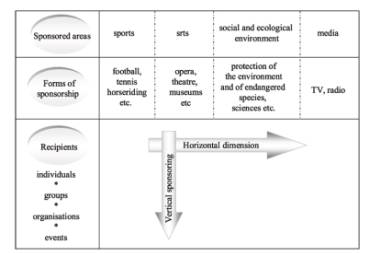
Fig.
2. Structure and dimensions of the sponsorship mix [1]
Consequently,
sponsorship is a tool of wide use for achieving goals of company towards
relations with consumers. A special place it has in
the in branding of products. By linking the idea of your
company with specific
groups of consumers, who are interested in
sports, science, culture or any other aspects of life, companies are making one
more step towards building a strong brand.
References:
1. Busch, R. Marketing communication
policies: monography / R. Busch. –
Berlin:
Springer-Verlag, 2012. – 378 р.
2. Foster
J. How to Turn Bloggers (and Other Influencers) Into
Your Brand Champions/ J.
Foster//
Oxford: Oxford University
Press. – 2014. - № 1. – P. 71-79.
3. Middleton, J. The ultimate strategy
library: the 50 most influential strategic ideas of all time /J. Middeleton. -
Oxford: Capstone, 2008. – 264 p.
4. Nanji
A. How Marketers Measure the Effectiveness of
Sponsorship and Event Initiatives/ A. Nanji// London: Osprey Publishing . – 2009. - № 3. – С. 114-117.
5. Wieser T. Social-Media Publishers Eager for
Paid Sponsorships/T. Wieser// Cambridge University Press. – 2011. - № 2. – С. 23-35.
6. Орлов П. А. Маркетинг: [ навчальний посібник] / П. А.
Орлов, С. І. Косенков, Т.П.
Прохорова та ін. – Х.: ВД «ІНЖЕК»,
2012. – 528 с.