Экономические науки /15 Государственное регулирование экономики
D.T. Jarikbaeva, associate professor, PhD doctor
S.S. Masakova, associate professor, candidate of economic sciences
Narxoz University, Almaty, Kazakhstan
FORMATION OF AN EFFECTIVE MECHANISM OF MONETARY REGULATION IN
KAZAKHSTAN: A RETROSPECTIVE ANALYSIS
Economic regulation as an instrument of the state's economic policy has
received its formation and development in connection with the emergence of such
a phenomenon as the economic crisis. In turn, monetary regulation as one of the
types of economic regulation was a response to the strengthening of economic
interconnections of national markets, through the development of the
institutions of the central financial regulator, affecting not only money and
money circulation, but also the financial market as a whole. We are talking
about the authorities - the central banks of states, various ministries and
departments that have in their arsenal special tools and tools that have
relevant characteristics.
In Kazakhstan, which survived the transit phase of economic development,
the so-called monetary authorities have increased the world experience in
regulating the use of these funds in the conditions of reform, when tasks such
as ensuring the stability of the national currency, the effective functioning
of the credit and banking system, and, in general, Development of the system of
settlements and payments. The implementation of these tasks and the achievement
of the goals of economic development through monetary regulation is due to the
effectiveness of the methodology for the use of basic tools and the development
of specific instructions for the application of this methodology. Together,
these methods and methods, as well as instructional materials under various
factors and conditions, represent a monetary regulation mechanism that
determines the rules and criteria for the activity of monetary authorities
depending on the selected goals of economic policy. At the same time, it is
obvious that flexibility is an important characteristic of the monetary
regulatory mechanism, ensuring that it is the main factor for the development
and stable functioning of money circulation, the banking system and, in
general, economic activity. In addition, flexibility contributes to the
effectiveness of various instruments in the coordination dimension, as well as
the achievement of the objectives of commodity-money balance and economic
stabilization.
In this connection, it should be noted that, both in general and in
methods, all instruments of economic regulation can be divided into measures of
direct and indirect impact, and methods of monetary regulation are also
subdivided, and depending on the economic situation, the relevant element of
the mechanism is put into effect. At the same time, the effectiveness of the
mechanism is based on the use of money supply as payment and settlement means
and maintenance of money demand.
In Kazakhstan these tasks were solved in stages and during this process
the mechanism as well as its interconnection with the fiscal mechanism,
including within the framework of improving the country's legislation, was
improved.
Within the framework of this
article, three stages of improving the mechanism of monetary regulation are
singled out:
1) the actual formation
(1991-1999), which took place in the conditions of transition to market
relations, namely the processes of privatization, liberalization and the
emergence of market competition.
2) Operation (2000-2007) in
relatively favorable conditions, when there were positive trends in the world
economy and world commodity markets, as well as stabilization of the economic
situation in the country, as a result of reforms, both in the real sector and
in the financial sector of the state.
3) Measures to improve the
effectiveness of the monetary mechanism (2008-2016), due to the crisis that
affected virtually all areas of the national economy, due to global financial
crises.
After
gaining independence in 1991, Kazakhstan faced the task of changing the
functioning of the economy, in connection with the transition from a planned
system to market principles: privatization, liberalization of pricing, and the
creation of a competitive environment were required.
The collapse of the USSR, the disruption of the economic ties that
existed before, led to a deep crisis in the first half of the 1990s in
virtually all spheres of the country's economy. In early 1992, measures were
taken to move to market pricing, conducted in the absence of a competitive
environment, price liberalization in 1992 led to hyperinflation, a
deterioration in the financial condition of enterprises, a reduction in
production, a drop in real incomes and stagnation in the entire economy. The
annual economic recession in 1991-1995 averaged 9.3%. Almost the payment
turnover between the enterprises was destroyed, the amounts of non-payments
reached significant volumes. The task of providing the necessary funds for the
economy was solved by the National Bank by providing loans to enterprises,
banks and the Government to finance the budget deficit, which affected the
preservation of high inflation rates. To overcome the crisis, it was required
to conduct a tight monetary policy, which was possible only after the
introduction of the national currency. In April 1993, the Law of the Republic
of Kazakhstan "On the National Bank of the Republic of Kazakhstan"
was adopted, according to which the main objective was to ensure internal and
external stability of the national currency of the country. In November 1993,
the national currency, the tenge, was introduced,
which allowed for an independent monetary policy.
When implementing monetary policy, the National Bank began using
classical instruments: lending to banks, setting an official refinancing rate
and minimum reserve requirements, conducting operations in the foreign exchange
market.
The measures taken by the National Bank helped to reduce inflation from
60.3% in 1995 to 1.9% in 1998. In 1996-1999, the average annual production
growth was 0.75%. The National Bank promoted the development of the
infrastructure of the monetary and financial markets. The system of electronic
over-the-counter market of government securities began to operate, allowing
real-time sales transactions.
In 1996, the National Bank started short-term repo operations against
security of government securities of the Ministry of Finance of the Republic of
Kazakhstan, which allowed it to effectively regulate banking liquidity.
In 1998-1999 as a result of the unfavorable situation in the world
prices for oil and non-ferrous metals, as well as significant devaluation of
the national currencies of the countries trading partners of Kazakhstan, the tenge significantly strengthened in real terms. This
reduced the competitiveness of Kazakh goods and had a negative impact on the
pace of economic growth.
To prevent negative consequences on the economy of the country, since
April 5, 1999, Kazakhstan has switched to the regime of a freely floating
exchange rate of the national currency. As a result, the supply of foreign
currency in the domestic foreign exchange market increased, which contributed
to the stabilization of the foreign exchange market and the financial sector.
Inflation in 1999 was 17.8%. In the conditions of stabilization of the
situation in the economy, the monetary policy was somewhat relaxed. The
refinancing rate in 1999 was phased
out from 22% to 18%. The
banks' mandatory reserve requirements remained unchanged at 10% of the total
deposit liabilities of the bank, except for the period from April 5 to 18,
1999, when the level of minimum reserve requirements was temporarily reduced to
5%.
The macroeconomic environment in Kazakhstan in the period from 2000 to
2006 developed under the influence of favorable internal and external factors.
Positive trends in the world financial and commodity markets, as well as the
consistent implementation of socio-economic reforms had an impact on the
stabilization of the macroeconomic situation in the country. In 2000-2006,
inflation was maintained at 6.4% -8.4%, while the average annual real GDP
growth was 10.3%.
The growth of the Kazakh economy was greatly facilitated by the
investment activity of domestic and foreign capital. There was a favorable
pricing environment for domestic exports (oil, gold, zinc, copper, lead and
grain) against the backdrop of domestic macroeconomic stability. As part of the
easing of monetary policy in the period 2000-2003, the refinancing rate was
phased out from 18% to 7%, the overnight rate from 27% to 8%, the repo rate
from 23% to 19% . In 2000, the norm of mandatory reserves of banks was
gradually reduced from 10% to 6%. The easing of monetary policy led to an
increase in lending to the economy by banks and an increase in the supply of
money. The annual growth in the volume of bank loans to the economy for
2000-2003 averaged 66.8%, the money supply - 37.5%. At the same time, inflation
fell from 9.8% to 6.8%.
Since 2004, the National Bank has begun to define the basic guidelines
of monetary policy for three years ahead with an annual refinement of
parameters. Achieving macroeconomic stability made it possible to carry out
forecasts and develop strategic directions for a longer period, taking into
account the situation in the economy and financial markets.
The period from 2004 to 2006 was characterized by high growth rates of
the economy. The volume of bank loans from 2000 to 2006 grew 17 times. At the
same time, the growth in lending, based on significant external borrowing by
banks, has also caused Kazakhstan's vulnerability to foreign economic
conditions.
Lending to the economy was disproportionate to the structure of the
economy, which led to excessive lending to certain sectors of the economy and
the emergence of "bubbles". Against the backdrop of the limited
choice of financial instruments for investing free cash funds, the subjects of
the economy were keenly interested in their profitable investment. The
placement of free cash resources in real estate has become especially
attractive. As a result, mortgage lending and equity construction increased
significantly, which triggered a rise in property prices.
The high inflow of foreign capital, the excess liquidity on the domestic
market, the growth of the state budget expenditures contributed to the increase
in inflationary pressures in the economy of Kazakhstan since 2005. In 2006, for
the first time since 2001, inflation exceeded the level of 8%.
The intensification of inflationary processes in the economy determined
the adoption of measures to tighten monetary and credit policy, that is, an
increase in the rates for monetary operations and the withdrawal of excess
liquidity.
When carrying out the foreign exchange policy, the floating exchange
rate regime of the tenge was maintained, which
presupposed its formation depending on demand and supply in the domestic
foreign exchange market. Significant inflow of foreign currency due to the
growth of prices for major export goods, as well as an increase in external
borrowing of banks, contributed to the strengthening of the tenge
since 2002 (Figure 1).
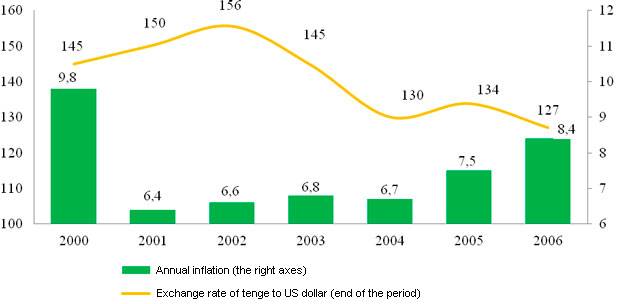
Figure 3 - Dynamics of inflation and the exchange rate in 2000-2006 years
The tendency to strengthen the tenge has led
to an increase in the volume of foreign exchange interventions by the National
Bank. Despite the fact that the National Bank sterilized the purchase of
foreign currency, operations in the foreign exchange market contributed to the
growth of liquidity in the market. This reduced the effectiveness of measures
to regulate inflation.
In order to limit excessive credit activity of banks due to significant
foreign borrowings, in July 2006, changes were made to the mechanism of minimum
reserve requirements. To curb inflation, the National Bank also took measures
to strengthen the regulatory impact of official rates. In 2000-2006, Kazakhstani
banks attracted significant borrowings from foreign markets. This contributed
to the economic growth of the country, but at the same time increased the
vulnerability of the financial sector to external shocks. In addition, this led
to a gradual acceleration of inflationary processes. Monetary policy in this
period was multidirectional: if in 2000-2003 the National Bank eased monetary
policy to support the economy, then in 2004-2006 the National Bank tightened
monetary policy in order to overcome inflationary pressures in the economy.
The functioning of the financial system of Kazakhstan in 2008 - 2011 was
influenced by the development of crisis phenomena in the world economy. In the
general economic aspect, it should be noted that the current conjuncture of
prices for the main exports of Kazakhstan under the influence of the
manifestations of the crisis consequences of 2008 made the monetary policy less
effective.
Kazakhstan today is going through not the best of times, and regarding
the policy pursued by the government to regulate the business cycle, too,
everything is not clear. Over the past ten years, there have been many changes:
the first tenge devaluation in 2008, the aggressive
intervention in the banking sector in 2009, the inflation surge in 2010 and
2014, the restructuring of the institutional system of the financial sector in
2011, the "financial" initiatives for IPOs, the second devaluation In
2013, the third devaluation in 2015, the use of methods of inflation targeting,
etc. It should be noted that the repeated devaluation of the tenge in Kazakhstan was partly due to the reduction of tenge liquidity in the economy and the slowdown in business
activity due to the dollarization of deposits and assets, although the
Government has taken and is taking measures to dedollarize
the economy. In particular, for currency (dollar) loans and deposits the most
unprofitable rates. At the same time, due to mass conversion of deposits from
foreign currency in tenge, excessive tenge liquidity accumulated in banks and from the second
quarter of 2016 the money market began to function in the conditions of
structural surplus of tenge liquidity. Therefore, in
order to limit inflationary processes, the National Bank carried out operations
to seize liquidity [1].
As we see, all these methods of regulation were
designed to stabilize the national economy, to protect it from more severe
shocks. At the same time, the free floating of the tenge,
which has manifested itself especially in recent times, and measures to reduce
inflationary pressures have had little effect on the performance of the
national economy (Figure 2).
The National Bank of the Republic of Kazakhstan, on
its application, seeks to reduce its participation in the foreign exchange
market in order to increase the flexibility of the tenge.
This means that with a drastic change in the economic situation, a sharp and
significant fall in world prices for energy resources and their retention at
this level for a long time, as well as devaluation in the countries that are
the main trading partners of the Republic of Kazakhstan, a sharp change in the tenge's exchange rate is possible.
Regardless of the scenario of economic development,
monetary policy measures are aimed at keeping the level of annual inflation in
the range of 6-8%. The increase in excess money supply, which stimulates
inflationary pressures, is mitigated by the growth of sterilization operations
of the National Bank.
However, the tightening of monetary policy as a whole
was one of the factors of the positive growth in GDP in 2016. In the short
term, the regulator managed to rectify the situation somewhat (Figure 2).
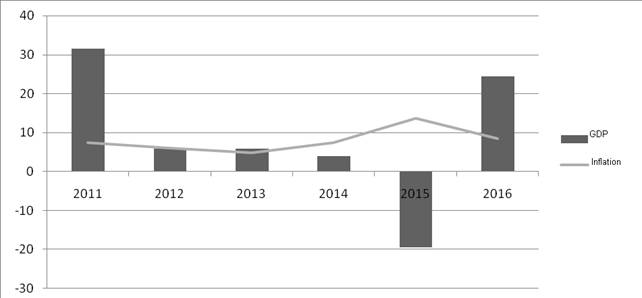
Figure
2 - Dynamics of GDP and inflation in the Republic of Kazakhstan, 2011-2016.
Naturally, all these measures reflect
the volatility of the real economy. The republic was faced with a lack of clear
coordination between the real economy and monetary policy. As a result, the
adjustment of monetary policy did not proceed smoothly, without jumps, without
the devaluation of the confiscatory nature and extreme rates, namely as
described above. The need for "surgical intervention" arose because
of the delay in the necessary actions at the level of macroeconomics and
guarantees that the process of depreciating the tenge
will not continue, at least until the balance in macroeconomics is reached.
References:
1. Sembieva
L.M., Alina G.B., Kulyibekova
A.M. Perspektivyi i protivorechiya
novoy denezhno¬-kreditnoy politiki Kazahstana// Vestnik KazNU, 2016. # 3. S.64-70.
2. Denezhno-kreditnaya politika Respubliki Kazahstan do 2020 goda [Elektronnyiy resurs]. URL:
http://www.nationalbank.kz (Data obrascheniya:
14.04.2017).