Technical sciences/11. Robotics
Bayasilova Z.A.1, c.ph.-m.s. Baktybayev M.K.1,
d.t.s. Mikhaylov P.G.2
Kazakh
National Research Technical University after K.I. Satpayev, Kazakhstan1
Penza
branch of the Moscow State University of Technology and Management after K.G.
Razumovsky, Russia2
Combined temperature and pressure
sensors
Currently combined temperature and pressure sensors can be used in
various fields of contemporary life: automotive industry, aircraft building,
housing and communal services, oil refining and chemical industry, medicine,
etc.
Measurements of temperature and pressure are required much more often
than measurements of other non-physical quantities. Therefore, temperature and
pressure sensors are extremely in demand. Moreover, all of them possess similar,
well-examined mechanisms. Nowadays hundreds of foreign and domestic companies
actively produce pressure and temperature sensors.
Due to the evident cheapness, semiconductor sensors based on the
strain-resistance effect are of the higher demand rate. Under the influence of
pressure, the resistance of those sensors is inclined to change. The main
disadvantage of these sensors is that the resistance varies not only under the
influence of pressure, but also temperature. This shortage can be eliminated through
installing a thermal compensation scheme. This solution is both simple and
reliable, but still has several disadvantages.
Typically, the thermal compensation scheme is a link located behind the
temperature measurement link. Therefore, the overall output characteristic of
the sensor is considered to be the multiplication product of the two following
link characteristics: temperature compensation and pressure measurement. The
problem is in the fact it is difficult to select a thermal compensation scheme,
so that the temperature affects it in an opposite way throughout the entire range
of both temperature and measured pressures.
The task simplifies in the case we use a combined temperature and
pressure sensor, connected to a microcontroller. In this case, it is enough to
record the pressure-temperature dependence into the memory of the
microcontroller in order to solve the problem. At the same time, you can record
its own dependence for each specific sensor, measured during the way-out from
production. This allows us to increase the lifetime of the sensor, since after
the sensor examination procedure it is possible to record a newly corrected
characteristic of the sensor. However, in the case of the thermo-compensation
circuit, this procedure is so laborious that it is easier to remove this
sensor.
The usage of the thermal compensation scheme in a combined temperature
and pressure sensor gives an opportunity to a further increase in accuracy of
the sensor as well as a decrease in requirements toward the resolution,
accuracy, and length of the measured voltage range in the microcontroller
analog-to-digital converter.
In addition to these advantages, this sensor finds new spheres of usage
where both temperature and pressure measurements are required simultaneously.
Such spheres include rocket engineering, mechanical engineering and heat
meters.
The use of combined temperature and pressure measurement reduces the
cost of the final product, simplifies the process of construction, since
mounting one sensor is simpler than two. For the matter further, it is able to
reduce the distance between the pressure and temperature measurement point up to
zero, which may be necessary for some scientific studies where both temperature
and pressure distribution in space through using a large number of sensors is
especially required.
In order to unify such a sensor, a microcontroller board with an output
interface chip, such as RS-232, RS-485 with MODBUS or PROFIBUS top-level
protocol or short-range I2C, SPI, and Usart interface can be used. This will
entail an increase in the price of the sensor, but heighten the accuracy of the
system and allow to maintain the corrective characteristics in the memory of
the microcontroller. Such a solution will automate the measurement process, the
data will be stored in the memory of the microcontroller every certain period
of time, lead an archive of readings, error reports, create triggers for giving
an alarm when the preset pressure and temperature parameters are exceeded, and
optimize the energy consumption of the sensor. This will ultimately simplify
the task for the developer of the company, acquiring the sensor, which can
compensate for the price increase.
There
are 3 types of pressure sensors, designed for measuring absolute, excessive and
differential types of pressure. Absolute pressure sensors measure pressures
from 0. Differential pressure sensors measure the pressure difference between 2
points. Excessive pressure sensors are considered to be a special case of
differential sensors and measure pressure relatively to atmospheric pressure.
The latter are more widely used in housing and communal services [1].
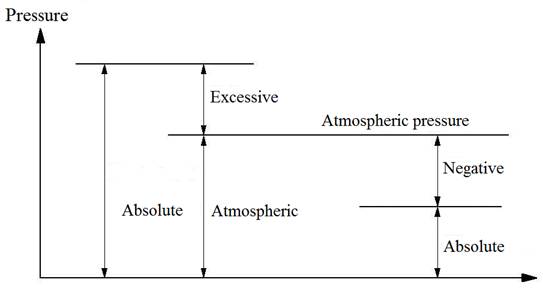
Picture 1 – Pressure
types
The pressure
sensor is a sensory element placed between two chambers - one from which contains
measured pressure, whereas the other - bearing pressure. In absolute sensors,
the effect on the crystal exists only on one side. One of the world leaders in
the production of semiconductor pressure sensors is NXP Company. In 2016, it
became the fourth in the world in terms of the volume of semiconductor
products. This company produces various pressure sensors in the range from 0 to
10,000 kPa. Let us consider the sensor scheme MPX2100, constructed by NXP in a
section-form, demonstrated on the picture 2 below [2]. This sensor has 7
modifications of different designs, allowing it to be used for measuring all
three types of pressure.
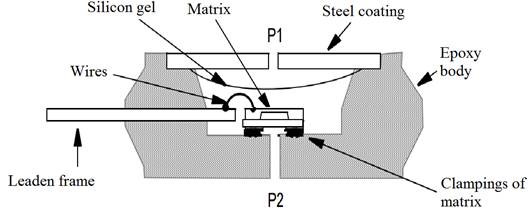
Picture
2 – Absolute pressure sensor [2]
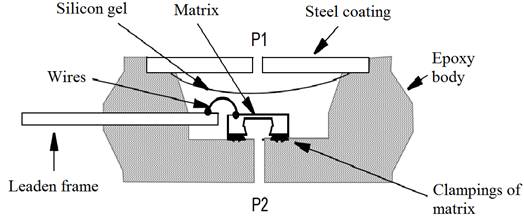
Picture
3 – Excessive or differential pressure sensor [2]
The
absolute pressure sensor is shown on the picture 3, the excessive or
differential - on the picture 2. Apparently, the main difference between the
sensors lies in construction of the matrix. The excessive or differential
pressure sensor suppose that the pressure P1 will always be higher than the
pressure P2, a vacuum is applied in the absolute pressure sensor toward P1. The
silicon gel isolates the silicon matrix and the supply wires from the
environment influence, without interfering with the influence of pressure on the
silicon matrix. The manufacturer indicates that the sensor suppose the exposure
to dry air. Exposure to other gases or mediums may result in inoperability or
shortening the lifetime of the product [2].
The
MPX2100 sensor uses the piezoresistive principle of operation. The point is
that under the influence of pressure differences, the resistance of tensoresistors
changes. The disadvantage of this method is the influence of temperature, for the
elimination of which thermal compensation schemes are applied. In addition, the
temperature can be measured and compensated through a microcontroller [2].
Summarizing,
the addition of a temperature measurement channel and microcontroller to the
sensor allows not only to combine the temperature and pressure measurement in
one sensor, but also to increase the accuracy of the pressure measurement due
to digital thermal compensation.
References
1. Vigleb G. Datchiki. Ustroystvo i primeneniye. – M.: Mir.-1989. –
196 s.
2. Datasheet «100 kPa On-Chip Temperature Compensated and
Calibrated Silicon Pressure Sensors». - Freescale Semiconductor.
- 2008. – 10 s.
3. Mikhaylov P.G., Petrunin
G.V. Sensornyye elementy robotov i robototekhnicheskikh kompleksov. – Penza: PGU. – 1998.
4. Mikhaylov P.G., Belousov Ye.F. Mikroelektronnyye datchiki. Proyektirovaniye, izgotovleniye, diagnostika. -
Penza: PGU. – 2001 – 87 s.