Филологические науки /
1.Методика преподавания языка и
литературы
Sergij Tschornyj, Olena
Tschorna
Kirovohrad, Ukraine
Internet-Based English
Teaching
The paper surveys advantages of using computer technologies while
teaching English, with special emphasis on computer-based and on-line tools.
Keywords : Internet-based resourses, Information and Communication Technology,
EFL learners, vocabulary exercises, computer-based dictionary.
Contemporary
society is getting more and more computer-based, where students are the most
sensitive group, as they “are growing up with technology, which is a natural
and integrated part of their lives” [2, p. 7]. “This phenomenal explosion of
technology has now given educational institutions new tools to carry out the
mission in ways never conceived before” [3, p. 13]. The objective of this
article is to discuss benefits of using on-line resourses in teaching English.
Computer-based
materials for language teaching, often referred to as as CALL (Computer
Assisted Language Learning), appeared in the early 1980-s. As access to
Information and Communication Technology (ICT) has become more widespread, so
CALL has moved beyond the use of computer programs to embrace the use of the
Internet and web-based tools [2, p. 7].
In the
meantime, even those Ukrainian schools and Universities which are well-equipped
with computers, lack possibilities to provide each students with a computer at
an English lesson. In such situation Internet-based resourses solve most
questions. Here are main reasons (as summarised by G. Dudeney, N. Hockly, M. K. Agarwal ) which stress the
importance of Web-based resources in up-to-date English teaching and learning:
1)
Interrnet access is becoming increasibly available to learners;
2)
Web-based activities allow the teacher to quickly give all students certain
information and to obtain information from the students quickly, too;
3) Technology,
especially the Internet presents us with new opportunities for authentic tasks
and materials, as well as access to a wealth of ready-made ELT materials;
4) Technology
offers new ways for practising language and assessing performance;
5) It
is ncreasingly mobile (can also be used at home, on the way to school or
University and in Internet cafes);
6)
These tools give learners practice in all four main language skills – speaking,
listening, writing and reading
7) It
leads to autonomy, as learners control exercises regarding the learning process
with the appropriate difficulty level and at their own pace, getting little
dependent on a teacher [1, p. 4; 2, p.
7–8].
Writing
is supposed to be the most difficult activities for EFL learners, and students
often need more practise in these, while instructors are pressed with time and topics
which should be covered within a certain period. Writing, especially academic
writing should be taught as a separate subject, which is not the case at many
language departments. We typically devote some15 minutes of a lesson to explain
basics of writing an essay or resume, but it is well understood that students
need much training.
They require
detailed explanation on composition, paragraph writing, creating a logical
thesis, developing topical sentences and providing supporting details.
Internet-based resourses seem to be a good solution in that.
Apart
from reading a lot of theory, learner can look through a number of more or less
successive essays and make their own conclusions on what promotes qualified
writing.
Here is
an example of an online-resource which can support students when they are given
a corresponding task (see Pict. 1; taken from http://lklivingston.tripod.com/essay/thesis.html).
Picture 1
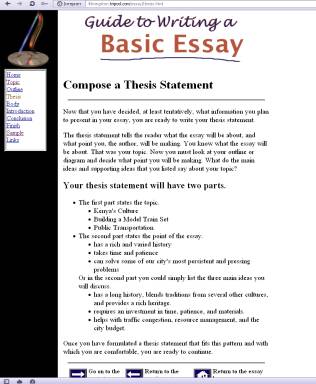 On-line guide on
writing essays
On-line guide on
writing essays
The same is true with teaching how to compose an e-mail, resume,
complaint letter, thank-you note, greeting card, etc.
One more problem students
should be taught to solve is selecting appropriate words. It seems to be a good
idea to refer to a respective English-English dictionary, especially a computer-
or Internet-based one.
Such resources
provide learners with much more than word meanings – one can look at lexeme in
the context, choose correct preposition, find out the word origin and style
reference.
This is
an example of The LONGMAN Dictionary of Contemporary English, 2006 [4],
electronic version (see Pict. 2).
Picture 2
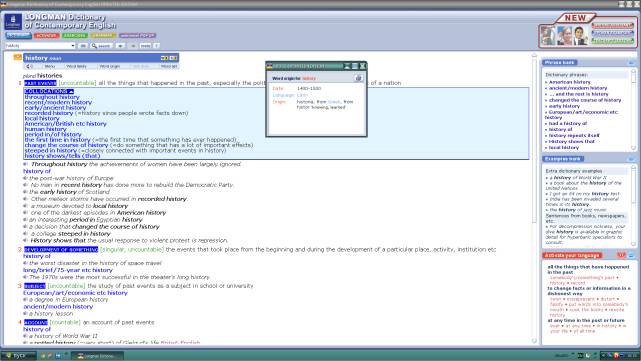 Computer-based
English-English dictionary
Computer-based
English-English dictionary
Moreover,
contemporary dicitionaries are supported with writing assistants and vocabulary
exercises. The latter serve to differentiate among synonyms (with explanation
and examples), to train spelling and check semantic and grammar rules of making
phrases (see Pict. 3).Internet sites provide a lot of vocabulary activities,
many of which can be downloaded and printed (e.g. Pict. 4, taken from http://www.englishwsheets.com/hobbies-1.html).
Picture 3 Picture
4
Longman computer-based Internet
ready-made
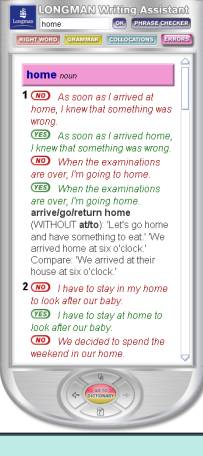
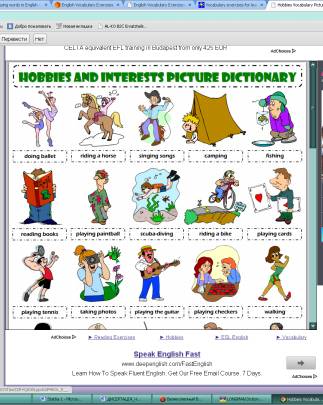 writing assistant vocabulary
exercises
writing assistant vocabulary
exercises
Those
which can be done on-line are good motivating tools for starting a new topic
and can be given as a home assessment (e.g. Pict. 5, taken from http://www.englisch-hilfen.de/en/exercises_list/mix_words.htm).
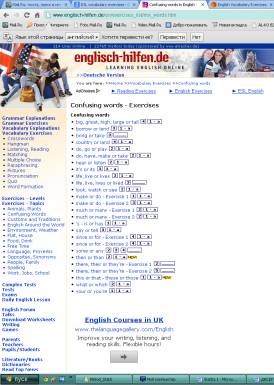
Picture 5
On-line vocabulary
activities
Thus, Ineternet-based
resources suggest a lot of benefits for a computer-friendly teacher. These are
time-saving, easy student-motivating, on-line assessment, possibilities for
distant and independent learning.
References
1. Agarwal M. K. Internet-Based
Language Learning and Teaching [Electronic source] / M. K.
Agarwal
// Innovative Infotechnologies for Science, Business and Education. – 2010. –
Vol. 1 (8). – P. 3–7. – Access mode :
http://journal.kolegija.lt/turinys/Agarwal-3-7-%20IITSBE-2010-1(8).pdf.
2. Dudeney G. How
to Teach English with Technology / Gavin Dudeney, Nicky Hockly. – Harlow :
Pearson, 2007. – 192 p.
3. Sankaran S. R.
Effectiveness of Web-Based Instruction for ESL Students : An Empirical Study
with Focus on Gender, Ethnicity and Instructional Media [Electronic source] /
S. R. Sankaran, T. X. Bui // Journal of Information Systems Education. – 1999. – P. 13–19. – Access mode : http://jise.org/Volume10/Pdf/Vol%202%20Pg
%2013.pdf.
4. The LONGMAN
Dictionary of Contemporary English / Managing edit. Ch. Fox. – 5‑th
edition. – Italy : La Tipografica Varese, 2006. – 1950 p. (computer-based
version).