Kraeva E.M., Masich
I.S.
Siberian State Aerospace University
named after academician M. F. Reshetnev, Russia
The criterion function and
its modification in construction of patterns for a classification model
A modification of the criterion function of the optimization model in the method of logical analysis of data to increase different rules in the classification model
is proposed. The empirical confirmation of the advisability
of modifying the criterion
function is given.
In [1] we have considered the optimization
model, the decision of which is patterns in the data to construct the
classifier.
Denote Ωs+ and Ωs− are sets of n-dimensional binary
vectors of positive and negative classes constituting the training data set.
The basis of
this approach is the notion of a pattern. A positive pattern called a subcube
of the space of Boolean variables B2t, which intersects the set Ωs+ and has a limited number of
elements in common with the set Ωs−. Negative pattern is
defined similarly.
A positive
ω-pattern for ω {0,1}t is a pattern containing a point ω.
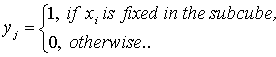
We define
corresponding subcube using variables yj:
Optimization
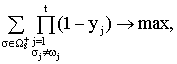
model has the following form.
 (1)
(1)
 for every
  ,
,  . (2)
. (2)
According to the
criterion (1), we seek to maximize the coverage of the resulting pattern, i.e. the
number of objects captured with the pattern. Each subsequent pattern maximizes
its coverage, capturing objects that are representative of the class, and
atypical class objects remain uncovered and in the final rule there are no
patterns that take into account the objects of the class. Therefore, we obtain
a set of similar patterns for the class, thereby reducing the quality of the
classification. To obtain a classification model with higher different
patterns, which can allocate significantly different subsets of objects, we
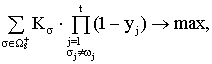
propose to modify the criterion (1) as follows:
 (3)
(3)
where Kσ
– is weight of the positive observations σ Ωs+, which is reduced when this
observation is covered, thereby reducing its priority to participate in the
formation of the next pattern in favor of uncovered observations.
Ωs+, which is reduced when this
observation is covered, thereby reducing its priority to participate in the
formation of the next pattern in favor of uncovered observations.
In order to
use the criterion (3) for the formation of patterns, it is necessary to set the
initial weight for all objects and rule changes weights for objects that
participated in the formation of the current pattern. We offer the initial
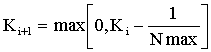
weights is set to 1 for each object in the training set. Rule of changes for
the weight of the object, which took part in the formation of this pattern:
 ,
,
where Ki,
Ki+1 are weights
of the covered object to the formation the current pattern and the next pattern, Nmax is parameter defined by the
researcher, which means the maximum number of patterns that can cover the
training sample object in the model.
Parameter
Nmax for each class is given in the range from 1 to the maximum number of
patterns constructed for this class. If Nmax is set to close or equal to the
maximum number of patterns for this class, then the value of the criterion (3)
tends to the value the criterion (1) for each pattern in the model, therefore,
the new model works similarly to the previous classification. If Nmax tends to
1, then the number of patterns with a value of the criterion (3) greater than 0
is reduced, because initially all objects are captured and their weights are
reset. In the new classification model, insufficient number of patterns is
presented, which eventually is not capable to classify new incoming objects,
i.e. classification quality decreases.
Thus, using
the criterion (3), we obtain the patterns that cover substantially different
subset of the objects.
According to
the results obtained it can be noted that the use of an optimization model with
the criterion (3) allows to simplify the classification model, reducing the
number of patterns in the model in 2-3 times compared to the full set for a
specific task. The accuracy of classification is not decreased or is decreased
only slightly. When the optimization model with the criterion (3) is used, average
degree of patterns becomes smaller, which means that the patterns themselves
become clearer and easier to interpret.
The work is supported by the Grant of President of
Russian Federation MK-1371.2013.8.
References
1.
Masich I.S. Pattern search in data for solving practical problems of
recognition. Materiály VIІI mezinárodní vědecko -
praktická konference «Zprávy vědecké ideje - 2012». – Díl 21.
Matematika. Fyzika: Praha. Publishing House «Education and Science», p. 14-15.