DYNAMICS OF PHYSICAL DEVELOPMENT OF
CHILDREN, DEPENDING ON THE APPLIED TECHNOLOGY OF CARE
N.S. Sultanova
Republican centre for reproductive
health, Republic of Uzbekistan
Physical development of
children is an informative indicator reflecting the nation's health and total
reflection of changes in the socio-biological and other conditions that occur
in society. Can significantly reduce the morbidity and mortality is the
physical development of children and babies is one of the leading
characteristics of reproductive health [1]. Infants and young children are
prone to delay the growth mainly due to malnutrition, but not unimportant role
play how to care [2].
Indicators of poor
nutritional status may serve as an early warning that a child in danger [3].
The most widely used with anthropometric measures. The measured parameters of
weight and height in children under 5 years can be compared to rates of weight
and height of children of this age-matched healthy population base. Basic
healthy population, a population made up of WHO and the Centers for Disease
Control and Prevention in Atlanta. Early detection of abnormalities in the physical
development of children, causes and their timely removal improves the
performance of the gene pool of the population [1, 3].
The aim of our study was to examine the
dynamics of physical development of children, depending on the used methods of
care.
Material and methods. Weights, growth and
body mass index [BMI] were studied in 395 children from birth to 5 years of
age, of whom 351 children were exclusively breastfed, while 325 children were
being introduced the principles of care, 26 the traditional ways of care, and
44 children received mixed feeding, with 16 of them children were being
introduced the principles of care, 28 the traditional methods of care.
Introduced under the care meant: Do not use nipple-pacifiers, diapers, powders,
oil solutions, sanitary napkins, soap and detergents for the care of the
skin, without a fixed upper and lower
extremities, frequent daily use of the bath with full immersion of children
with herbs (chamomile, series, saline sodium chloride) at a water temperature
of 36.6 to 37 º C. Traditional care included - fixation of limbs, the use
of nipple-pacifiers, diapers, powders, oil solutions, sanitary napkins, soap
and detergents for the care of the skin, fixing the upper and lower extremities
[occasionally or always] and rare or no use of the bath with full immersion of
children with herbs at a water temperature of 36.6 to 37º C.
Results. The dynamics of the BMI for
children from 0 to 60 months we have studied in differentiated exclusively
breast-fed and mixed depending on the used care in order to study the direct
influence of the principles of care for the physical development of children (Figures
1 and 2).
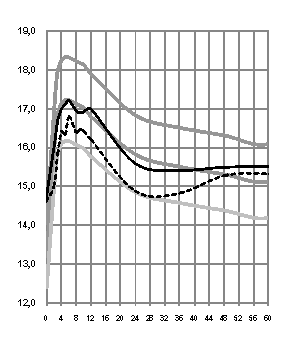
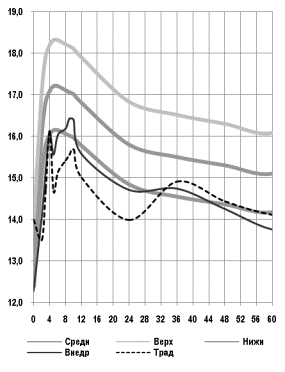
Note: The solid black line -
introduces care, dashed line - traditional care.
Fig. 1. The
dynamics of body mass index in children who received exclusive
breastfeeding from 0 to 60 months depending on the applicable principles of
care. Fig. 2. The
dynamics of body mass index of children who received mixed feeding from 0
to 60 months depending on the applicable principles of care.
The results of this
study showed that BMI in children who received exclusive breastfeeding and
implemented care were comparable with the average BMI, characteristic of the
age in the population, even during some periods of exceeding. Children who
receive the traditional ways of care had a BMI below the average values characteristic
of a given population, but BMI did not extend beyond two standard deviations.
As seen in figure adaptive process in non-traditional care was much smoother
than traditional care, especially in the early period of development.
When studying the growth
of mass-index in children who received mixed feeding (Fig. 2) revealed that the
BMI values were very low compared with children from other groups in the application
being implemented care BMI values were
at the lower boundary of the two standard deviations from the mid- statistical
significance, and the application of traditional care in some age periods even
lower.
Low BMI can express the
value of the consequences of prolonged exposure to malnutrition and to point to
chronic malnutrition in children who lack essential nutrients, but it can also
be linked to lack of appropriate care and multiple infections.
Resume. The results show how the
principles of child care make a significant contribution to children's physical
development. Our data are comparable to the experience of specialists from different
countries, children who have received adequate and efficient care, rarely get
sick, have better indicators of age-related physical development are more
resistant to adverse environmental effects.
References:
1. Абольян Л.В. Основные
итоги охраны и поддержки грудного вскармливания в Российской Федерации // Вестник
врача общей практики. – 2004. –№2. – С. 5-10.
2. Ваганов П.Д. Физическое
развитие детей до 1 года.//Мед.науч. и учебно-метод. журн. – 2004. – №22. – С.
30-38.
3. Вельтищев Ю.Е. Рост
ребенка: закономерности, нормальные вариации, нарушения и их коррекция // Росс.
вестник перинатол. и педиатрии. – 1998. – 77 с.