research of destructive seismic shocks
S.B. Smirnov, B.S. Ordobaev. Sh.S. Abdykeeva
Кыргызско-Российский Славянский университет, Кыргызская Республика, г. Бишкек
It is firstly rigorously proved that accelerograms, used in seismic design, are not real speeding-up of the ground in
earthquakes, and applying pendulous accelerometers
for measuring seismic accelerations sets them too low and completely hide real
danger . Just accepting and application resonance model of seismic failure is
shown to be the fact of maleficent inattention
to destructive earth tremors. Seismic vibrations are demonstrated not to arise
in the hypocenter, but to be generated under structures near Earth’s surface by
the upper layer of the ground, displaced by waves from the seismic focus,
springing up in the hypocenter on mutual shift of two block of the earth's crust, when in the plane of fault connections
between block are destroyed, creating jumps of accelerations.
Eyewitnesses of earthquakes almost
always feel and describe two qualitatively different types of seismic
ground motions. Firstly, they indicate short and strong single shock, and,
secondly, they sense long time vibration
[1]. And at the same time many people marked that
destruction of buildings sprang up just after the first strong earth tremor,
and following oscillations were usually less dangerous and could only deepen
failures, but were not able to cause them [1].
The typical example of the temblor, taken place in Skopje (Yugoslavia) on July 26, 1963, is bellow.
”Main tremor was like impact and
accompanied by strong ground vibrations for 8 – 12 seconds” [1].
Contrary to such evidences official science about earthquakes
primordially decided that most dangerous phenomenon is seismic resonance, and
isolated tremors are not so perilous. In former Soviet Union resonance model
dominated until destroyed Carpathians earthquake in 1986.
So, developers of resonance model were interested in low frequency
vibrations only, because just these vibrations can cause structures’
resonance.
In this situation impulsive load did not correspond to well composed and
showy strategy of anti-resonance seismic design. Therefore, scientists become
to consider seismic impulsive load as specific oscillations not able to cause
resonance and, consequently, nonhazardous.
This principal decision was not explained or proved rigorously. It was
just applied by general act.
However, in non-official discussion its developers and the most advanced
advocates always
justify in the following way. “If impulsive seismic load exists, we can
consider them to be specific vibrations or even part of it. Besides, it is
clear that isolated beat can’t give rise to resonance and, therefore, is less
dangerous than a sequence of swings. We consider upsurges and steps on accelerograms, supposedly reflecting seismic
impulsive load, as isolated very strong beats. Preparing stress analysis, we replace
them by a number of beats of the same intensity. It provides safety of
structures.”
They give the following answer for main and most difficult question
about finding impulsive acceleration with the help of pendulous
accelerometers. “We have no problem to find accurate value of impulsive
acceleration. Having possibility to determine accelerations for oscillations,
we can do the same for isolated movement, and, so, we calculate impulsive
accelerations using our accelerograms.”
Just the last optimistic statement hides dirty
trick and main mistake, which showing up disprove official oscillating seismic
conception and demonstrates inefficiency of respective earthquake protection. The
core of the problem is as follows.
Indeed, ordinary pendulous accelerometers
can represent low frequency vibrations, having fixed frequency and amplitude. But,
they are useless for measuring impulsive accelerations because of their
principle of operation. They can be applied under following conditions only:
oscillations must be harmonic, have stable frequency and amplitude, and last
for sufficiently long time to avoid influence of natural vibrations of
accelerometer’s bob [2].
The tip of the accelerometer is a weight of mass m, fixed on the hard, considerably
deformed spring, having stiffness of r.
It starts to vibrate as permanent seismic oscillations Dг(t) appears.
Soil movements must have form of Db(t) = Dbasinwгt, and their
accelerations have to be described by equation of аb(t) = аbasinwbt = -Dbawb2sinwbt too, where аba and wb are
constants. Judging by form of known accelerograms, these requirements never
fulfill.
Ground acceleration ag(t),
being of interest for us, has amplitude of
agα = Δgαωg2
and can be also described as sinusoid ag(t)
= аgasinwgt = -Dgawg2sinwgt.
After fast dying of natural high
frequency oscillations of the tip of the accelerometer, arisen in the beginning
of ground motions, the tip just stars to repeat measured low frequency
vibrations of the soil and their accelerations, being depicted by the formula Dм(t)=  sin(wgt - j), where j is lagging.
Amplitude аga can
be calculated by formula [2]
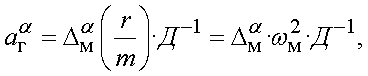 (1)
(1)
where wм= is natural frequency of accelerometer’s bob, which must be much more than wg, Д is dynamic amplification factor, depending on wг · wм-1 and damping factor x of bob’s natural vibrations. Under b<0.6 and x = 0.7 amplification factor equals to 1. So, we obtain the plot of soil
accelerations, shifted on j [2].
is natural frequency of accelerometer’s bob, which must be much more than wg, Д is dynamic amplification factor, depending on wг · wм-1 and damping factor x of bob’s natural vibrations. Under b<0.6 and x = 0.7 amplification factor equals to 1. So, we obtain the plot of soil
accelerations, shifted on j [2].
If acceleration is impulsive, situation
fundamentally changes. Likeness of plots of аg(t), Dg(t) and Dм(t) does not
take place. Besides, maximum of soil acceleration corresponds to Dм= 0. So, we obtain zero instead of real value of
its speeding-up!
As a result, error of measurement of аg(t) amounts
to infinity, and its real value is unknown. It’s only clear that this
acceleration is large as shown at Fig. 1.
Presence of impulsive load is reflected by sudden changes at accelerograms.
But, they can’t be used to estimate real values of soil accelerations, which
are much more than plots show. Sudden changes image appearances of the bob’s
natural high vibrations under action of impulsive load. It is strongly
prohibited by the theory of
pendulous accelerometers. In addition, it should be
indicated that all requirement of this theory do not fulfil in measuring
earthquake accelerations, and existing plots of them are not real seismic accelerograms.
Let’s clear up cause of rise of impulsive seismic load. It is clear that
impulses can spring up in hypocenters only, and seismic waves bring them to
buildings.
Most of seismologists consider elastic rebound as mechanism of the
temblor, when the fault suddenly slips producing the earthquake. Before it,
shear stress t slowly increases there.
Plates of the earth's crust are
compressed by giant horizontal pressure of μP
(P is gravity load, μ is Poisson's ratio). However,
increase of shear stresses at apexes of cracks, lying at the plane of the
fault, gives rise to onset of tension stress maximum peak (σ+). When it exceeds strength of intermolecular bonds,
failure occurs and σ+ disappears.
Magnitude of σ+ approximately
amounts to 0.1E, where E is modulus of elasticity.
Uneven disappearance of σ+ is equivalent to blow at fault’s
plane. Just at this time impulses arise (Fig. 1).
As a result, plates sharply move by
amount of D, t decreases, and plates are connected by μP again.
So, elastic rebound of the earth's crust’s plates
creates destructive impulses. However, official seismology considers that such
impulses do not come to earth surface. Vice versa, it holds low frequency
vibrations occur in the hypocenter and run up to grass. But, this phenomenon
can arise if only a mysterious vibrating body is situated at the hypocenter!
Yet, no model of the earthquake supposes presence of it. Thus, as a matter of
fact seismology is not able to explain mechanism of oscillations, being assumed
as the only cause of failure of structures.
Let’s briefly consider how the model of
soil oscillating in the earthquake to develop in general.
On establish of seismology at the beginning of the
twentieth century two problems had to be solved. In the first place, it was
necessary to find parameters of destructive motion of soil. Secondly,
methodology of analysis structures under seismic load must have been worked
out. These problems might be extremely difficult; therefore simplification of
them was desirable. Scientists wanted to see known type of load, which was
discover in the form of low frequency vibrations of the soil. To calculate
their parameters and analyse buildings under such load were easy. Besides,
existing ordinary pendulous accelerometers can be applied to measure frequency
and amplitude of seismic soil vibrations and their accelerations.
This successful situation was saddened by
evident presence of hard shocks having unknown parameters, which could not be
measured with the help of
pendulous accelerometers. However, adopting effective
and well-known theory of resonance for seismic structural analysis scientists
began to ignore impulsive earthquake load, as it can not be a cause of
sonority.
But impulsive seismic load display itself
not only as sudden
changes at accelerograms. It cause abnormal failures such as shear destructive
of reinforced concrete columns, partitions, walls, brittle ruptures of welding
seams, and many other failures, which cannot be produced by low frequency
vibrations [3, 4].
However seismology ignored all facts contradicting resonance model of
seismic failure [4]. This model dominated up to 1986. According to it, in
former Soviet Union many skeleton buildings, including structures with the
flexible ground floor considered as anti-sonority, were constructed. In
addition, new designs of anti-sonority buildings were suggested.
Very clever idea to use special destructive bonds, being failed at the
beginning of the earthquake, is the most known. It prevents resonance. This idea was suggested by professor Ya. M. Eisenberg, who is the leader of seismology in Russia
and initiator of using anti-resonance buildings.
But, in Carpathian
earthquake, having intensity of 8 degrees on the MSK – 81 scale, reinforced
concrete columns, designed temblor of 9 degrees, were sheared without any
resonance in Kishinev and other towns and villages [5]. It was like a bolt from the blue for scientists, dealing with anti-resonance
seismic structures. As a result theory of such protection was buried, and they
haven’t mentioned about it.
In addition, term of seismic
load is used now instead of vibrations. However, pendulous accelerometers are
applied, although they’re intended for measuring oscillations with constant
amplitude and frequency.
It must be noted that bending failure of
columns have not been observed. Even under artificial conditions structures
avoid resonance because of non-linearity. At the same time, skeleton structure
especially having flexible ground flour show low level of seismic stability.
For example, it took place in Kobe in 1995 [6]. Reinforced concrete columns
were sheared as well as in Kishinev by seismic impulsive load without occurring
sharp bend, expected under large oscillations of buildings. Myth about
invulnerability of steel skeleton building was destroyed in Kobe too, as mass
brittle failure of welded seams took place on this temblor [6]. Such effect can
be caused by impulsive seismic load rather than vibrations of soil and
buildings [3, 4]. But even these facts cannot bury seismic oscillations model,
dominating now, which is dangerous for people in seismic regions.
It should be emphasized that under absence
of facts of seismic resonance, not being used by seismology at present, and
ignoring impulsive seismic load make unaccountable reason of catastrophic
seismic share failure, because soil oscillations, registered by pendulous
accelerometers, are not able to spring them up.
As regard explanation of
nature of seismic vibrations of the soil, it is clear that can’t come from
hypocenter and arise near the buildings in the time of seismic wave’s arrival.
To
uncover mechanism of their occurring specific properties of surface layer of
the ground were scrutinized and it is found that the upper layer has low shear
stiffness and, correspondingly, high shear suppleness. Its modulus of elasticity in shear G and elastic modulus in compression E are in two orders of magnitude lower
than these values for deep-laid strata. It is caused by large volume of pores.
The deeper stratum is the smaller size of pores takes place and density of soil
ρ, G, and E increase. At
the depth H of 100 m there are not
too much opens and ρ, G, and E don’t considerably increase with rising depth.
Let’s show how high gradient of G and E
are in upper layer of the soil
and estimate their ratios with such parameters of deeper strata. To do so, we
can apply results of tests of measuring velocity of waves in the ground at
various depths and dependences of them with G and E: Е
= rс2, G
= r 2, where с and
  are middle phase velocities of P-waves and transverse waves in
the soil, having density of r. According
to [7] for the loam:
are middle phase velocities of P-waves and transverse waves in
the soil, having density of r. According
to [7] for the loam:
For Н = 1 m and r = 1400 kg/m3 с = 260 m/s;
For Н = 60 m and r = 2800 kg/m3 с = 1870 m/s.
Thus, at the top of the
stratum c is by an order of magnitude less, than this value at the bottom
of the stratum. Taking into account that density of soil decreases in two
times, E and G at the top of the stratum is two orders greater than at the bottom.
Middle values of E and G for surface stratums are 100 times less, than for
lower layers. Correspondingly, shear stiffness is 100 less too.
That is why seismic impulses, coming from
hypocenter, shift the surface stratum much more that the lower stratum. After
impulsive shear on value of D, surface stratum start
vibrating. Oscillation frequency can be figured out by formula [8]
w2=  ·k, (2)
where k is correction factor, allowing for the fact that the
centre of gravity of the surface stratus is at the distance of 0.4H from
its bottom,
r = GF(H)-1,
m = rHF,
where F is area of the surface
stratum, H is height of the surface stratum.
So,
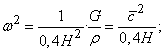
 ;
;  . (3)
. (3)
If  = 500 m/sec
(this value is given in [6]) and H =
100 m, w = 7,85 sec-1, and period of
vibrations is equal to 0.8 sec. It is about the middle of interval of
seismograms.
= 500 m/sec
(this value is given in [6]) and H =
100 m, w = 7,85 sec-1, and period of
vibrations is equal to 0.8 sec. It is about the middle of interval of
seismograms.
It is shown in [8] that the surface stratum may intensify seismic load.
But, if it consists of rock with constant value of G, increasing earthquake load does not take place. It explains low
failure rate of buildings on the rock foundation.
Therefore, in temblors we can see 2 (not one!) movements of the soil.
One of them is impulsive load being felt as shock, and the second is low
frequency vibration. Under the same displacement acceleration in shock exceeds
acceleration in vibrations in  times, where
Tk is period of low
frequency oscillations, tu
is time of action of impulsive load. In example, given at Fig. 1 n = 16.
times, where
Tk is period of low
frequency oscillations, tu
is time of action of impulsive load. In example, given at Fig. 1 n = 16.
Ignoring existence of impulsive seismic load causes permanent problems
in earthquake engineering.
The main showing of these failures is inability of Building Codes to
provide given guarantees of seismic stability even under intensity of temblors
taken into account [9, 10]. After all, if the structure is designed according
to the Code, it must withstand seismic events having designed intensity. But,
in reality it does not take place and building are often destroyed in
supposedly non-dangerous temblors of smaller intensity [5, 6].
It shows that Building Codes using vibration methodology and applying
pseudo seismograms considerably underestimate seismic stresses in structures
[9, 10].
To confirm this fact qualitatively new test is offered. It shall permit
to refute oscillation model of seismic load unconditionally. Direct, but not
indirect, measurements of seismic stresses in bearing members and comparison of
them with stresses, calculated by seismograms are required.
It is clear that real stresses are considerable larger than computed
with the help of seismograms.
Using simple reinforced concrete columns with the mass on the top is
suggested. In the seismic zone it is necessary to measured shear stresses from
the first shock and to compare them with values, calculated by reading of the
accelerometer set on the column. In [11] there is detailed description of such
test, which is planned to fulfill in Kyrgyzstan in the foreseeable future.
Having completed this test and show large difference between real
stresses and computed with the help of seismograms, we clearly disprove
oscillating model of seismic load.
After that it will be necessary
to find parameters of seismic impulsive load with the help of new devices.
Then, theory of analysis structures under such effects, which idea is suggested
in [12], can be developed.
On the base of this theory new concept of earthquake protection and new
Codes can be worked out.
References
1.
Поляков С.В. Последствия сильных землетрясений. – М.: Стройиздат, 1978, 331с.
2. Клаф Р., Пепзиен Дж. Динамика сооружений. – М.: Стройиздат, 1979, 320 стр.
3. Смирнов С.Б. Исследования аномальных форм в сейсмических разрушениях зданий, противоречащих официальной теории сейсмозащиты и опровергающих официальный взгляд на причины разрушения зданий при землетрясениях // Объединенный научный журнал. – М., 2008, №9, С. 51-59.
4. Смирнов С.Б. Формы сейсмических разрушений как надежный источник информации о реальном разрушительном волновом сейсмическом воздействии // Жилищное строительство, 2012, № 1, с. 39-41.
5. Карпатское землетрясение 1986 г. – Кишинев: Штиинца, 1990, 334с.
6.
“A
survey report for building damages to the Hyogo- Ken Nanbu carthquake”,
Building Research Institute; Minestry of Constuction (Japan), 1996, March,
222p.
7.
“Soils
and Foundaitions.” Special issue of Geotechnical aspects of the January, 17
1995, Hyogoken Nanbu carthquake, Japanese Geotechnical society, January 1996,
359c.
8. Смирнов С.Б. Поверхностная толща грунта, как усилитель разрушительного эффекта сейсмических волн и генератор сдвиговых колебаний // Жилищное строительство, 2009, № 12, с.33-35.
9. Смирнов С.Б. СНиП II-7-81* «Строительство в сейсмических районах» как документ, опровергающий официальную колебательную доктрину сейсмического разрушений зданий // Жилищное строительство, 2010, № 4, с.9-11.
10. Смирнов С.Б. СНиП II-7-81* «Строительство в сейсмических районах» и новый вариант СНИП 22-03-2009 как дополнительные источники сейсмоопасности и сейсмического риска для граждан Российской Федерации // Жилищное строительство, 2010, № 9, с.49-51.
11. Смирнов С.Б., Ордобаев Б.С., Айдаралиев Б.Р. Сейсмические разрушения – альтернативный взгляд / Сборник научных трудов Ч.2. – Бишкек, 2013, 144с.
12.
Смирнов С.Б. Особенности работы и прочностного расчета
зданий при импульсных сейсмических воздействиях // Жилищное строительство,
1995, № 3, с. 14-17.