PhD Illiashenko N.S., PhD Melnyk Yu.M.
Sumy State
University, Ukraine
Method of estimation of an
institution of higher learning potential
An institution of higher learning potential means its ability
of the rational utilization of the available material and non-material
resources to meet the needs of a person in education, of the institution in
professional development and welfare of its staff, of enterprises in the
increase of the professional community potential, of society in extended
reproduction of its overall personal and intellectual potential.
The
main components of an institution of higher learning potential are as follows: an
intellectual component; material support; standard documentation and rights; informational
support of its activity; a scientific component; the organizational structure
of the institution; a marketing component; a financial component.
Let’s
dwell on each component in detail.
Intellectual component. This component be
evaluated using the following methods. First of all we have to analyze the
qualification structure of the teaching staff. The percentage of doctors of
science, professors and candidates of science, associate professors, must correspond
to norms and requirements.
Then we
have to ask students about their teachers professionalism. There are three main
questions:
1. What
teachers taught you?
2. Evaluate
these teachers as to the following parameters according to a 10-point scale: simplicity
of material exposition; interesting and creative way of material exposition; intensity of instruction;
attending to all students; joint work with students at the lessons; civility.
3. Your
propositions.
When
students have given all the answers, you can make up a conclusion about the
level of satisfaction as to the main consumer needs.
After
that, we have to determine the level of professionalism of the teaching staff using
the following methods.
1. To
determine the characteristics, which basic for determining the level of professionalism
of the teaching staff. Choosing from the ones below: teaching and methodical
work; research work; brining up and community work.
2. To determine
the weight of the following characteristics: teaching and methodical work –
0,5; research work – 0,3; brining up and community work – 0,2.
3. To
evaluate these characteristics using different quantitative and qualitative
indicators. For example, teaching and methodical work: the number of textbooks
written by the teachers, the number of publications, intensity of work, etc.
4. To
calculate an integral indicator of the level of professionalism of the teaching
staff using the following formula:
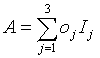 (1)
(1)
oj
– the weight of j-characteristic
Ij
– the value of j-characteristic.
The
level of professionalism of the teaching staff (A) has to work for 1.
After
that, you have to calculate an average age indicators of the teaching staff.
Next
indicator is qualification fluctuation coefficient of the teaching staff. It is
the ratio of the teaching stuff “outflow” to the teaching stuff “inflow”.
After
all these calculations, all indicators of this institution and other
institutions be tabulated. Than calculate an integral indicator of the level of
the intellectual component using the well-known method of distances.
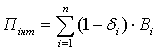 (2)
(2)
п – quantity of indicators;
Ві – the weight of і-indicator;
δі – relative value
of і-indicator. It is
calculated using the follow rules:
 , if the larger value is good (3)
 , if the smaller value is good (4)
Пі – value of і-indicator;
Пmax – the maximum
value of the indicator of all the institutions of higher learning, which are
compared;
Пmin – the minimum
value of the indicator of all the institutions of higher learning, which are
compared.
After that, you have to calculate an average value of
the level
of the intellectual component: 0,7.Пінтср≤Пср≤1,3.Пінтср. If
our integral indicator is less than the average, then the level of the intellectual
component is high. If other wise, then the level of
the intellectual component is low.
Material
support. Its main constituents are as follows: quality of study buildings, lecture halls and labs; computers
and information systems; communication components; information systems support;
dormitories; social infrastructure.
This component be evaluated using the following
procedure. First, we have to calculate the level of availability of study
buildings, lecture halls and labs in accordance with requirements. It is the
ratio of the number of study buildings, lecture halls and labs, available at
the institution to the number of study buildings, lecture halls and labs, which
are necessary for normal activity. The
same as to calculate the level of conform of the dormitories and social
infrastructure. You can evaluate their quality in comparison with study
buildings, lecture halls, labs, dormitories and social infrastructure of other
institutions.
We can calculate an integral indicator of material
support the same way as an integral indicator of the intellectual component.
Standard
documentation and rights. Their
main constituents are as follows: the
level of license; the level of accreditation; ownerships of patents,
merchandise marks, designs, know-how, trade marks etc.; certificates of
conformance of educational services to international educational standards, for
example, in developed countries. To evaluate this component can using the
following methods. We can evaluate the ownerships of patents, merchandise
marks, designs, know-how, trade marks etc using cost parameters: input method, income
method (that is royalty exemption), analog method, determining market value.
To evaluate other constituents
we can use the following indicators: total amount of professions; the portion
of professions of the IVth level of
accreditation; the portion of professions with certificates of
conformance to international educational standards; the number of new, popular
professions; availability of correspondence courses; availability of
post-diploma education; other indicators.
Then all these indicators are compared with analogous indicators of
other institutions. The integral indicator of this component is calculated just
as the integral indicators of the previous components.
Informational support of an activity. Its main constituents are as follows: teaching
and methodical literature; library stock; Internet access.
To
evaluate this component we can use the following indicators: the level of availability of teaching and
methodical literature in accordance with the requirements; quality of the
teaching and methodical literature as compared with other institutions; the
level of the library stock as compared with other institutions; availability of
Internet access; others.
The
integral indicator of this component is calculated just as the integral
indicators of the previous components.
Scientific component. Its main
constituents are as follows: state budget research and economic agreement
research; international grants;
scientific schools; business projects; conferences, seminars, competitions,
exhibitions.
To
calculate this component we can use the following indicators: the number of
conferences, seminars, competitions, exhibitions, in which students and
teachers take part; the number of conferences, seminars, competitions,
exhibitions, which students and teachers organize themselves; the number of
repots of conferences, seminars, competitions, exhibitions, in which students
and teachers take part; the number of winners in all-Ukrainian competitions;
the number of reports, in which students won; the number of grants won by the
institution; quality of business projects performed by the institution; the
level of conferences organized; others.
After
that you have to compare all these indicators with analogous indicators of
other institutions. An integral indicator of this component is calculated the
same way as the integral indicators of the previous components.
The organizational structure of the
institution. Its main constituents are as follows: an effective organizational
structure; manager’s qualities; social and psychological climate; corporate
culture.
To
calculate efficiency of the organizational structure, social and psychological
climate and corporate culture you can use different sociological and
psychological methods.
To
evaluate manager’s qualities you can use the following methods. You have to
evaluate the following qualities of managers: business qualities (education,
knowledge and experience); ability (talent, genius); culture and erudition,
honesty and decency; character; temperament; the main interests; age; health.
Each
quality is evaluated using a 5-point scale. An integral indicator of manager’s
qualities is evaluated using the expert method. An integral indicator of this
component is calculated just as the integral indicators of the previous
components.
Marketing component. Its main
constituents are as follows: an effective marketing complex; relations with
economic contractors; economic information; image, reputation. To calculate
this component we can use the following methods.
First,
we have to calculate a marketing complex. It consists of four main parts: product
policy, price policy, sales policy and communication policy. All these parts be
evaluated separately.
To calculate
the level of the support of economical information we can use the following
coefficients: information completeness coefficient; information accuracy
coefficient; information argumentativeness coefficient; an integral indicator
of the level of the support of economical information. It is the previous
coefficients multiplication. If it is less than 0.3 then the level of the
support of economical information is low. If it is more than 0.3 but less than
0.7 then the level is average. If it is more than 0.7 then the level is high.
To
calculate the level of the relations with economic contractors we can use the
following indicators: the number of contractors, with which the institution
communicates; the portion of students placed in a job at the enterprises, with
which the institution communicates; the portion of students done practical work
at the enterprises, with which the institution communicates; the portion of
applicants entered the institution from schools, with which the institution
communicates; others.
To
calculate the image of the institution we can ask potential applicants,
students, their parents, teachers, enterprises representatives, international
partners about that.
An
integral indicator of this component is calculated just as the integral
indicators of the previous components.
Financial component. Its main constituent is the
level of the financial condition, which means the ratio of the gross
institution’s proceeds to main its costs. The main costs consist of: the wage
fund of teaching staff, educational support personnel and managerial personnel;
factor costs on realization educational program, which consist of costs on
teaching material, current educational costs, costs on stationery, etc; costs on institution keeping, which consist
of costs on fixed assets keeping, costs on professional development of the
teaching staff, costs on development of good image, etc.
If the
level of the financial condition is more than “1”, then it is high. If other
wise, then it is low.
An integral
indicator of an institution of higher learning potential is calculated just as
the integral indicators of its components.