Sulyaeva
Yulianna
PhD in Philosophy, Petrova Yulia Andreevna
Rostov State University of Economics (RIPE)
The economic behavior of firms in
the conditions of perfect competitiveness and pure monopoly.
Monopoly – is an exclusive right on production, trade or other
activity owned by one person, group of people or state [1]. By its nature,
monopoly – is a “power”, which undermines the competitiveness of the natural market. Absolute
monopoly spreads
through the world economy,
which means a complete
exclusion of free market competition.
The problems of monopolization of the commodity markets call too much attention today as among
professionals and as among general population. The success of economic reforms
largely depends on the
weighed regulatory system of the state of monopolistic processes and
competitive relations. There are different kinds of monopoly: natural, legal
and artificial; those
exist in different countries and in different historical periods of the
economy [1].
It can
be said that a monopoly – is a union of entrepreneurs, who "throw off money into the general basket", forming a
solid authorized capital. Monopolists actually make out "copyrights"
on manufacture and sale of their products, in violation of which follows
serious sanctions. Organizing the general management of their factories and
department stores, the monopolists are the most powerful company with a high
turnover of finance and goods at high prices, allowing them to control the
market of the country, while small firms do not stand the competition and go
bankrupt. [2].
Analyzing the economic behavior of the firm in the conditions of perfect
competitiveness and pure monopoly, has allowed us to identify some major
economic impact of monopoly power.
1. In
terms of pure monopoly, the firm sells at a better prize less products at the
same expenses and demand, then in pure competitiveness. This can be shown
graphically (Fig. 1). Assume that we are talking about the same industry, which
produces certain and similar products.
In
the first case, a large amount of small firms operate in this industry, which
are independent from each other, i.e. industry is quite competitive. Then the
equilibrium price will be determined by Pc
at the point of intersection of the graphs of market value and sectoral offers
– the point Mc.
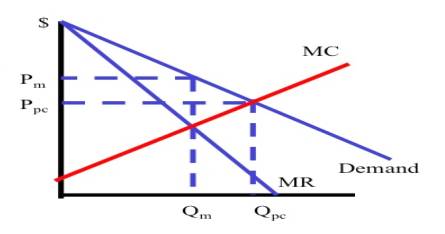
Fig.1. The definition
of price and the volume of output in industry competitive dynamics in the
conditions of pure monopoly.
The
curve of market supply in the industry will be determined, as we have
established in the preceding paragraph, by adding the horizontal segments
schedules of marginal expenses MC separate competitive companies (above the
minimum A YC).
Consequently, when the monopolists select optimal output, ensuring their
maximum gross profit, not enough effective allocation of economic resources
occurs, from the point of view of society (P < MC). It is profitable for the
monopolists to restrict sales by implementing fewer products, but at a higher
price, that is, they can use fewer resources for the production of these
products than necessary to society.
2.
Pure monopoly promote increases inequality in the distribution of income in
society as a result of the monopolistic market power and the establishment of
higher prices for the same cost than under perfect competitiveness for getting
monopoly profits.
3.
Price discrimination can be used by monopolists in terms of market power when
different prices are assigned to different buyers. Such a possibility is
connected with the situation when buyers are able to purchase monopolists’
goods at a higher price than P,", it is called – “solvent demand”. At the same time there
are buyers who aren’t able to pay the price P, " for products, but can
purchase for a lower price. [3].
Of
course, the best example of price discrimination is not in industries that are
not working on the production of goods but on rendering of services. It is because of
realization of goods for lower prices could lead to following resale for higher
prices [4]. Anyhow,
products of human services are less suitable or even unsuitable for resale, for
example, provided transport service or generated electricity.
Price
discrimination is widely spread in Russia and is used in a number of industries
in the sale of products of various types: electricity, transport services,
telecommunication services, utilities, etc. All this contributes to the profit mark-up of
the monopolist that allows him to sell the part of his products at a higher
price for buyers, who are able to pay. All this leads to the growth of product release, because of
sales at lower prices and less solvent customers by expanding the
market.
Literature
1.
Savchenko V.E. “State business in a
market economy” JSC “NPO "Economy"”, 2000.
2.
Atkinson, Scott E., and Robert
Halvorsen. “The Relative Efficiency of Public and Private Firms in a Regulated
Environment. Journal of Public Economics 29 (April 1986): 281-294.
3.
Robert Philips, Pricing and Revenue
Optimization. Stanford University Press, (2005): 74
4.
http://web.mit.edu/14.271/www/hio-pdic.pdf