METHODS OF CALCULATION THE INFORMATION ANALYSIS OF
QUALITY OF TECHNOLOGICAL PRODUCTS AND PROCESSES
SUGGESTED BY SHANNON
S.Sh.Kazhikenova,
S.N.Shaltakov
Quantitative estimations of
sense and value of the information can be made for the information analysis of
quality of technological products and processes of their reception only after
the preliminary agreement about what precisely in each concrete case has value
and sense for the considered phenomena. Methods of calculation the information
suggested by Shannon allow to reveal a ratio of quantity of the predicted
information (that is formed by the certain rules) and quantities of the unexpected information which cannot be
predicted beforehand, and thus to enable to define a qualitative and
quantitative estimation of the certain technological circuit. As a probability
of detection of the main element of technological system it is possible to
accept its maintenance in a product, expressed in shares of unit.
For example, let’s examine the
maintenance of a considered chemical element, in our case - copper, in products
of technological repartition. Also for probability of detection it is possible
to take the maintenance of suitable fraction (remnants, briquettes) in a
corresponding product. The same concerns the process of extraction of an
element in this or that product, as in this case a parameter of extraction is
equal to a probability of transition of the given element from
one condition of system into another. These both parameters - the maintenance
and extraction - can be equally used for an estimation of quality of a product
or technological repartitions.
Let's show how quality of
technological products and the technological operations resulting in reception
of these products is estimated by results of technological repartitions
copper-liquating manufactures on Zhezkazgan and Balkhash mining-metallurgical combines (table 1) and CODELCO concern's (table 2).
Table
1 - The maintenance of copper in products on Zhezkazgan and Balkhash mining-metallurgical combines
|
Repartition |
The level. |
The name |
Maintenance % |
Average value |
|
|
% |
д.е. |
||||
|
Extraction |
0 |
Ore |
0,5-1,2 |
0,85 |
0,0085 |
|
Enrichment |
1 |
A concentrate |
5,5-40 |
22,75 |
0,2275 |
|
Melting |
2 |
Stein |
40-55 |
47,50 |
0,4750 |
|
Converting |
3 |
Draft copper |
98,6-98,9 |
98,75 |
0,9875 |
|
Fire refinement |
4 |
Anodic copper |
99,2-99,5 |
99,35 |
0,9935 |
|
Electrolyte refinement |
5 |
Cathode copper |
99,9-99,99 |
99,95 |
0,9995 |
Table
2 - The maintenance of copper in products on CODELCO mining-metallurgical combines
|
Repartition |
The level. |
The name |
Maintenance % |
Average value |
|
|
% |
д.е. |
||||
|
Extraction |
0 |
Ore |
1,0-2,0 |
1,5 |
0,0150 |
|
Enrichment |
1 |
A concentrate |
8,0-50,0 |
29,0 |
0,2900 |
|
Melting |
2 |
Stein |
55,0-58,0 |
56,5 |
0,5650 |
|
Converting |
3 |
Draft copper |
97,0-98,5 |
97,75 |
0,9775 |
|
Fire refinement |
4 |
Anodic copper |
99,8-99,85 |
99,83 |
0,9983 |
|
Electrolyte refinement |
5 |
Cathode copper |
99,9-99,99 |
99,95 |
0,9995 |
For accounting of a various
degree of unexpectedness (probability) of events K. Shannon has suggested to
use probabilities' function of entropy borrowed from statistical physics,
resulted as follows [1]:
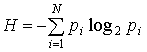 ,
,
where  – is a probability of
detection of any homogeneous element of system in
– is a probability of
detection of any homogeneous element of system in  .
.
If  is a probability of detection of a controllable
element then unexpectedness or uncertainty of this detection is equal to
is a probability of detection of a controllable
element then unexpectedness or uncertainty of this detection is equal to  .
.
In our variant of estimation
this uncertainty will be expressed as:
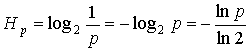 . (1)
. (1)
Before the publication of K.
Shannon's theory R.Hartly has suggested to define quantity of the information
under the formula [2]:
 , (2)
, (2)
where  ,
,  - number of levels,
  - length of a code
The determined component of
the information  is defined by
equality:
is defined by
equality:
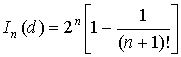 Bit/el.
The system determined
component  is equal:
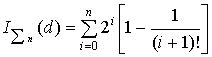 Bit/el.
Having defined degrees of
determination and ineradicable stochasticity at each level of technological
system under formulas [3]:
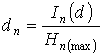 ,
, 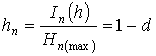 ,
,
let's analyze the received results of the carried out calculations which
are submitted in table 3.
Table 3 -
Settlement information-entropy characteristics of technological repartitions in
hierarchical system for  ,
, 
|
|
|
|
|
|
|
|
|
0 |
0 |
1,0 |
0 |
0 |
1,0 |
0 |
|
1 |
1,0000 |
2,0 |
0,5000 |
1,0000 |
3,0 |
0,3333 |
|
2 |
3,3333 |
4,0 |
0,8333 |
4,3333 |
7,0 |
0,6190 |
|
3 |
7,6667 |
8,0 |
0,9583 |
12,0000 |
15,0 |
0,8000 |
|
4 |
15,8667 |
16,0 |
0,9917 |
27,8667 |
31,0 |
0,8989 |
|
5 |
31,9556 |
32,0 |
0,9986 |
59,8222 |
63,0 |
0,9496 |
|
6 |
63,9873 |
64,0 |
0,9998 |
123,8095 |
127,0 |
0,9749 |
|
7 |
127,9968 |
128,0 |
1,0 |
251,8063 |
255,0 |
0,9875 |
|
8 |
255,9993 |
256,0 |
1,0 |
507,8056 |
511,0 |
0,9937 |
|
9 |
511,9999 |
512,0 |
1,0 |
1019,8055 |
1023,0 |
0,9969 |
|
10 |
1024,0000 |
1024,0 |
1,0 |
2043,8055 |
2047,0 |
0,9984 |
|
11 |
2048,0000 |
2048,0 |
1,0 |
4091,8055 |
4095,0 |
0,9992 |
|
12 |
4096,0000 |
4096,0 |
1,0 |
8187,8055 |
8191,0 |
0,9996 |
|
13 |
8192,0000 |
8192,0 |
1,0 |
16379,8055 |
16383,0 |
0,9998 |
|
14 |
16384,0000 |
16384,0 |
1,0 |
32763,8055 |
32767,0 |
0,9999 |
|
15 |
32768,0000 |
32768,0 |
1,0 |
65531,8055 |
65535,0 |
1,0 |


We shall illustrate the
comparison of these data with practical "know-how" of copper on
Zhezkazgan and Balkhash mining-metallurgical
combines (tab. 1) graphically in coordinates  on figure 1 and on CODELCO mining-metallurgical combines (tab. 2) on figure 2. The factor of their
correlation has made for
on figure 1 and on CODELCO mining-metallurgical combines (tab. 2) on figure 2. The factor of their
correlation has made for 
 ,
, 
 figure1, for
 ,
, 
 on figure 2 testifies the
adequacy of suggested model of an information estimation of quality of products
in consecutive operations of the technological circuit.
on figure 2 testifies the
adequacy of suggested model of an information estimation of quality of products
in consecutive operations of the technological circuit.
The size  in this case does
not influence the solution of a problem as it is reduced at calculation of
level determinations
in this case does
not influence the solution of a problem as it is reduced at calculation of
level determinations 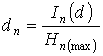 and system
determination
and system
determination 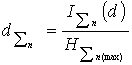 .
.
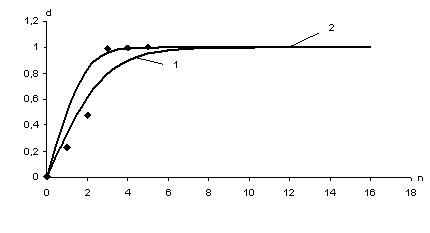
1 - dependence on new model  , 2 -
dependence on new model
, 2 -
dependence on new model  ,
,
points - experimental data
Figure 1 - Dependence of a degree of
determination on a level on Zhezkazgan and Balkhash mining-metallurgical combines
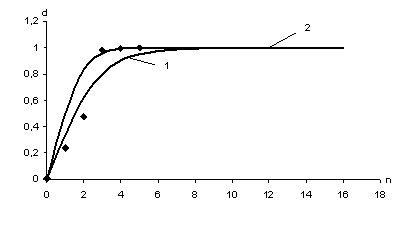
1 - dependence on new model  , 2 -
dependence on new model
, 2 -
dependence on new model  ,
,
points - experimental data
Figure 2 - Dependence of a degree of
determination on a level on CODELCO mining-metallurgical combines
Influence of length of a code  that is elements of system
(target component and the basic impurity) can be revealed in the further
researches. As a whole the improvement of quality of a product in process of
its technological processing correlates with dynamics of growth of the
determined component in abstract hierarchical system that proves the expediency
of the further entropy-information analysis of similar
systems. It can interest a reader as from the point of view of its theoretical
analysis of various technological circuits, and also with its concern of the
further development of entropy-information representations and
display of any objects.
that is elements of system
(target component and the basic impurity) can be revealed in the further
researches. As a whole the improvement of quality of a product in process of
its technological processing correlates with dynamics of growth of the
determined component in abstract hierarchical system that proves the expediency
of the further entropy-information analysis of similar
systems. It can interest a reader as from the point of view of its theoretical
analysis of various technological circuits, and also with its concern of the
further development of entropy-information representations and
display of any objects.
The
literature
1. Кажикенова С. Ш. Информационная оценка качества
технологических процессов производства
свинца // Цветная металлургия. – 2009.-№.8. – С.22-29.
2 Kazhikenova S.Sh Information estimation on
extraction and contents of
technological redistribution аt steel production// Geomaterials. - Scientific Research
Publishing, USA, 2012. – Vol.2№1. – Р.24-27.
3. Kazhikenova S.Sh New Technology for Refractory Material
Preparation // Refractories and Industrial Ceramics. – SpringerLink,
2014. - Vol.55, № 2. – P. 108-111