Technical
sciences/2. Mechanic
Maksym Gladskyi, PhD, Volodymyr Frolov,
PhD, Danylo Shuplietsov,
Oleksii Solomenko
National Technical
University of Ukaine “KPI”
Prediction of Fatigue Life under Cyclic Block
Loading
Machine
and constructions elements often undergo irregular multiaxial cycle loading.
Though multiaxial materials fatigue has been studied for a long time and enough
of experimental data has been accumulated, problem of including of loading
irregularity in low-cycle fatigue area is still actual. Many attempts to
describe fatigue damage process were made, which resulted in many developed
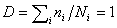
models of damage accumulation. The most wide-spread is the conception of linear
damage accumulation, offered by Miner, where damages  per cycle at variable
loading amplitude are added linear and failure happens in the case when
per cycle at variable
loading amplitude are added linear and failure happens in the case when
 .
.
In the
paper it is studied influence of sequential loading effects on the titanium
alloys VТ9 and VТ1-0 fatigue damage and under tension-compression, torsion and
90° out-of-phase non-proportional loading. It is proposed life estimation
method both under regular and irregular multiaxial loading. Damage model is
proposed, which considers non-proportion effects, which appear at loading
regime change.
With
the purpose of getting stress-strain state close to homogeneous were used
tubular specimens with outer diameters of 11,5 mm and 11 mm, wall thickness of
0,75 mm and 0,5 mm, test portion length of 20 mm and 21 mm for VT1-0 and VT9
respectively.
Specimens
of VT1-0 were tested at constant deformation amplitude, and under both
proportional and non-proportional regular loading. The VT1-0 alloy showed
behaviour which is typical for cyclic-stabilized materials under the tested
loading conditions. Tests results are showen in the Table 1,
where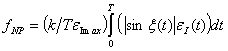 – non-proportional parameter of strain cycle [2].
Table
1. Path, strain peak values, non-proportional parameter
and number of cycle to failure for VT1-0 titanium alloy
|
path |
|
|
|
|
|
a |
0,7 |
- |
0 |
1280 |
|
a |
0,9 |
- |
0 |
470 |
|
a |
1,1 |
- |
0 |
229 |
|
t |
- |
1,21 |
0 |
2045 |
|
t |
- |
1,56 |
0 |
953 |
|
t |
- |
2,91 |
0 |
470 |
|
i |
0,55 |
0,75 |
0 |
1580 |
|
i |
0,72 |
0,94 |
0 |
822 |
|
i |
0,78 |
1,34 |
0 |
318 |
|
o_45 |
0,59 |
1,02 |
0,5 |
931 |
|
o_45 |
0,76 |
1,32 |
0,5 |
372 |
|
o_45 |
0,93 |
1,61 |
0,5 |
211 |
|
o |
0,7 |
1,21 |
1,0 |
733 |
|
o |
0,9 |
1,56 |
1,0 |
301 |
|
o |
1,1 |
1,91 |
1,0 |
199 |


 , cycle
The
assessment of VT1-0 titanium alloy fatigue life under non-proportional loading
showed that the application of Pysarenko-Lebedev modified criterion resulted in
good correlation of predicted and test data due to the complex consideration of
the strain state type and non-proportionality of the loading [3]. That is why
it is advised to apply the Pysarenko-Lebedev modified criterion as well as the
chosen damage accumulation hypothesis for assessing the VT9 titanium alloy
fatigue life. In the paper the two damage accumulation hypotheses were
analyzed: the linear hypothesis and the Manson’s approach , according to which
the damage curve is the relative fatigue life nonlinear function and looks like
this:
 ,
,
where  ;
;  – the number of
one-level loading cycles;
– the number of
one-level loading cycles;  – number of cycles
before failure under the given loading level;
– number of cycles
before failure under the given loading level;  – material constant
that is calculated from the test data under sequential double-level loading.
– material constant
that is calculated from the test data under sequential double-level loading.
As a
result, one can come to a conclusion about the linearity of damage accumulation
process for a given loading type. The combined application of the
Pysarenko-Lebedev modified criterion and of the Manson’s approach showed the
high level of predicted and test data correlation for all the loading
programmes except the alternating torsion. So the following modification of the
Manson’s approach is proposed:
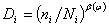
where
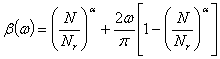 ;
;
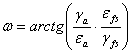
is strain path orientation angle, which determines the dominating type of
the strain state;  and
and  are fatigue strength
coefficients at finite life
are fatigue strength
coefficients at finite life  for uniaxial and
torsional loadings.
for uniaxial and
torsional loadings.
So,
during the alternating torsion the damage accumulation is linear, during the
tension-compression – with the application of the Manson’s approach, and during
the biaxial proportional and non-proportional loading their linear
interpolation.
The
application of proposed formula resulted in the
best correlation of the best correlation of the predicted and test data that is
shown on the Figbre
|
|

Conclusions
The
proposed method of fatigue life assessment under multiaxial low-cycle regular
and irregular loading, which is based on the Pysarenko-Lebedev modified
criterion, the linear damage accumulation hypothesis and the non-linear
Manson’s approach turned to be effective and allowed to take into consideration
such factors as strain state type, strain path type and loading irregularity.
References
[1] Fatemi A., Yang L. Cumulative fatigue
damage and life prediction theories: a survey of the state of the art for
homogeneous materials // Int. J. Fatigue. – 1998, vol.20, No.1, pp. 9-34.
[2] Itoh T., Sakane M., Ohnami M., Kida S.,
Sosie D. F. Dislocation Structure and Non-Proportional Hardening of Type 304
Stainless Steel // In: Proceeding of the 5th International Conference
Biaxial-Multiaxial Fatigue and Fracture, Cracow. – 1997, vol. 1, pp. 189-206.
[3] Shukayev S., Zakhovayko O., Gladskyi M.,
Panasovsky K. Estimation of low-cycle fatigue criteria under multiaxial loading
// Int. J. Reliability and life of machines and structures. – 2004, vol.2, pp.
127-135.