MATHEMATICAL MODELLING OF BIOLOGICAL
WASTEWATER TREATMENT, OF DAIRIES
Assoc. Prof. Semenovа О.I., Assoc. Prof. Smirnova J.S., student
Marchenko A.D, student Zhylyk
A.V.
National University of
Food Technologies
Rapid development of
Ukrainian food industry focuses the increased interest of applied ecology on
this sector of the economy. As it is known, dairy industry has a sufficiently
large number of unsolved environmental problems, among which the main is the
disposal of wastewater. Most dairies’serum with high a COD value is not used in
the secondary production and discharged together with wastewater in municipal
sewers or natural water bodies, creating significant damage to the environment.
One of the effective ways to solve this problem is to increase the efficiency
of treatment facilities by constructing mathematical models and further
experimental confirmation or refutation of their theoretical results.
Biological wastewater treatment is widely used around the world, due to its
versatility and relatively low operating costs.
The mathematical description of process regularites of
biological wastewater treatment is based on the classical equations of
enzymatic kinetics, e.g. the Michaelis-Menten equation, which describes the
dependence of enzymatic reaction on the substrate concentration:
(1)
where, V = Kkat · E0 - maximum speed of enzymatic
reactions; E0 - concentration of biomass of microorganisms, mg/l; Kkat -
constant of decay rate of fermentation substrate complex; Km - Michaelis-Menten
constant, numerically equal to the substrate concentration at which the reaction
rate is equal to V/2; S - substrate concentration, mg/l.
The method of biological wastewater treatment is based
on biotic circulation of substances, including recycling processes,
transformation and mineralization of organic matter through fermentation process of organic matter by
specific set of organisms - aerobic and/or anaerobic active sludge.
The rate of growth of microorganisms is determined by
the concentration of limiting substrate and described by Monod, similar to
Michaelis-Menten equation, which assumes that the mathematical pattern
of a complex population of active sludge
growth is similar to patterns of
pure bacteria cultures growth, and the principles of enzymatic kinetics can be
applied to the "pollution of wastewater - active sludge".
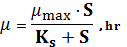 (2)
(2)
where, μ - specific rate of microorganisms
growth, hours; μmax -
maximum growth rate of microorganisms, hours; S - concentration of
substrate, mg/l; Ks - saturation constants [1].
Using the Mono model values of the
number of kinematic parameters (specific rate of growth of microorganisms,
organic decay constant depending on certain conditions of the process of
fermentation) have been determined.
In order to design the best systems of biological
treatment by anaerobic fermentation and define the apparent organic pollution
load, duration of treatment and predicting the degree of wastewater treatment
and biogas output the kinetic model of fermentation process based on the Mono
model has been suggested:
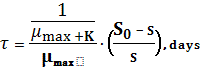 (3)
(3)
where, τ - duration of treatment, days; μmax
- the maximum growth rate of microorganisms, hours; K - kinetic parameter of
the process; S0 - initial concentration of substrate, mg/l; S - substrate
concentration in treated water, mg/dm3.
As an indicator of substrate concentration the content
of organic contaminants is considered as COD, mgO2/dm3.
Under the known parameter values and initial
concentration of pollution by COD the COD value in treated wastewater can be determined by the following formula:
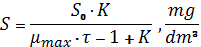 (4)
(4)
where, S - substrate concentration in treated water,
mg/dm3; S0 - initial concentration of substrate, mg/l; K - kinetic
parameter of the process; S0 - initial concentration of substrate,
mg/l; τ - duration of treatment, days; μmax - the maximum
growth rate of microorganisms, hours. It has been determined that the kinetic
parameter (K) decreases, and the maximum rate of growth of microorganisms
increases with the increasing temperature process.
For example, an increase in temperature from 10 C to
35 C leads to a reduction of K from 7.59 to 2.56, and an increase from 9.90 to
40.82 days. Increasing the setting causes the reduction of a purity degree,
thus to deterioration of the process
and the impact of metabolic products on the enzymatic process. Temperature
effect on process setting is described by Arrennusa principle.
The maximum rate of the growth of microorganisms is
described by a linear function in temperature ranging from 20 to 35 C.
The specific biogas yield per unit of the bioreactor
volume is described by the modification of the equations of Mono’s model:
 (5)
(5)
where, B0 - the maximum biogas yield per
unit of organic matter during the continuous processing time, m3/kg;
S - substrate concentration in treated water, mg/dm3; τ -
duration of treatment, days; K - kinetic parameter of the process; μmax
- the maximum growth rate of microorganisms, hr [2].
Conclusions: Identification of process parameter K and
μmax by the experimental way
enables to determine the concentration of pollutants in treated
wastewater of dairies and the specific
biogas yield by formulas (4) and (5) under different temperatures and initial
values of COD, depending on the duration of treatment in
bioreactors.
1.
Савченко А.І., Дяченко Н.М., Кравченко О.Ю., Математичне
моделювання процесу біологічного очищення стічних вод у коридорах аеротенках //
Вісник Кременчуцького національного університету імені Михайла Остроградського.
– 2012 – №6 (77). – С.109-111.
2.
Никитин Г.А. Метановое бродение в биотехнологии. – М.:
Стройиздат, 1990. – 207 с.