Burmistrova T.V., Kamanina O.A., Rybochkin P.V.,
Ponamoreva O.N.
Tula State
University, Russia
Methylotrophic
yeast Ogataea polymorpha BKM Y-2559 immobilized
in polymer structures
In
recent years, particular attention is directed to exploring possibilities
sol-gel chemistry to obtain the immobilized microorganism in the silicate
matrix. Silicon-based materials have the advantage over other polymers used for
the immobilization of cells [1]. Encapsulated bacteria are of considerable
interest for the development of effective biocatalysts, including the creation
of biosensors [2].
The
disadvantages of sol-gel method for the immobilization of microorganisms
include excretion of lower alcohols during matrix formation, which are toxic
for microorganisms. Because of this, we must introduce an additional step of
removing alcohol from the reaction mixture. Low molecular weight alcohols are
natural substrates for methylotrophic yeast, because of presence of an active
oxidation system, which gives them significant biotechnological potential.
Therefore we proposed to use these microorganisms to produce biohybrid
materials using sol-gel process without an intermediate step of removing the
alcohol.
Previous
approaches for obtaining encapsulated in an organosilicate shell methylotrophic
yeasts have been developed for potential methanol wastewater treatment and
creation of microbial sensors. Hybrid materials were prepared on the basis of
different ratios of methyltriethoxysilane (MTES), tetraethoxysilane (TEOS), and
methylotrophic yeast cells.
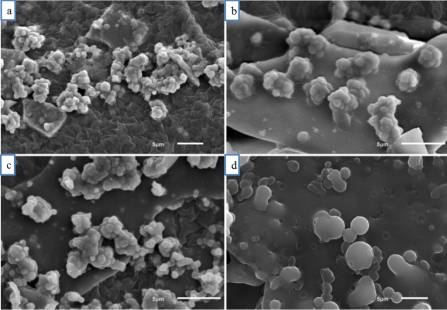
Using
scanning electron microscopy (SEM) formed structures were studied. Biosilicate
architecture template derived from MTES and TEOS in a ratio of 85%: 15% is of greatest
interest (Figure 1c). Each cell is formed around the capsule, wherein the
encapsulated cells form a solid hybrid architecture biomaterial. Changing of
the MTES content leads to inefficient encapsulation of yeast.
|
|
Figure 1. SEM image Ogataea polymorpha BKM Y-2559,
encapsulated in a bimodal sol-gel matrices of different compositions: a – 10% on a hydrophobic
additive; . b – 50 vol%; c – 85 vol%;
d – 90 vol%). |
An
important feature of the consumer biocatalyst is its resistance to the harmful
effects of various environmental factors. Since methylotrophic yeasts are
encapsulated in sol-gel matrix, it is important to evaluate the effect of
stressors on the activity of the biomaterial.
a
biosensor system based on the oxygen electrode which surface is in direct
contact with the encapsulated cells was used to study the degree of stress
factors influence on the respiratory activity of the encapsulated
methylotrophic yeast cells.
Wastewaters
often contain heavy metal ions, which reduce the results of the determination
of methanol. To identify the protective function of the capsules to the effects
of heavy metal ions a comparative analysis of the methanol oxidize ability of
the encapsulated yeast and microorganisms without capsule in the presence of
heavy metal ions was carried out. The biosensor response values are almost
independent of the presence of metal ions, except for Cu (II) and Cd (II) due
to their high toxicity on all living organisms. Thus, the presence of heavy
metal ions in the solution does not affect the respiratory activity of the
encapsulated yeast, indicating that the capsules demonstrate their protective
function.
Thus,
the encapsulation of living cells in the methylotrophic yeast organosilicate
sol-gel matrix provides the protection from the damaging effects of heavy
metals and acidity.
Bibliography:
1.
Sakai-Kato K., Ishikura K. Integration of biomolecules into analytical systems
by means of silica sol-gel technology // National Institute of Health Science.
‒ 2005. ‒ V. 6. ‒ P. 70-75
2. Jia
J., Tang M., Chen X., Qi L., Dong S. Co-immobilized microbial biosensor for BOD
estimation based on sol–gel derived composite material // Biosensors and
Bioelectronics. ‒ 2003. ‒ V. 18, I. 8. ‒ P. 1023-1029
The work on state orders in the field of
scientific activities of the Russian Federation Ministry of Education (Task N
2014/227).