Bilous І.І., Pavlovych L.B., Chornenka Zh.А., Bytsko N.I.
Higher State Educational
Institution of Ukraine
«Bukovinian State Medical University»
ASSESSING THE PREVALENCE OF
THYROID DISEASE IN CHERNIVTSI REGION OVER THE LAST 5 YEARS.
Diseases
of the thyroid gland (TG) have drawn a lot of attention recently. On the one
hand, this is due to the fact that it is TG that responds actively to
geochemical environment, followed by the onset of some of thyroid diseases. On
the other hand, in the current conditions the population remains alone with the
adverse effects of the environment, as an effective experience of the
international community in fighting iodine deficiency has not been implemented
in Ukraine.
In general, diseases of the endocrine glands,
particularly the thyroid pathology cause great social and economic loss that is
determined by the cost of medical care and social security (due to disability,
disablement, untimely death of patients).
Studying the prevalence of
thyroid diseases was previously considered in terms of total endocrine sickness
related to previous years. Unfortunately, the statistical analysis and
probability of these changes were not considered. We have analysed the official
statistics of Ministry of Health of Ukraine (analysis of endocrinology service
of Chernivtsi region for the Ministry of Health of Ukraine) regarding the
prevalence of adult and child population in thyroid pathology over the last 5
years between 2011 and 2015. The analysis of official statistics showed a high
prevalence of endocrine diseases. According to these criteria the endocrine
pathology is one of the leading in the structure of overall morbidity. Ukraine
is characterized by an increase in the number of patients with various
endocrinopathies, the most common among them are diabetes mellitus (DM) and
thyroid diseases.
At the moment, we decided to concentrate our attention
on the pathology of the thyroid gland, which was first described back in the
second century BC by a Roman physician Galen and it occupies an important place
among endocrine diseases after DM. The structure of thyroid diseases, included
in official statistics, consists of euthyroid diffuse goiter, nodular goiter,
hyperthyroidism, hypothyroidism, thyroiditis, thyroid cancer. Diffuse goiter is
the most common pathology. Goiter is an enlargement of the TG above its normal
size. Without touching the age and sex
features of the gland parameters, we note that its size is determined by
palpation and ultrasound measurement of its volume. According to a current
classification, WHO identifies the first and second degrees of goiter. In order
to attract the attention of endocrinologists to the need for pharmacological
treatment of this pathology in Ukraine, official statistics of diffuse goiter
identifies the ІІ–ІІІ degree of goiter instead of the ІІ degree.
The area in which the prevalence
of the first degree thyroid hyperplasia is 5% or more among children or 30% or
more among adults is considered to be goiter endemic. Ukraine is an endemic
area with low iodine in the environment. There is no region in Ukraine, where
people do not feel the iodine deficiency, and Chernivtsi region is not an exception.
Iodine deficiency is especially dangerous for pregnant women, resulting in an
increased risk of having children with low birth weight, sensorineural
deafness, spastic paralysis, cretinism as well as stillbirths and miscarriages.
Iodine deficiency affects the mental development of older children significantly.
Prevalence of endocrine thyroid disease
in Chernivtsi region over the last 5 years
|
Nosological unities |
Patients registered in 2011 |
Patients registered in 2012 |
Patients registered in 2013 |
|||||||||
|
Adults |
Children under 17 |
Adults |
Children
under 17 |
Adults |
Children
under 17 |
|||||||
|
Abs.number |
on 100 th. |
Abs.numbe |
on 100 th. |
Abs.numbe |
on 100 th.. |
Abs.numbe |
on 100 th. |
Abs.numbe |
on 100 th. |
Abs.numbe |
on 100 th. |
|
|
Thyrotoxicosis E05 |
1134 |
158,4 |
8 |
4,3 |
1196 |
166,7 |
- |
- |
1272 |
176,6 |
- |
- |
|
Nodular goiter E04.1, 2.4, D34 |
3128 |
437,0 |
23 |
12,3 |
3445 |
480,3 |
- |
- |
3828 |
531,4 |
- |
- |
|
thyroiditis E06 |
2115 |
295,5 |
152 |
81,9 |
2152 |
300,0 |
- |
- |
2252 |
314,0 |
- |
- |
|
Hypothyroidism |
1533 |
214,2 |
68 |
36,6 |
1631 |
227,3 |
- |
- |
1799 |
239,5 |
- |
- |
|
02-03 E, E89, incl. Рostoperative hypothyroidism |
277 |
38,7 |
5 |
2,6 |
294 |
41,0 |
- |
- |
325 |
45,1 |
- |
- |
|
Simple goiter E01, E04 |
21477 |
3000,7 |
12034 |
6487,5 |
22918 |
3195,0 |
- |
- |
24346 |
3379,0 |
- |
- |
|
І degr. |
16837 |
2352,5 |
11056 |
5960,2 |
18143 |
2529,3 |
- |
- |
19362 |
2687,0 |
- |
- |
|
ІІdegr. - ІІІ degr. |
4640 |
648,3 |
978 |
527,2 |
4775 |
665,7 |
- |
- |
4984 |
691,9 |
- |
- |
|
Thyroid
cancer C 73 |
313 |
43,7 |
6 |
3,2 |
256 |
35,6 |
- |
- |
267 |
37,0 |
- |
- |
|
hypoparathyroidism E20 |
17 |
2,3 |
1 |
0,5 |
16 |
2,2 |
- |
- |
17 |
2,3 |
- |
- |
|
hyperparathyroidism E21 |
1 |
0,1 |
0 |
- |
3 |
0,41 |
- |
- |
3 |
0,4 |
- |
- |
Table 1
Table 1(extension)
|
Nosological unities |
Patients registered in 2014 |
Patients registered in 2015 |
||||||
|
Adults |
Children
under 17 |
Adults |
Children
under 17 |
|||||
|
Abs.number |
0n 100 th. |
Abs.number |
0n
100 th. |
Abs.number |
0n
100 th. |
Abs.number |
0n
100 th. |
|
|
Thyrotoxicosis
E05 |
1335 |
185,2 |
- |
- |
1424 |
197,3 |
12 |
6,5 |
|
Nodular goiter E04.1, 2.4, D34 |
4358 |
604,7 |
- |
- |
4812 |
666,9 |
38 |
20,5 |
|
Thyroiditis E06 |
2424 |
336,3 |
- |
- |
2633 |
364,9 |
218 |
117,6 |
|
Hypothyroidism |
1882 |
261,1 |
- |
- |
2151 |
298,1 |
71 |
38,3 |
|
02-03 E, E89, incl. postoperative
hypothyroidism |
356 |
49,4 |
- |
- |
371 |
51,4 |
3 |
1,6 |
|
Simple goiter E01, E04 |
25719 |
3568,6 |
- |
- |
26933 |
3732,5 |
12937 |
6981,3 |
|
І degr. |
20528 |
2848,3 |
- |
- |
5364 |
743,4 |
956 |
515,9 |
|
ІІdegr. - ІІІ degr.. |
5191 |
720,3 |
- |
- |
425 |
58,9 |
3 |
1,6 |
|
Thyroid cancer C 73 |
377 |
52,3 |
- |
- |
19 |
2,6 |
2 |
1,1 |
|
Нypoparathyroidism E20 |
18 |
2,5 |
- |
- |
6 |
0,8 |
- |
- |
|
Нyperparathyroidism E21 |
7 |
0,9 |
- |
- |
8 |
1,1 |
- |
- |
The
structure of endocrine pathology in the adult population of Chernivtsi region is dominated by thyroid
disease.The structure of endocrine diseases is shown in Fig.1 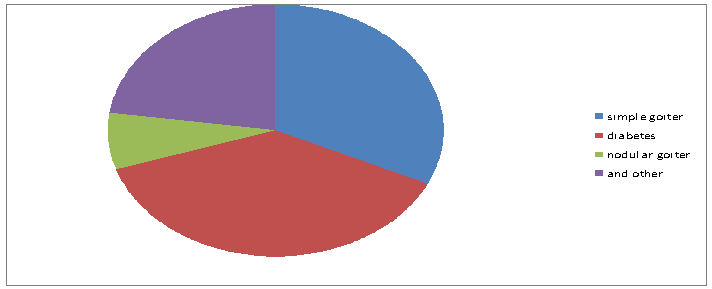 Fig. 1 The structure of
endocrine pathology in the adult population of Chernivtsi region.
Fig. 1 The structure of
endocrine pathology in the adult population of Chernivtsi region.
It should be noted that euthyroid diffuse goiter and
DM are the most common diseases. And if we take into consideration the fact
that thyroid diseases also include hyperthyroidism, hypothyroidism, thyroiditis
and cancer of the gland, it can be argued that thyroid diseases account for
nearly half of all endocrinopathies.
Unlike the initial stage of the first degree goiter,
that of the II degree defies regression immediately after improving the iodine
status. We need at least 5 years for the positive trend to reduce the incidence
of this stage of goiter to manifest itself. In previous years there was a
gradual shift in the cases of I degree goiter to the II degree, indicating a
lack of preventive work to eliminate IDD and, therefore, an inadequate intake
of dietary trace element iodine, but even now the prevalence of the I-II degree
goiter does not allow to say that the residents of Bukovyna consume enough
dietary iodine. The prevalence of thyroid endocrine pathology in the adult
population of Chernivtsi region is presented in Fig.2.1. and 2.2.
Fig.2.1.
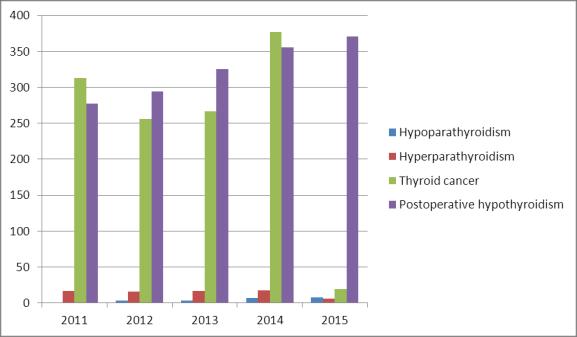

Fig.2.2.
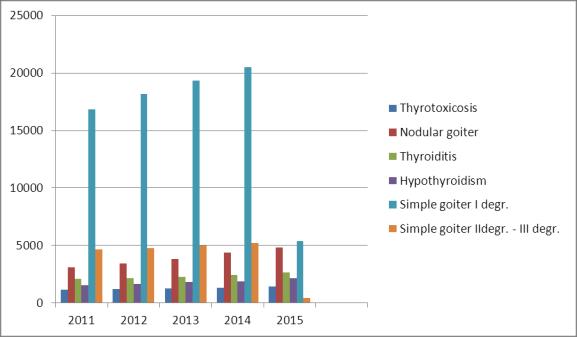

Fig. 2.1. and 2.2. The prevalence of thyroid diseases among adults in Chernivtsi
region (on 100 thousand people)
Iodine prophylaxis in the region
covers 70% of the population. Preventive maintenance is carried out in three
areas: mass (the use of iodized salt, milk and bread), group (is made with
drugs of potassium iodide in special risk groups (children, adolescents,
pregnant women)), individual (by a doctor’s prescription and as an autotherapy).
In general, diseases of the endocrine glands, particularly the thyroid
pathology cause great social and economic loss that is determined by the cost
of medical care and social security (due to disability, disablement, untimely
death of patients).
References
1. Delange F. Iodine deficiency in Europe // Thyroid International. - 1994. - № 3. - P. 8.
2. Zimmermann M.B., Hess S.Y., Molinari L. et al. New re-ference values
for thyroid volume by ultrasound in iodinesufficient schoolchildren: a World
Health Organization/Nutrition for Health and Development Iodine Deficiency
Study Group Report // Am. J. Clin. Nutrit. - 2004. - Vol. 79. - P.
231-237.
3. Митник З.М. та ін. Стан ендокринологічної служби України в 2007
р. та перспективи розвитку медичної допомоги хворим з ендокринною патологією // Статистично-аналітичний довідник МОЗ України та Українського науково-практичного центру ендокринної хірургії, трансплантації ендокринних органів і тканин. - К., 2008. - 49 с.
4.Цифровий звіт ендокринологічної служби в Чернівецькій області за
2011-2015 рр., Обласна
комунальна установа «Чернівецький обласний ендокринологічний центр», 2011–2015
рр.
4. Петри А.,
Сэбин К. Наглядная статистика в медицине: Пер. с англ. - М.: ГЭОТАР-Мед, 2003. — 144 с.
5. Delange F. Iodine deficiency in Europe // Thyroid
International. - 1994. - № 3.
- P. 8.
6. Tronko N., Bogdanova T. Thyroid cancer
in children and adolescents. Health effects of Chornobyl accident / Ed. by A.
Vozianov, V. Bebeshko, D. Basyka, A. Chumak. -
Kyiv: DIA Ltd, 2003. - P. 60-68.
7. Кравченко В.І., Ткачук Л.А., Турчин В.І. та ін. Споживання йодованих продуктів та стан
йодної забезпеченості населення України // Доп. НАН України. - 2005. - № 10. - С. 188-194.
8. Звіт «Про національне дослідження вживання населенням
харчових мікронутрієнтів». - К.: Прем’єр Медіа, 2004. - 64 с.
9. Оцінювання йододефіцитних захворювань та моніторинг їх
усунення: Пер. з англ. / Під ред. В.І. Кравченка. - К.: К.І.С., 2008. - 104 с.