Кoketai T.A., Тussupbekova A.K.,
Ismailov Zh. T., Nukygazy S.A.,
Mussina G.I.
Karaganda State University named after
academician Y.А.Buketov,
Republic of Kazakhstan,
Karaganda
The
absorption spectra of the luminescence excitation and emission of the KDP
crystals
Potassium
dihydrogen phosphate (KH2PO4 or KDP) crystals are
considered as one of the most important construction materials in modern
technology. The following problems which appear after this require a behavior
forecast of construction materials in extreme conditions and modification of
physical properties or creation of new materials with specific features. Research
objects are single crystals of potassium dihydrogen phosphate and transition
metal’s ions activated KDP crystals. КDР crystals
maintains nonlinear optical properties. Some modern devices have found the
usage to various single crystals from KDP [1]. The simplest method to change
optical, mechanical or electrical properties of crystals is introduction of
various substitution impurities or ionizing radiation exposure.
The
growth of KH2PO4 single crystals was produced of
saturated aqueous solutions using isothermal evaporation of the solvent at
400C. Given temperature conditions of growth were taken from
research work [2]. After 10-12 days this process there were 5 mm to 40 mm sized crystals.
Our
work in particular included measurements of the absorption spectra of the
luminescence excitation and emission at different temperatures which were used
from the optical research methods. Absorption spectra of crystals and induced
absorption spectra in the area of 200 – 800 nm were measured using
photoelectron method on spectrophotometer SPh-16 by standard methods [3].
Additional absorption spectra were measured towards non radiated crystals. The
last one took place to learn the influence of ionizing radiation on impurity
absorption. Measurement of the absorption spectra was done at 80 – 320 K
temperature range.
Fig.
1 shows traditional TSL curves for KDP crystals, activated by Me2+
ions. Comparison of experimental results shown on Fig. 1 alongside with the TSL
curve for a pure KDP [4] shows that recombination processes in activated
crystals are doing some noticeably rapid changes. There are some new TSL peaks
in crystals with bivalent manganese impurity ions in areas of 140 K, 210 K and
230 K (Fig. 1, curve 1). In pure KDP crystals the lightsum of recombined glow
at this temperature range is not severely noticeable. The activated KDP-Mn2+
crystal obtains the lightsum of the low temperature peak which is noticeably
more towards the matrix peak at 180 K. In crystals with bivalent cobalt
impurity ions (Fig. 1, curve 2) there is a new peak in the TSL at 140 K which
is clearly defined. TSL peaks which are considered normal for the matrix with
maxima at 180 K and 290 K are slightly suppressed. The low-temperature peak of
the recombined luminescence has a maximum at 110 K.
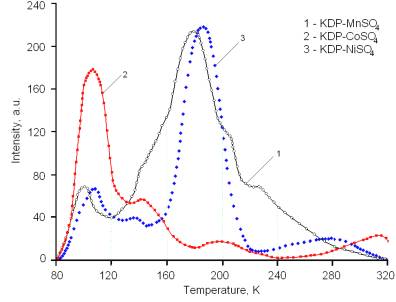
Fig. 1. TSL curves of activated KDP crystals. Radiated dose – 150 kGy.
In
crystals with bivalent nickel (Fig. 1, curve 3), a new peak in the TSL appears
as a “shoulder” in the high-wing emission peak with a maximum at 110 K. Thermal
annealing carried out at 100 – 110 K for pre-irradiated X-rays of the sample
allows selecting a new peak emission. It is a maximum of 140 K. TSL peak, which
is normal for the matrix with maxima at 290 K, is depressed. Recombined
luminescence peak with maximum at 190 K is dominant at accumulated lightsum.
KDP
pure crystals get colored under the ionizing radiation. Three observed
absorption bands have the maximum points at 2.26 eV, 3.17 eV and 5.75 eV. The
received results are as expected in the papers [4], according to which DKDP
crystals have been detected to obtain radiation navigated absorption bands at
230 nm, 390 nm and 550 nm (5.39 eV, 3.18 eV and 2.25 eV). In [5] research work
it is shown that radiation navigated absorption bands are conditioned with
absorption in B-radicals at 2.26 eV, 3.17 eV and with interstitial hydrogen
atoms at 5.75 eV.
The
temperature dependence of the absorption band for the activated crystal is
different from that in a pure sample. The given outcome is considered as a
direct proof to the fact that Co2+ ions increase the thermal
stability of B-radicals in KDP crystals. Analogous outcome was received for
KDP-MnSO4 crystals. From all the facts mentioned above, there is
only one recombined luminescence appearance peak at 140 K which is related to
the influence of transition metal ions. Its observing does not depend on the
nature of transition metal impurity ions.
References
1. Singh, P.,
Hasmuddin, M., Vijayan, N., Abdullah, M.M., Shakir, M. and M.A. Wahab, 2013.
Investigation on growth features and crystal structures of pure and metal ion
(Mn2+) doped KDP single crystals. Optik, 124. P. 1609-1613.
2. Rez, I.S. and V.I. Pachomov, 1967. The growth of
single crystals of KDP with different modifiers. Bulletin of Acad. Of Science
USSR, 31(Physics). P. 68-72.
3.
Zaidel, A.N., G.V. Ostrovsky and Yu.I. Ostrovsky, 1972. Technique and practice
of spectroscopy. Moscow: Nauka. P. 376.
4. Chirila,
M.M., Garces, N.Y., Halliburton, L.E., Demos, S.G., Land, T.A. and H.B.
Radousky, 2003. Production and thermal decay of radiation-induced point defects
in KD2PO4 crystals. J. Appl. Phys., 94(10). P. 6456-6462.
5.
Kim, L.M. and B.S. Tagayeva, 2008. Radiation-induced absorption bands in KDP
crystals. Bulletin of University of Karaganda, 4 (Physics). P. 21-26.