Yudina N., Savenkon A.,
Arlyapov V.
Tula State University, Russia, Tula
The BOD biosensor’s specifications based on yeast Debaryamyces
hansenii encapsulated in
dialysis membrane
Biochemical
oxygen demand (BOD) is one of the most broadly used indices for monitoring the
purity of aqueous environments. By definition, it represents the amount of
oxygen required for biochemical oxidation of organic substances contained in
the sample. The duration of classical BOD tests is 5 days (BOD5) and more, which is
too long for the on-line assessment of an ecological situation [1]. BOD
assessment methods for express assays are being developed based on biosensor
analyzers. As recognition elements, BOD biosensors use microorganisms capable
of metabolizing a broad range of organic compounds.
The receptor
element of sensor was formed by using yeast Debaryamyces
hansenii. These microorganisms can oxidize many alcohols, carbohydrates,
amino acids and other organic substances [2]. Dialysis membrane encapsulation
allows immobilizing yeast in the softest conditions. Thus, it is possible to
avoid binding the enzymes active centers of whole cells in the case of
immobilization by chemical cross-linking, and also loosing of activity under
adsorption on glass fiber filter and the inclusion in different gels.
The aim of
this work is to determine the characteristics of the cuvette BOD biosensor
yeast Debaryamyces hansenii, encapsulated in a dialysis membrane.
Materials and methods. Electrochemical measurements
were carried out using an Ekspert-001-4.0.1 pH meter– ionometer–BOD thermal
oximeter (Ekonics-expert Ltd, Russia) coupled with a computer operated by
EXP2PR specialized software. The maximal rate of oxygen concentration change at
the addition of substrates (mg/dm3•s) was the measured parameter
(biosensor response). Clark-type oxygen electrodes containing immobilized
microbial cells were used as transducers. A sodium–potassium phosphate buffer
solution (pH 6.8) was used. A mixture of glucose and glutamic acid (GGA) at a
mass ratio of 1:1, applied as the BOD5 determination standard in the
Russian Federation and in international practice [1], was used as a model
mixture. In accordance with the regulatory documents, a value of BOD5
equal to 205 mg/dm3 was taken to correspond to a solution containing
150 mg/dm3 glucose and 150 mg/dm3 glutamic acid (BOD5
= 0.68×СGGA). The method of encapsulation in dialysis membrane (Sigma-Aldrich, USA) of microorganisms
was used for formation of the receptor element.
Results and discussion. This selectivity
of biosensor analysis
is determined by biomaterial substrate specificity
of a sensor receptor element. Predominantly
readily oxidizable organic substances were taken as substrates, since their
ingress into water reservoirs leads to a significant reduction in the level of
dissolved oxygen and subsequent eutrophication. Figure 1 presents the data for
the substrate specificities of the developed biosensor.
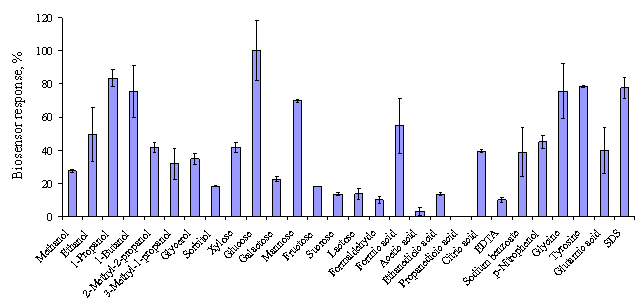
Figure 1. Substrate specificities of the developed biosensor.
Cells Debaryamyces hansenii, immobilized by
encapsulation in a dialysis membrane are capable to oxidize a very wide range of
organic substances (Figure 1). These substances can be detected in the effluent
of the various industries, which is promising from the standpoint of the
possibility of microorganisms use for the evaluation of BOD. Dialysis membrane
which used for encapsulation of yeast skips macromolecular substrates having a
molecular weight less than 12 kDa. That’s why the sensor responses depend only
on the enzymatic activity, as opposed to the immobilization of microorganisms
by inclusion in gel or adsorption, where the sensor response was dependent on
the diffusion through the matrix substrate.
The main
characteristics of BOD biosensor based on yeast encapsulated in dialysis
membrane (table 1).
Table 1.
Characteristics of the yeast based BOD biosensor.
|
Characteristics |
Values |
|
|
Sensitivity coefficient, slope of the
linear segment of the dependence of sensor response on the value of BOD5, s–1 ∙10–4 |
3,0± 0,3 |
|
|
Range of determined BOD5
values, mg/dm3 |
1.3–40 |
|
|
Operational stability, relative
standard deviation by 15 consecutive measurements, % |
6,5 |
|
|
Long-time stability, time within which
the value of biosensor response to the same concentration of GGA was no less
than 25% of the initial value, temperature 20ºC , days |
55 |
|
|
Unit assay time, duration of
single measurement, min |
3-4 |
|
Developed sensor surpasses analogues [2] on the long-term
stability and unit assay time. Designed
biosensor allows to analyze samples with a high correlation to the reference method (R = 0,9998) and in a
wide range of BOD (from 2
to 32 000 mg/dm3).
References:
1. PNDF
14. 1: 2: 3: 4. 123-97. Quantitative chemical analysis of water. Methods of
measurement of biochemical oxygen demand after the n-days of incubation (BOD)
in surface freshwater, groundwater (groundwater), drinking water, sewage and
effluent. - M .: 1997. 25 p.
2. V.A. Arlyapov, N. Yu. Yudina, L.D. Asulyan, S.V.
Alferov, V.A. Alferov, A.N. Reshetilov. BOD biosensor based on the yeast
Debaryomyces hansenii immobilized in poly(vinyl alcohol) modified by
N-vinylpyrrolidone. Enzyme and Microbial Technology , № 53 (2013) pp.
257– 262.
Acknowledgements
The work was carried out within the framework of the State Assignment of
the Ministry of Education and Science of the Russian Federation and the Federal Targeted Programme for
Research and Development in Priority Areas of Development of the Russian
Scientific and Technological Complex for 2014–2020 (Project No.14.574.21.0062).