UDC
657.44.3
Zhytnyy Pavlo
Yevhenovych Doctor of economic sciences, professor
Lukyanova
Olena Yuriyivna Philosophy doctor in economic science
Financial
and industrial system management structures interaction
Financial and industrial system management (FIS) terms transfer pricing
has two levels. The first one is transfer pricing within each FIS involved
structure (e.g., bank). The second level is transfer pricing between FIS
structural units (e.g., enterprise – enterprise, enterprise – bank, bank –
insurance company).
The approach which is suggested below is the most appropriate for
banking institution transfer pricing in FIS conditions.
Responsibility centers bank internal circulation resources’ planning is
based on strategic plan. Bank treasury makes financial plans that contain
assets and liabilities as parts of united banking portfolio in responsibility
centers management. Financial plans period must be less than strategic planning
one. Active operations funding plans are made to manage interest costs in
accordance to financial plans. Assets and liabilities are grouped by funding
urgency there.
Responsibility centers costs calculation is made for each funding
period. Also support segments are chosen for each funding period based on
active operations resource base.
Main monetary capital markets are these ones which are marked as
principal credit sources by bank strategy for each term.
Resources transfer prices calculation is made for each funding term by
alternative market costs method applying. Transfer price determines center
direct marginal costs that are calculated in accordance to bank financial plan.
Bank treasury accrues revenue to profit centers that accumulate
resources in external surroundings and transfer expenses to costs centers that
place resources to external surroundings in the end of financial plan period.
Planned and actual data are taken into calculations.
FIS effective functioning great importance point is transfer pricing
between FIS structures.
Fig. 1 presents schematic version of financial and industrial structures
interaction chain in FIS conditions.
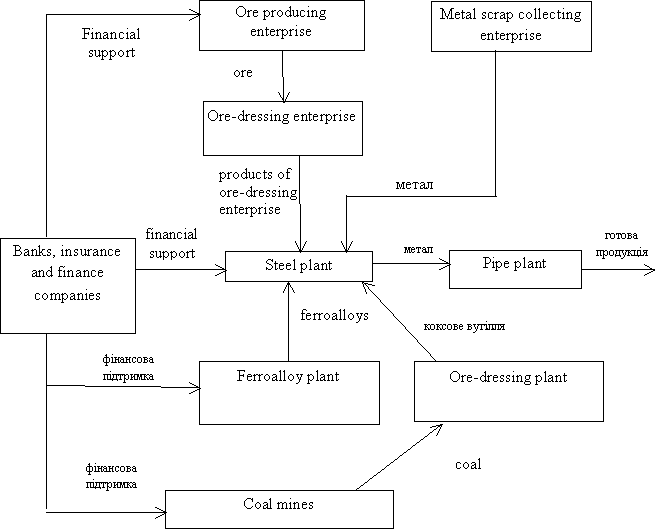
Fig. 1. Management structures interaction in FIS conditions
Transfer pricing formation requires control in each FIS participant
structure and management costs.
Costs calculation is based on such basic concepts as costs types and
costs centers. Management control is made by responsibility centers.
Than specific matrix (table 1) is formed for costs analysis. Its rows
are responsibility centers, columns are profit-oriented industrial business
programs.
Table 1
Costs variants matrix
|
Cost
centers /
resource type |
Wage
|
Consumables |
Bank
services |
etc |
Total |
|
Cost
center 1 |
а
11 |
а
12 |
а
13 |
а
1m |
|
|
Cost
center 2 |
а
21 |
а
22 |
а
23 |
а
2m |
|
|
Cost
center 3 |
а
31 |
а
32 |
а
33 |
а
3m |
|
|
Cost
center 4 |
а
41 |
а
42 |
а
43 |
а
4m |
|
|
etc |
а
n1 |
а
n2 |
а
n3 |
а
nm |
|
|
Total
|
|
|
|
|
|
Costs information in the matrix that was given above is summed by rows.
Result is responsibility centers costs data. This information describes program
cost that is necessary to determine services price and profitability assess.
United codification of cost (profit) centers (each center is FIS
structural unit) makes possible to consolidate different businesses total cost.
Result optimization has such variants as:
Variant I. Positive results increase at lower costs.
Variant II. Positive results increase at costs maintaining.
Variant III. Positive results increase faster than costs rise.
Variant IV. Positive results are the same, costs are reduced.
Variant V. Results decrease rate is lower than costs.
The variants point that FIS functioning goal is results increasing.
In the best variant each structure is profitable but it is difficult to
achieve in practice. E.g.: coal mines, ore-dressing enterprises, separate
services (repair, etc.) operate with losses under normal market pricing, steel
plants, pipe plants have profit. Transfer pricing should be directed to FIS
weak links maintenance and development in this situation. It gives possibility
to these structures innovative progress and FIS technological cycles
self-sufficing.
These
research results can be used as risk management practical recommendations for
large-scale business structures.
Literature
1. Zhytnyy P.Y.
Risk management peculiarities for financial and industrial system conditions /
Zhytnyy P.Y., Lukyanova O.Y. // Chasopys ekonomichnykh reform (Time description
of economic reforms) :
naukovo-praktychnyj zhurnal. – 2015. – Sievierodonetsk. – Vol. 1 (17). –
P. 62 – 67.
2. Zhytnyj P.Y. Oblikova polityka v umovakh rozvytku
finansovo-promyslovykh system: metodologiya ta organizaciya (Accounting
policies for financial and industrial systems terms conditions: methodology and
organization) : monograph / P.Y. Zhytnyj. – Luhansk : Volodymyr Dahl East Ukrainian National University publishing office,
2007. – 352 p.
3.
Ryzyky, bezpeka, kryzy i stalyj rozvytok v ekonomici: metodologiyi, modeli,
metody upravlinnya ta pryjnyati rishen (Risks, safety, crisis and economy
sustainable development: methodology, models, management and decision-making) :
monograph / scientif. edited by prof. S.K.
Ramazanov. – Luhansk : Noulidzh (Knowledge) publishing house,
2012. – 948 p.
4.
Gnylyczka L. Vykorystannya oblikovo-analitychnykh texnologij pry rozrobci
metodyky upravlinnya pidpryyemnyczkymy ryzykamy v systemi ekonomichnoyi bezpeky
pidpryyemstv (Using an analytical technologies in the development of
entrepreneurial risk management techniques in the system of economic security)
/ L. Gnylyczka // Bukhgalterskyj oblik i audyt (Accounting and Auditing).
– 2012. – №3. – P.41–47.
5.
Salov A. Informacionno-analiticheskoe obespechenie sistemy upravlenija riskami
investicionnoj dejatelnosti predprijatija i regiona (Information and analytical
support for management system of investment activity risks for economic units
and region) / A. Salov // [Za materialamy mizhnar. nauk.-prakt. konf.
«Oblikovo-analitychni systemy subyektiv gospodarskoyi diyalnosti v Ukrayini»
(25-26.03.2005)] // Formuvannya
rynkovoyi ekonomiky v Ukrayini (Formation of market economy in Ukraine). –
Lviv: Ivana Franko National University of Lviv. – 2005. –Vol. 15. – Part 2. –
P.209–217.
6.
Prymostka L. Ekonomichni ryzyky v diyalnosti bankiv (Economic risks in banks
activities) / L. Prymostka // Bankivska sprava (Banking). – 2004. – Vol. 3. –
P. 16–23.
7.
Zhytnyy P.Y. Osoblyvosti upravlinnya operacijnym ryzykom v umovakh komercijnogo
banku (Operational risk management peculiarities for commercial bank) / Zhytnyj
P.Y.,.Zhytnyj V.Y. // Visnyk Shidnoukrayinskogo universytetu im. V. Dalya
(Digest of Volodymyr Dahl East Ukrainian
National University). – 2009. – Vol. 3 (133). – P.64–72.
8.
Shmatko N. Systema ocinky ryzykiv bankiv pry investuvanni u cinni papery (Risk
assessments system for investing to securities)/ N. Shmatko //
Oblikovo-analitychni systemy subyektiv gospodarskoyi diyalnosti v Ukrayini
(Business entities accounting and analytical systems in Ukraine) : scientific
digest. – Lviv, 2005. – Sp. Vol. 15 (part 20. – P. 596–605).
9.
Aoki M. Firma v japonskoj ekonomike (Economic unit in Japanese economic):
[translated from edition in English] /M. Aoki. – SPb. : Lenizdat, 1995. – 431
p.
10.
Rudenko L.V. Mizhnarodni kredytno-rozrahunkovi i valyutni operaciyi
(International credit-settlement and currency transactions) : [Pidruchnyk]
(Tutorial) / L.V. Rudenko. – Kyiv : CUL, 2003. – 616 p.