Kochetkova M.V.
Departament
of Quality Management and Technology of Building Production
«Penza
State University of Architecture and Construction»,
Russia
DISTRIBUTION
OF STRESSES AND STRAINS
IN multilane pile grillage under pillar
Grillage under the column rests on piles, the
number of which may be 3 -
4 or multiple row
arrangement of piles 5 - 12. Existing methods of
calculation is not shared by the
two groups grills under the
column, assuming that all work in the same pile, and the total load is divided equally between them. Our
experiment refutes this
assumption.
Prototypes designed in the
form of models in scale 1:3. Step
piles longitudinally - 3 d, in cross - 4 d. (d - side cross-section
of the pile, taking into account the
scale - 100 mm).
Height grills -
220 mm, size columns 200x300 mm has been
assigned on the basis of the
results of studies of regulatory calculation
methods. Was used a different kind of reinforcement. Along
with reinforcing mesh reinforcement was applied at a concentration of bars above the supports-piles. Figure
1 shows the dimensions of formwork and reinforcement
of prototypes with the number of piles equal to eight.
Grillage loaded hydraulic jack through the metal plate that mimics the column. Were measured compressive strains on the supports using dial
gauges and strain gauge
transducer. Compressions set over supports are shown
in Fig 2. The
deformation amount varied depending
on the reinforcement and the structural condition (before and after cracking).
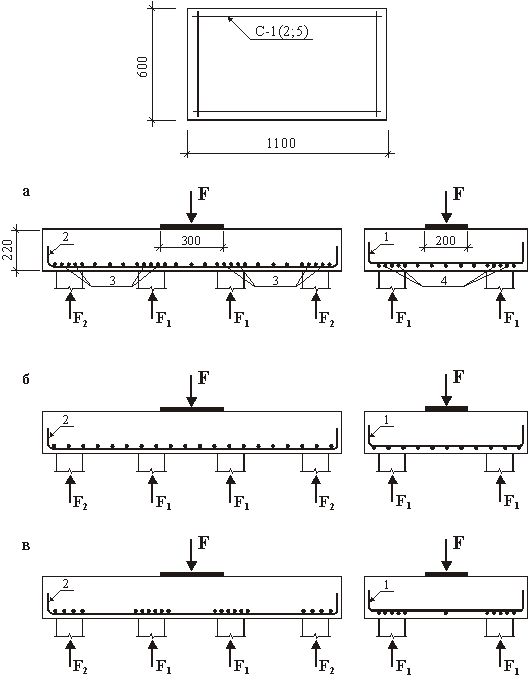
Fig.1. Reinforcement scheme samples:
а – РК 1 (μs = 1,2 %); б – РК 2 (μs = 0,18 %); в – РК 5(μs =0,18 %);
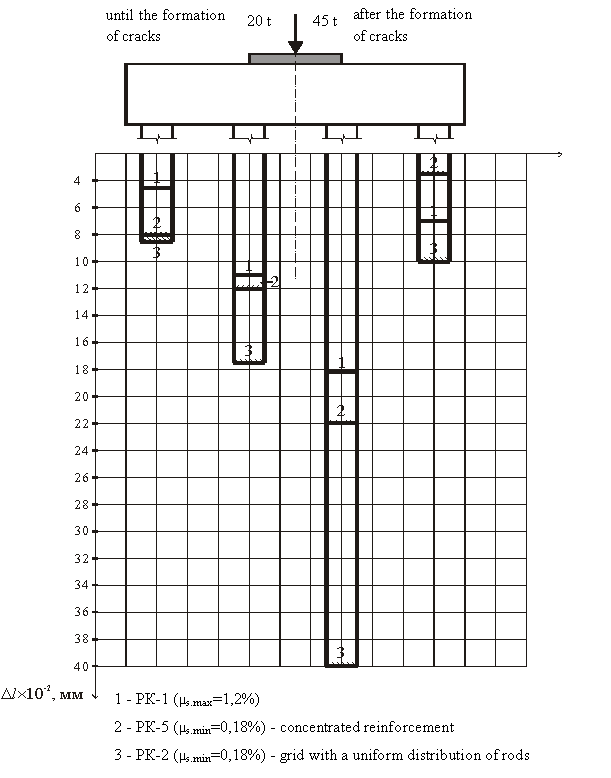
Fig.2. The average compressive strain on piles in the grillage depending on the type of reinforcement 1; 2; 3.
The
results of data processing make
it possible to draw the following conclusions:
o
Deformation in the grillage over supports with a large percentage of the reinforcement
(ms = max) is less than in the same raft foundation with a minimum percentage of reinforcement
(ms =min).
o
If
you compare options 2 and 3, it can be said that
the concentration of reinforcement led to a more even distribution of load between the outer and
middle supports and less deformation of supports in general.
o
After the formation
of cracks was
observed slow growth deformations
and their redistribution.
o
Redistribution of efforts after
cracking occurs as follows: In areas that are closer to the column, the
deformation grew faster than in remote locations. Furthermore, remote locations
are often observed a decrease in strain after the formation of cracks.
o
Distant piles less loaded
than the central pile. Voltage over
the central and far the supports
differ by 2-4 times. The quantitative ratio depends on the circuit
and the percentage of reinforcement.
o
Above each support a zone of compressive stresses. Stress intensity
depends on the location of the pile.
The area of the compressed area depends not only on the cross-sectional dimensions of the pile but also by the
reinforcement. With increasing percentage
of reinforcement increases the
area of the compressed zone and
reduces stress on the support.
The findings should be taken into account in improving the methods of
calculation and designing grills.