PhD
in Economics, Associate Professor Коrneyev М.V.
LLC
"AgroInvestGroup", Ukraine
THE THEORETICAL AND METHODICAL BASES OF FINANCIAL AND REAL SECTORS STUDY
IN CONDITIONS OF THE TRANSITION TO FINANCIAL ECONOMY
The
development of segmental structure of economy financial and real sectors
correlates with the general development of economic system in whole. At a later
time is assured the stability of such system, the regularity of its subjects
economical activity, is assured the need in trusty protection from many
financial and economic risks which exist in every specific conditions of
management. The activity of financial and real sectors separate subjects
acquires the considerable paces in any conditions of economic development and
of course depends on segmental structure of economy. The public policy in the
region of development of economy financial and real sectors directs at
improvement of normative and legal base, at expansion of financial and economic
services volume in the market, thereafter at increase of subjects reliability
of one or another sector of economy. The tactical and strategic development of
subjects activity of economy financial and real sectors with position of
situational modelling can occur in the form of several scripts which meet the expectations
of such subjects different groups [2;3;6].
Function
of economy financial and real sectors subjects must be held according to
particular rules which are defined by the economic system (fig. 1).
The methodical bases before estimate of development
state of sector structure on the stage of the transition to financial economy
are characterized with the system of separate base indicators:
1) The correlation of economy financial and real
sectors on separate macro-indicators (in general or on separate groups of such
sectors subjects). Such correlation characterizes the degree of domination of
one sector over other in every specific conditions of management; in addition
also is determined the speed of the resources move (on their kinds) on these
sectors of economy.
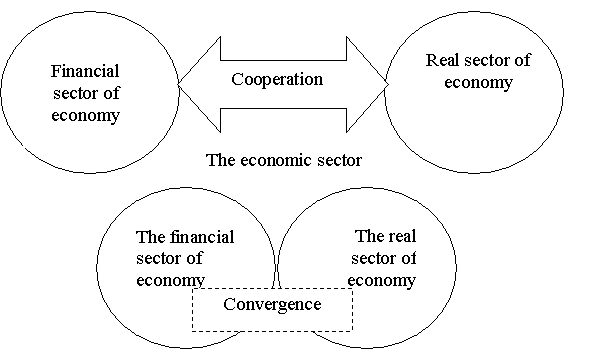

Fig.
1. Cooperation and convergence of economy
financial
and real sectors
2) The flexibility of financial (real) sector (in
general or on separate groups of such sectors subjects) characterizes the relative
occasion of adjustment of sector subjects to changeable conditions of
management; in addition also is determined the degree of balance (or inversely
the imbalances on their kinds) on these sectors of economy.
3) The resistance of financial (real) sector (on
separate groups and all sum-total of such sectors subjects) characterizes the
flexible response to influences of economic circumstances purposely of separate
cases prevention.
4) The stability of financial (real) sector (on
separate groups and all sum-total of such sectors subjects) characterizes the
relative ability of sector (groups of its subjects) to function persistently,
equivalently, without structural changes.
5) The activity of financial (real) sector (on
separate groups and all sum-total of such sectors subjects) characterizes the
measure what directs to realization of potential for further achievement of
results.
6) The indicator of competitive ability of financial
(real) sector (on separate groups and all sum-total of such sectors subjects)
is addition to previous indicator and characterizes the level of ability to
compete on separate criteria.
7) The segmentation (branching) of financial (real)
sector (in general or on separate kinds of subjects) characterizes the degree
of division into approximate, corresponding on characters components.
The dynamics and structure of above-listed indicators
increasingly characterize the macroeconomic bases of development of sector
structure on the stage of transition to financial economy. The results of
corresponding analysis are possibility to detail the system of specializing
indicators concerning subjects or their groups for one or other sector of
economy in specific period of time: the indicators of transformation
(negotiability of assets on their kinds); the indicator of capital
negotiability on its kinds and in general; the indicators of backlog
negotiability on its kinds; the indicator of dependence (independence); the
indicators of concentration and flexibility of capital (on its kinds); the
indicators of provision; the indicators of liquidity on its kinds; the
indicator of responsibility; the indicators of economic efficiency
(profitability) on its kinds; the indicator of reinvestment; the indicator of
resistance of economic growth. In addition on indicators of transformation and
negotiability it is possible to determine the periods of assets and liabilities
negotiability on its kinds on subjects, the periods of backlog discharge on its
kinds concerning subjects or their groups of one or other sector of economy
during specific period of time [1;4;5].
In practice taking into account base and specializing
indicators of estimate of development state of economy financial and real
sectors is formed the generalizing indicator what characterizes the degree of
their interaction. In addition is determined the degree of convergence of
economy financial and real sectors (in other words the degree of converging of
such sectors, their institutional mechanisms) in every specific conditions of
management. In separate conditions of economic development is determined the
degree of divergence of economy financial and real sectors (in other words the
degree of such sectors variety) [4;5;7].
On basis of structural correlation of real and
financial sectors during long run it is possible to determine the degree of
transition to financial economy. In case of approximate relative equality of
structural correlation of real and financial sectors during long run it can
argue about transition to so-called financial economy. Within such economy
neatly is traced the relative leveling of examined sectors in terms of
financial resources volume, and their degree of convergence achieves the
considerable level in compliance with other periods of study, also happens the variation
of financial flows within given sectors on corresponding characters etc. In the
pre-crisis period farthest is achieved the occasion of transition to financial
economy, at the same time the crisis events visually decrease the speed of such
transition (cease such transition).
Literature:
1.
Ізмайлова К.В. Фінансовий аналіз: навч. Посібник / К.В. Ізмайлова – 2-ге
вид., стереотип. – К.: МАУП, 2001. – 152 с.
2.
Корнєєв М. В. Особливості державного регулювання сегментів
фінансового ринку / М. В. Корнєєв // Збірник наукових праць ВНАУ.
Серія: Економічні науки. – 2013. – №3. –
С.130-139.
3.
Корнєєв М. В. Формування концептуальних засад розвитку суб’єктів
фінансового сектору в умовах глобалізації / М. В. Корнєєв //
Інвестиції: практика та досвід. - 2013 – №22. - С.31-34.
4.
Левина И. К вопросу о
соотношении реального и финансового секторов / И. К. Левина // Вопросы экономики.
– 2006. – № 9. – С. 83-103.
5.
Ломачинська І.
А. Вплив
конвергенції фінансового та реального секторів на розвиток національної
економіки україни / І. А. Ломачинська, А. О. Кравцова // Вісник ОНУ
імені І. І. Мечникова. – 2012. –
Т. 17. –
Вип. 2. – С. 139-146.
6.
Науменкова С.В. Розвиток фінансового сектору України в
умовах формування нової фінансової архітектури: [монографія] / С.В. Науменкова,
С.В. Міщенко. – К.: Університет банківської справи, Центр наукових досліджень
НБУ, 2009. – 384 с.
7.
Сафина
Т. Р. Финансовый и реальный сектор: подходы к оценке места и роли в экономике /
Т. Р. Сафина // Финансы и кредит. – 2007. – № 46.
–
С. 25-31.