Sergey A. Sheludko
Odessa National Economic University, Ukraine
The principles of the foreign exchange reserves of the National bank of
Ukraine and their place in the national economy of Ukraine
An
importance of the subject of this study is caused, first of all, by the
unstable position of the Ukraine's economy in the global currency market that
is dependent on the global system wide financial crisis. Incoordinate and
inconsequent steps of the political institutions in order to develop the
domestic economy directly affect the overall situation in the country, the
standard of living and well-being of its citizens. These actions, caused rather
by the political reasons than the objective reasonability, hurt not only the
entire economy as a whole but also its specific components by demonstrating a
complete failure of the prospective analysis.
Currency
regulation, one of the instruments of which is the country's foreign exchange
reserves, is an integral part of the national economy macroeconomic management
and therefore must enforce a number of problems most of which is to maintain
sustainable economic growth. Achievement of this objective also depends on the
skilled and scientifically proven foreign exchange reserves management
(hereinafter – FX reserves) of the country the liquidity and the value of which
is beyond doubt. Thus, the role of the foreign exchange reserves in the
economic development is extremely significant.
Analyzing
the past scientific researches concerning the topic we study it should be noted
that the special attention to this problem was already paid in the middle of XX
century. Thus, among the foreign economists engaged in the problems of the
formation and managing the foreign exchange reserves should be called the works
of the following authors: R. Aliber, W. Argi, A. Ben-Bassat, I. Balabanov, C.
Blackman, S. Brady, D. Williamson, R. Clark , H. Dellas, P. Downes, M. Dooley,
B. Dyuyzenberha , S. Edwards , B. Eichengreen, A. Greenspan , M. Kelly, N.
Kiyotaki , N. Krasavina , D. Landel-Mills, T. Lettera , D. Lizondo, K.
Matsuyama, K. Mahoney, J. Murray, D. Mathewson, T. Nordman, I. Noskova, M.
Pebro, S. Petermann, K. Rikkonen, S. Roger, J. Sinci, W. Smith, M. Feldstein,
D. Frenkel, M. Khan, G. Heler, D. Healy and others.
Ukrainian
scientific thought turned to this subject just in the end of the last century.
The foreign exchange reserves have been studied in the works of the following
national authors: S. Borynets, A. Halchynskiy, G. Zadorozhniy, N. Kostin, A.
Lupin, A. Moroz, A. Nicolenko, M. Puhovkina, M. Savluk, V. Stelmah, V.
Yushchenko and others. However, their researches have different contradictory
conclusions about the most efficient ways of the foreign exchange reserves use,
differences in the theory of the nature and importance in the system of the
monetary and foreign exchange policy of the central bank. This allows us to
talk about the need for synthesis of the available scientific works and
determination of a unified approach to the definition and understanding of the
main point of the central bank foreign exchange reserves in the national
economy of the country.
Considering
the scientific approaches to the definition of “foreign exchange reserves” it
should be noted that the vast majority of authors [1, p. 47; 2, p. 326; 3, p. 33;
8, p. 57-58; 9 p. 43] defines the foreign exchange reserves as assets – in
other words, the funds which are completely controlled by the central bank.
Other scientists in their definitions use the term of “resources” presuming
that the assets in the balance are accounted as balances on the corresponding
accounts. In this case it is possible to say that the terms of “assets” and
“resources” are the similar. It allows us to make a very important conclusion
about the active nature of the central bank foreign exchange reserves – this
category of financial resources is completely controlled by its administrator
and owner – the state (represented by the central bank or other government
authority that performs the similar functions).
According
to the Law of Ukraine “On the National Bank of Ukraine”, “the foreign exchange
reserves – are the reserves of the state of Ukraine reflected in the balance of
the National Bank of Ukraine which includes assets recognized by the
international community as the international ones and designated for
international settlements” [4, p. 1]. The definition of the FX reserves in the
law describes just their way of reflection in the financial statements (NBU
balance) as the assets.
It
is also necessary to point out the differences in the terminology of the
category we study. Among the most common names, except “foreign exchange” it is
also possible to find “forex”, “gold and currency”, “official” and “international”
reserves and also “reserve assets” and “foreign-exchange holdings”. Despite the
fact that the FX reserves consist not only of gold and foreign currency, it is
reasonable to use the term of “foreign exchange reserves” for historical
reasons and because it is commonly used for scientific usage.
According
to the above-mentioned positions we can offer our own definition for the
studied category. Thus, foreign exchange reserves are the assets owned and
controlled by the state, managed by specially designated authorities, may be
used on the first demand to carry out their functions and the value and high
liquidity of which is also practically assured.
First
of all, it is necessary to characterize the qualitative composition of the
foreign exchange reserves. It is usually a combination of assets that offers an
opportunity for the central bank to provide a regulatory effect on the currency
relations and organization of the external economic activity in the country [2,
p. 330].
The
reserves structure directly depends on the national economic situation on the
world stage. In any case, the structure of reserves includes four main
components [5, p. 347], shown in fig. 1.
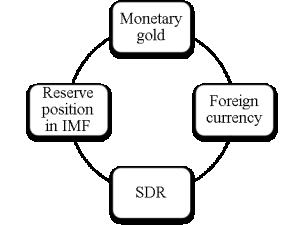
Fig. 1. Foreign exchange
reserves structure*
* Drawn up by the
author according to [1, p. 41-44].
As
shown in fig. 1, the structure of the central bank foreign exchange reserves contains
monetary gold, foreign currency, special drawing rights and reserve position in
the IMF.
Monetary
gold (stock of gold) – fine gold in the form of coins, ingots and powder of at
least 995 fine which is owned or controlled by the central bank or other public
authorities (e.g. Treasury ) [5, p. 347]. Gold reserve serves as an insurance
fund to obtain the particular foreign currency needed for the country to
maintain its international liquidity (because it is always possible to sell
gold in the world gold market). In addition, the stock of gold can be used as
collateral for the foreign loans in foreign currency.
An
important component of the foreign exchange reserves is the foreign currency
reserve that is registered on the NOSTRO accounts in the foreign banks and also
in the form of securities expressed in a foreign currency which are traded on
the international financial market. These securities include mainly treasury
bills and government bonds as the most reliable types of the stock instruments.
Securities transferred to the counterparties under securities loan operations
(issued in exchange for other securities) are included in the international
reserves while the securities for the collateral by the direct REPO
transactions are excluded from the reserves. Securities received as collateral
for the reverse REPO transactions or securities lending are not included in the
international reserves [3, p. 34]. A certain part of the foreign currency
reserves can be saved in cash in the central bank cash departments. The basic
currencies that are included in the foreign exchange reserves (and that is why
they are called the “reserve currencies”) are the following hard currencies:
U.S. dollar, euro, Japanese yen, British pound, Swiss franc and other which
bring the highest income.
Special
Drawing Rights – is a component of the foreign exchange reserves and is a
collective currency within the IMF which is shared between the member states
proportionally to their IMF quotas (according to art. XV of the IMF Statute).
The quota determines the amount of the subscription of the country to the IMF
capital, the possibility to use the Fund resources and, finally, the number of
votes that the country has in the Fund. The quota can be changed at the
suggestion of either the member state or the governing bodies of the Fund (but
only in case of approval of the corresponding state). The quotas amount of the
member countries are based on the economic value and the share in the world
economy and international trade. The terms of SDR came into force on 1 January,
1970. The main purpose of the SDR is the balance of payments regulation, the
official reserves replenishment and settlements with the IMF. SDR functionate
only at the international level as the entries on the IMF correspondent accounts
and accounts of the central banks of the IMF member states. In fact, the SDR is
a perfect IMF currency (which exists only in the form of entries on the
accounts), the exchange rate of which is based on the average currency basket.
Since 1 July, 1974 till 1 January, 1981 in the SDR basket there were 16
currencies, till 1 January, 1999 – 5 currencies (U.S. dollar, Japanese yen,
German mark, French franc and British pound). Since 1 January, 1999 up to date
– 4 currencies (U.S. dollar, euro, Japanese yen and British pound) [5, p.
587-588]. SDR basket is reviewed every 5 years.
Finally,
the last foreign exchange reserves component is the reserve position in the IMF
– the amount of the reserve share of a country in it and loans to it from the
IMF. Some authors [8, p. 59; 9, p. 44] incorrectly interpret this asset just as
the country's quota in the Fund because the reserve position is only 25 % of
the quota [1, p. 41]. Reserve quota share is the part of the contribution of
the state to the IMF that is paid in SDR or other hard currencies. And credit
position of the state in the IMF is the loans granted by the state under the
additional loan agreements [3, p. 38]. Getting by the government of the loans
from the IMF is carried out by purchasing of the foreign currency in exchange
for the national one.
We
should consider the structure of the NBU foreign exchange reserves in
1994–2013. (table 1).
Table 1
Structure of the NBU
foreign exchange reserves in 1994-2013*
|
As of 01.01: |
Foreign exchange reserves |
||||
|
Total, mln. USD |
Among them: |
||||
|
Monetary gold, % |
Foreign currency, % |
SDR, % |
Reserve position in IMF, % |
||
|
1994 |
166,0000 |
2,6506 |
97,3494 |
0,0000 |
0,0000 |
|
1995 |
664,4000 |
2,0620 |
70,7556 |
27,1824 |
0,0000 |
|
1996 |
1068,9000 |
1,7120 |
84,7881 |
13,4999 |
0,0000 |
|
1997 |
1971,6000 |
0,5884 |
96,0032 |
3,4084 |
0,0000 |
|
1998 |
2358,8000 |
0,7504 |
96,2354 |
3,0142 |
0,0000 |
|
1999 |
792,9000 |
3,9854 |
73,0105 |
23,0042 |
0,0000 |
|
2000 |
1093,6000 |
4,3160 |
89,6763 |
6,0077 |
0,0000 |
|
2001 |
1475,4000 |
8,3842 |
74,8001 |
16,8158 |
0,0000 |
|
2002 |
3089,5000 |
4,3405 |
87,5320 |
8,1275 |
0,0000 |
|
2003 |
4629,0000 |
5,9408 |
93,4327 |
0,6265 |
0,0000 |
|
2004 |
7068,0000 |
3,5512 |
96,3073 |
0,1556 |
0,0000 |
|
2005 |
10042,3800 |
2,2043 |
97,6405 |
0,1552 |
0,0001 |
|
2006 |
18582,4300 |
2,3477 |
97,5768 |
0,0754 |
0,0000 |
|
2007 |
22388,4600 |
2,3284 |
97,6118 |
0,0598 |
0,0000 |
|
2008 |
31841,5800 |
2,4268 |
97,5542 |
0,0190 |
0,0000 |
|
2009 |
28821,8400 |
2,6021 |
97,3042 |
0,0936 |
0,0001 |
|
2010 |
25285,5700 |
3,7539 |
95,9967 |
0,2493 |
0,0001 |
|
2011 |
35138,9800 |
3,3196 |
96,6574 |
0,0230 |
0,0001 |
|
2012 |
31364,1100 |
4,9442 |
94,7332 |
0,3243 |
0,0001 |
|
2013 |
24651,9600 |
7,7282 |
92,2343 |
0,0374 |
0,0001 |
* Calculated by
the author according to [6; 7, p. 533-534].
As
shown in the Table 1, during the analyzed period the foreign exchange reserves
structure had some changes but the general trend of the foreign currency
domination over the other components remained. Thus, in 1994 the share of this
component was 97.35 % but in a year it fell down to 70.76 % – this is due to
the introduction of SDR in 1995 which at once occupied almost one-third of the
total index. Till 1998 the assets valued in foreign currencies began to increase
their own share again on the background of reducing the SDR share, and in early
1999 the past situation repeated: SDR increased to 23%. In 2000-2001 there were
fluctuations in SDR and foreign currency shares and since 2002 the share of
foreign currency assets began to rise again. In 2005 there was a historic
maximum of 97.64 %. This situation war remaining for 2005-2008 and since 2009
the foreign currency share began to steadily decrease (small increase to the
level of 96.66 % was in 2011) and in early 2013 was 92.23 %.
The
share of monetary gold which in 1994 was 2.65% reduced to the level of 0.59% in
1997, showed growth in 1998-2001 and reached its historical maximum of 8.38%.
During 2002-2007 the share of gold with minor fluctuations was decreasing and
in 2007 was only 2.33%. However, starting from 2008, the index began to rise
again and in 2013 was 7.73%.
The
SDR component appeared in the foreign exchange reserves structure in 1995 and
at once occupied a significant share – 27.18% and till 2002 was nonuniformly
decreasing by demonstrating significant values in 1996 (13.5%), 1999 (23%) and
2001 (16.82%). Since 2003 until today, the SDR share is less than 1% and
demonstrates insignificant fluctuations.
Reserve
position of Ukraine in the IMF during the analyzed period has very low values
of about 0.0001%. For the first time this index appeared in the foreign
exchange reserves in 2005 but it has not significantly affected the structure
of these assets.
Table 2
NBU foreign exchange
reserves dynamics in 1994-2013*
|
As of
01.01: |
Foreign exchange reserves |
|||||||||
|
Total amount |
Among them: |
|||||||||
|
mln. USD |
Rin,
% |
Monetary gold |
Foreign currency |
SDR |
Reserve position in IMF |
|||||
|
Total,
mln.
USD |
Rin,
% |
Total,
mln.
USD |
Rin,
% |
Total,
mln.
USD |
Rin,
% |
Total,
mln.
USD |
Rin,
% |
|||
|
1994 |
166,0 |
– |
4,4 |
– |
161,6 |
– |
0,0 |
– |
0,0 |
– |
|
1995 |
664,4 |
400,2 |
13,7 |
311,4 |
470,1 |
290,9 |
180,6 |
– |
0,0 |
– |
|
1996 |
1068,9 |
160,9 |
18,3 |
133,6 |
906,3 |
192,8 |
144,3 |
79,9 |
0,0 |
– |
|
1997 |
1971,6 |
184,5 |
11,6 |
63,4 |
1892,8 |
208,8 |
67,2 |
46,6 |
0,0 |
– |
|
1998 |
2358,8 |
119,6 |
17,7 |
152,6 |
2270,0 |
119,9 |
71,1 |
105,8 |
0,0 |
– |
|
1999 |
792,9 |
33,6 |
31,6 |
178,5 |
578,9 |
25,5 |
182,4 |
256,5 |
0,0 |
– |
|
2000 |
1093,6 |
137,9 |
47,2 |
149,4 |
980,7 |
169,4 |
65,7 |
36,0 |
0,0 |
– |
|
2001 |
1475,4 |
134,9 |
123,7 |
262,1 |
1103,6 |
112,5 |
248,1 |
377,6 |
0,0 |
– |
|
2002 |
3089,5 |
209,4 |
134,1 |
108,4 |
2704,3 |
245,0 |
251,1 |
101,2 |
0,0 |
– |
|
2003 |
4629,0 |
149,8 |
275,0 |
205,1 |
4325,0 |
159,9 |
29,0 |
11,5 |
0,0 |
– |
|
2004 |
7068,0 |
152,7 |
251,0 |
91,3 |
6807,0 |
157,4 |
11,0 |
37,9 |
0,0 |
– |
|
2005 |
10042,4 |
142,1 |
221,4 |
88,2 |
9805,4 |
144,0 |
15,6 |
141,7 |
0,0 |
– |
(table
2 breakover)
|
2006 |
18582,4 |
185,0 |
436,3 |
197,1 |
18132,1 |
184,9 |
14,0 |
89,9 |
0,0 |
40,0 |
|
2007 |
22388,5 |
120,5 |
521,3 |
119,5 |
21853,8 |
120,5 |
13,4 |
95,5 |
0,0 |
100,0 |
|
2008 |
31841,6 |
142,2 |
772,7 |
148,2 |
31062,8 |
142,1 |
6,0 |
45,1 |
0,0 |
250,0 |
|
2009 |
28821,8 |
90,5 |
750,0 |
97,1 |
28044,9 |
90,3 |
27,0 |
446,9 |
0,0 |
300,0 |
|
2010 |
25285,6 |
87,7 |
949,2 |
126,6 |
24273,3 |
86,6 |
63,0 |
233,5 |
0,0 |
100,0 |
|
2011 |
35139,0 |
139,0 |
1166,5 |
122,9 |
33964,4 |
139,9 |
8,1 |
12,8 |
0,0 |
100,0 |
|
2012 |
31364,1 |
89,3 |
1550,7 |
132,9 |
29712,2 |
87,5 |
101,7 |
1258,7 |
0,0 |
100,0 |
|
2013 |
24652,0 |
78,6 |
1905,2 |
122,9 |
22737,6 |
76,5 |
9,2 |
9,1 |
0,0 |
100,0 |
* Calculated by
the author according to [6; 7, p. 533-534]. Rin – rate of increase.
According
to the analysis of the foreign exchange reserve structure the largest share has
foreign currency and this share is close to 100% that means that this component
has a crucial importance in the use of reserves. Next in importance is the
monetary gold. Although it did not show a significant share (was not exceeding
10%) its share remained at the same level. The SDR share was nonuniformly
fluctuating but for over the last 10 years has not played a significant role. A
similar statement applies to the reserve position in the IMF. The next step in
the NBU foreign exchange reserve study is the analysis of their dynamics in
terms of the components (Table 2).
As
shown in the Table 2, the foreign exchange reserves changes were characterized
by the significant nonuniformity. Thus, in 1994-1998 the reserves total amount
increased from 166 million USD to 2358.8 million USD.
After
decreasing in 1998 to a level of 792.9 million USD in early 1999, during
2000-2008 the reserves were only increasing and reached in 2008 the amount of
31841.6 million USD. Another decreasing in 2008 till the level of 28821.8
million USD changed by gradual growth in early 2009 and in 2011 the foreign
exchange reserves reached its historical maximum of 35139 million USD. However,
starting from 2012 and until now there has been a sharp reduction and as of
01.01.2013 the reserves amounted only to 24652 million USD.
It
should be noted owing to which components there were changes in the total
volume: an increase in 1994-1998 was mainly caused by the increasing of the
foreign currency volume. The first decreasing (1999) was accompanied by a
reduction of the above-mentioned component on the background of growth of SDR
and monetary gold. The next period of growth (2000-2008) is caused by
increasing both of the foreign currency and monetary gold and also by a new
component that appeared in 2005 (reserve position in the IMF) but the volumes
of SDR were just reducing. The change of the reserves level in 2009 occurred
due to the decline of the gold and foreign currency volumes and a simultaneous
increase of the SDR. The positive trend of 2010-2011 was characterized by
corresponding changes in two of the four indicators (excluding SDR and reserve
position in the IMF). Finally, the reduction since 2012 is due to a reduction
of all indexes except monetary gold (which has slightly increased).
There
are the following ways to use the foreign exchange reserves that are defined in
the Law of Ukraine “On the National Bank of Ukraine”: sale of the currency on
the financial markets for monetary policy purposes, including exchange rate
policy and also transactions with foreign currency, monetary metals and other
reserve assets [4, p. 48]. These provisions of the Law are not perfect because they
do not specify on which financial markets – internal or external – can be
carried out the sale of the currencies. The law does not allow the foreign
exchange reserves to be used for loans, guarantees and other commitments to
residents and non-residents of Ukraine [4, p. 48].
Thus,
despite the fact that there is no a unified definition of “foreign exchange
reserves” we managed to give a common approach of the modern economists to this
category. In addition, we have adduced the typical FX reserves components,
described their economic nature and analyzed the structure and dynamics of the
NBU foreign exchange reserves.
In
summary, from the conducted research it follows that the foreign exchange
reserves of the country play a significant role in its national economy. Their
importance especially increases in times of unstable economy, financial,
currency and other crises, restructuring of economy and transition to new
patterns of business relationship in the country.
Reference
list:
1.
O. Butuk. Monetary and financial
relations [Text]: tutorial/ O. Butuk. – К.: Znannya, 2006. – 349 p.
2.
O. Dzyublyuk. Monetary policy
[Text]: textbook / O. Dzyublyuk. – К.: Znannya, 2007. – 422 p.
3.
B. Lapchuk. Monetary policy [Text]:
tutorial / B. Lapchuk. – К.: Znannya, 2008. – 212 p.
4.
On the National Bank of Ukraine
[Electronic resource]: Law of Ukraine as of May 20, 1999 №79-XIV. – Access
mode: http://zakon2.rada.gov.ua/laws/show/679-14
5.
L. Ryabynyna. Money and credit
[Text]: tutorial / L. Ryabynyna. – К.: Centre of educational literature, 2008.
– 602 p.
6.
State of international reserves and
foreign currency liquidity [Electronic resource] / – Access mode:
www.bank.gov.ua/doccatalog/document?id=46944
7.
The central bank and monetary policy
[Text]: Textbook / Joint authorship.: А. Moroz, M. Puhovkina, M. Savluk
etc.; By edition of Dr.sc.oec, professor. А. Moroz and Ph.D. in Economics,
associated professor M. Puhovkina. – К.: KNEU, 2005. – 556 p.
8.
T. Shemet. Theory and practice of
the foreign exchange rate [Text]: tutorial / By edition O.Rogach. – К.: Lybid,
2006. – 360 p.
9.
V. Yushchenko. Currency regulation
[Text]: tutorial / V. Yushchenko, V. Mishchenko. – К.: Znannya, 1999. – 359 p.