Политология/2. Политическая конфликтология
Polyakov E.M.*, Panchenko E.K.**
Voronezh State University, Russia
*PhD in Political
Science; **Student of Political Science
Event analysis of the political
conflict in Ukraine
(November 2013 - February 2014)
Political
conflict in Ukraine began as a reaction of the population to an abrupt change
in the course of the government and the president. Series of actions and
miscalculations parties to the conflict have contributed to its deployment and
escalation, which eventually led to many casualties, protracted
multidimensional crisis and complicate the situation in the country.
For this
conflict is typical diversity and multiplicity of actions of actors that need
to organize, to assess the situation, identify the overall dynamics of the
conflict, to follow the laws of its development and the styles of conflict
behavior of the parties. To perform the above steps, we have used the method of
event analysis, because it can help to systematize the behavior of conflict’s
parties.
Confrontation
of forces within the political system was a factor that influenced the
development of warfare on the streets of Kiev and other Ukrainian cities. Thus,
the subjects of the conflict were the presidency, as well as change or retain
the constitutional rules of the political game.
During this
event analysis was the action of two opposing parties, conventionally called
the “authority” and “opposition” under consideration. Select the category name
can be explained, revealing the main actors of these parties. The category of “authority”
included: President Viktor Yanukovych, the Ukrainian government (including
individual agencies), the Party of Regions (hereinafter – PR) as well as the
Communist Party of Ukraine (hereinafter – CPU).
In the category
of “opposition” includes: the opposition parties of the Verkhovna Rada
(“Bat’kivshina”, “Udar”, “Svoboda”), as the main actors in intra-conflict
(along with the President, the Government and the Party of Regions), as well as
social structure “Maidan”, “Right sector” and many other members of the opposition presidential
power during the study period. It is obvious that the executive branch, with an
impressive support in parliament (PR, CPU), is concentrated in the hands of the
parties to the conflict, included in the first category.
The
chronological terms of this issue (21 November 2013 – 22 February 2014) due to
key events in the studied conflict: 21 February, the government suspended the
preparations for the signing of the Agreement with EU, which was the direct
reason for the start of protests on 22 February PR and CPU went into opposition
“new power”, and disappeared from the conflict one of its main subjects –
Viktor Yanukovych. Thus,
the objects of study are the opposing sides of the conflict, and the subject –
attacks of the parties over the study period. Actions of the both sides are
classified into physical and verbal, are also split into hostile, neutral and
cooperation actions with respect towards each other.
It is
important to note that during the analysis did not consider Ukrainian news
sources, due to the situation, the information counter in a country where the
media are distributed among interested in different outcomes conflict owners. The
overall dynamics of the conflict can
be represented graphically in the
form of time series of indicators
of physical shares hostile parties as a
direct manifestation of the
conflict.
Figure
1. Dynamics physical hostile actions “authority” and “opposition”.
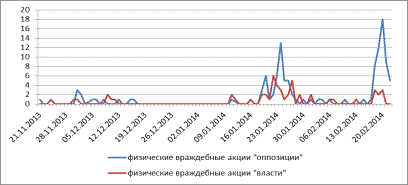
Given in
Figure 1. Dynamics allows to empirically determine the beginning of the
conflict escalation and radicalization (from 19 February), which contributed to
the onset of the president's policy (January 16 adoption law toughening
responsibility for illegal mass actions), and the actions of the opposition of
a number of radicals.
Bivariate
correlation coefficient of performance schedule is 0.51, suggesting that the
average power of direct communication. We can therefore conclude that, despite
the close relationship of action, physical hostile actions were not always in
response to the opponent's actions, which can be clearly seen in the graph.
Table 1. The results of the event analysis.
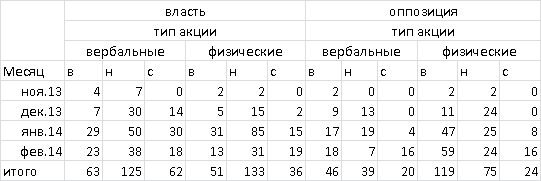
From the
above table shows the prevalence of verbal actions by the “authority” is
especially interesting that the total number of shares aimed at cooperation in
virtually equal to the number of hostile. From this we can conclude the
apparent indecision “Udar” party to the conflict, as well as the lack of a
clear plan of action. At the same time, shares of verbal “opposition” have the
double advantage of hostile actions. Moreover, the number of shares of hostile
verbal grew during each month.
Among verbal
shares “authority” dominated neutral. This distribution can be explained by
numerous verbal procedures (applications, references, etc.) the president and
his supporters, both parties to the conflict, and in the process of executing a
job (Ministerial Declaration, the President's address, etc.). Neutral verbal
action “opposition” prevailed during December and January, giving primacy
hostile shares in February, when the conflict radicalized.
Analyzing
stocks Cooperation (verbal and physical) parties to the conflict, it should be
noted a clear superiority of such actions on the part of the “authority”. It
clearly says that in the process of deepening contradictions and escalating
tensions (January-February), the president's supporters tried to broaden the
dialogue to find a compromise with the “opposition”. In January, the opposition
supporters as actively moving toward cooperation with the president and his
supporters, in February this trend is changing towards demonstrate greater
activity and interest in the de-escalation, resulting in a compromise reached
on February 21. Considering
the overall “contribution’ of the two main parties to the conflict, optimally
present it graphically. Visualization of time series of indicators facilitate
comparison.
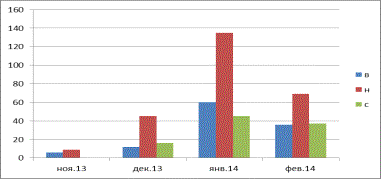
Histogram 1.
Cumulative index shares the president's supporters.
Histogram 2.
The aggregate shares of opposition supporters.
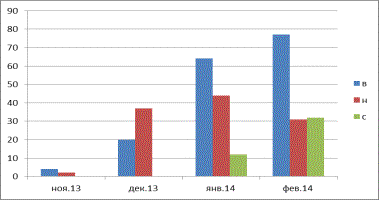
From the
above histograms obvious increase hostile actions of the parties, however,
while the “opposition” continued to increase the number of hostile actions, the
president's supporters reduced him. Also evident in the graphs above argument
about the growth potential of cooperation in opposition, but set a maximum
aggregate hostile actions that can be attributed to a split among the
opposition forces, in particular the non-recognition of the armistice the
president and opposition factions nationalist organization “Right sector”,
which was mobilized during considerable period (January-February).
Comparing the
figures of hostility and cooperation of the both side of conflict, represented
in the Histogram 1 and 2, we can see, that the growth of tension and deepening
contradictions (as a consequence of the strengthening of the forces of the
opposition) supporters of the president increasingly reluctant to cooperate.
This trend actually ends in January, when the hostile actions of the parties
reach parity, suggesting that the work of the above patterns in the opposite
direction, leading to an increase in the tendency to cooperate in the
“opposition”.
Taking into
account that the figures do not reflect the histograms in the balance of power
should be considered a convention of such a law. Despite the large number of
hostile actions “opposition” in February, it should be remembered that the
security forces, which had long been in a state of defense, periodically go on
the offensive to recapture that often failed to opposition forces. In many
ways, this factor, namely the real power factor, played a role in the growth index
of cooperation “opposition”.
Thus, on
February 22 after fleeing Yanukovych and the balance of forces of the opposing
sides, the conflict appeared extinguished, keeping a dangerous potential for
future deployment. Actually, the current events in Ukraine are also a
consequence of unresolved conflict.
Based on the
identified conflict behavior style of opposition supporters, can be considered
a natural methods new central government (the former opposition) to resolve the
contradictions in the south-east of Ukraine at the moment, as well as
determination and lack of alternative views on the current problematic
situation, which was awarded after the escalation of the conflict in
January-February 2014.
References:
1. N. Zinets,
P.Polityk. Khronologiya – Ukrainskiy “Evromaidan” (Chronology – the Ukrainian
“Euromaidan”). http://ru.reuters.com/article/topNews/idRUMSE9BG03Q
20131217?pageNumber=1&virtualBrandChannel=0&sp=true.– Date Views: 25.04.14
2. Tekushie sobytia
na Ukraine (Current events in Ukraine). http://www.gazeta.ru/subjects/ukraina_es.shtml.–
Date Views: 27.04.14
3. Krisis na
Ukraine (Crisis in Ukraine). http://itar-tass.com/krizis-na-ukraine.– Date Views: 15.04.14