Sankov
P.N, Tkach N.A, Bliznyuk A.N., Tyoshina L.O. Architectural and construction
methods for providing acoustic safety in the residential area
*228389*
ЭКОЛОГИЯ/2.Экологические и
метеорологические проблемы
больших городов и промышленных зон.
УДК 628.517.2
Ph.D., Assoc. prof.
Sankov P.N, Ph.D., Assoc. prof. Tkach N.A,
Master of architecture
Bliznyuk A.N., student Tyoshina L.O.
Prydniprovs’ka State Academy
Architectural
and construction methods for providing acoustic safety in the residential area
Relevance: in the context of the existing buildings, the issue of providing
acoustic security for residential areas located in close proximity to motorways,
in which noise is a harmful factor of environmental pollution is vital.
Goal: providing acoustic safety in the premises of
residential buildings and on the residential areas.
The
goal is achieved by solving the following tasks:
2.
Determine
the level of noise pollution in the residential area from vehicles using the
full-scale instrumental measurements.
3.
Performing
an analytical review of the existing system of sanitary, technical and
construction rationing in the field of noise protection in
4.
Comparison
of the results of full-scale instrumental measurements with the existing
standard of acceptable noise and the determination of deviations from them.
5. Development of practical recommendations on noise
protection of residential areas and determination of their economic value.
General
part. As a research
object, the building at
The territory of the residential building along
Taking into account the provisions of the existing
Sanitary Norms and State building norms of
а) for living
rooms of apartments, for day and night time, the normatively permissible
noise levels are presented below in the table 1:
Table 1
|
Part
of day |
LAeq,
dBA |
|
From
|
40 |
|
From 10 p.m to |
30 |
б) in areas directly adjacent to
residential buildings, for day and night time, the normatively permissible
noise levels are presented below in the table 2:
Table 2
|
Part
of day |
LAeq,
dBA |
|
From
|
55 |
|
From 10 p.m to |
45 |
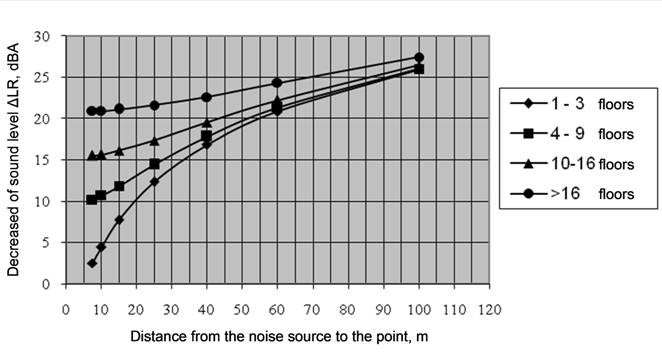
Figure 1 Decreasing of the sound level on the facades
of the first echelon of buildings with the increasing in the size of the
contact butt zone
To achieve the norm of permissible noise in the living
rooms of apartments, it is proposed to use the method - noise-proof windows as
the main noise protection measure. For each first echelon building, noise
levels are determined in
Table 3
|
Number of storeys |
Calculation of the cost of soundproof windows for
the first echelon of building at Polya Avenue |
|||||
|
G class |
D class |
Total |
||||
|
∆LА w= 28 -30 dBA |
∆LА окна= 25 -27 dBA |
|||||
|
Кw = 2800 UAH. |
Кокна = 2300 UAH. |
|||||
|
Number of windows (Ni), th |
Cost of windows, UAH |
Number of windows (Ni), th |
Cost of windows, UAH |
Number of windows, th |
Cost of windows, UAH |
|
|
2 |
48 |
134400 |
32 |
73600 |
80 |
208000 |
|
3 |
256 |
716800 |
120 |
276000 |
376 |
992800 |
|
4 |
72 |
201600 |
316 |
726800 |
388 |
928400 |
|
5 |
1536 |
4300800 |
1956 |
4498800 |
3492 |
8799600 |
|
6 |
32 |
89600 |
60 |
138000 |
92 |
227600 |
|
9 |
67 |
187600 |
809 |
1860700 |
876 |
2048300 |
|
12 |
42 |
117600 |
462 |
1062600 |
504 |
1180200 |
|
Total number
of soundproof windows Σ Ni, th |
5808 |
|||||
|
Total cost of
soundproof windows Кgen = Σ Кw х Ni, millions
of UAH |
14,4 |
|||||
Conclusions: 1. For the
first echelon of buildings on Polya Avenue, it is necessary to use 2053 G-class
windows and 3755 D-class windows of soundproofing class and 1111 windows of
lower soundproofing class (their number and cost are not taken into account in
table 3). 2. Total cost of soundproof windows Кgen = 14,4 millions of UAH.
Literature
1. Sankov P.N.,
Тkach N.А (2013), «Improvement of algorithm of localization of noise pollution
of inhabited territories for the purpose of ensuring acoustic safety in
dormitory areas of the cities», Nauchnaia diskussiia: voprosy tekhnicheskikh
nauk. Materialy VIII mezhdunarodnoi zaochnoi nauchno-prakticheskoi konferentsii
[Scientific discussion: questions of technical science. Materials VIII of the
international extramural scientific and practical conference], Moscow, Russia,
April 04, 2013, pp. 145 -150.
2. Sanitary
norms of admissible noise in rooms of
residential and public buildings and in the territory of the housing estate: SN
3077-84/ МZ
3. Protection
of territories, buildings and structures from noise: DBN V.1.1 - 31: 2013. -
[Effective from 2013-12-27] - K .: Minregion of Ukraine, 2014 - 54 p. - (State
building regulations).