R.I. Shishkov
Kuzbass State Technical University, Kemerovo Russian Federation
S.M. Tagiev
Kuzbass State Technical University, Kemerovo Russian Federation
A.V. Remezov
Kuzbass State Technical University, Kemerovo Russian Federation
STUDY
OF ROCK PRESSURE AND ITS FORMS IN THE CONDUCT CLEANING WORKS (PART I)
Annotation: analysis of the factors determining the formation of the reference pressure in the zones of influence of geomechanical and advanced treatment developments.
Keywords: geomechanics , rock pressure , voltage , roofing
Rocks array is a heterogeneous environment , the structure of which is characterized by natural planes of weakness associated with the genesis of rocks , so the implementation of the shift there is a combination of the following factors : physical and mechanical properties of rocks ; strained state of the array ; by structural weakening , and their orientation in space of principal stresses [ 1 ] .
The intensity and duration of stress redistribution in the rocks around the treatment workings are more complex than around development workings and areas the size of a new stress-strain state is much more than around development workings , which is mainly due to the fact that the sewage treatment works moonlighting rock mass at significant areas .When driving on the cutting stope roof generate immediate, more exposed, and works in a similar plate attached to the four-sided circuit, ie, the four sides of the production. In developing the plate bending strain, which lead to the immediate collapse of the first roof. The maximum span of the first collapse of the roof just after the departure of the working face of the split-step generation called her initial collapse of LH. NCR. The amount of LH. NKR reaches 18-20 m, and the conditions for Kuzbass mines it usually is within 8-15 meters.
            Further stope collapse occurs periodically rock the immediate roof . Spans caving in this mode is called steady- step immediate collapse of the roof lу.н.кр.

For the coal mines in Kuzbass lу.н.кр ≈ (0,4-0,5) lн. нкр.
In
the process of the destruction of the immediate roof rocks form a kind of zone
, called zone of intense crushing and intense disintegration . In the
subsequent sealing takes place in this zone , and in some cases - caking breed.
This pattern of failure is observed mainly in thin-layered and fractured
argillites , siltstones and other breeds with high plastic properties . The
coefficient of loosening the lowest layers of the immediate roof Кр = 1,6-1,8, for the top layers and reduced to Кр
= 1,1-1,15.
The
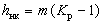
height of the roof caving zone close hнк can
be calculated using the formula :
 (1)
(1)
where
m - the capacity of the reservoir
The span of the main roof caving in
this mode is called a step steady collapse of the main roof . According to the
observations of mine in Kuzbass conditions
lу.окр ≈(0,4-0,5) lн.окр=12-25 м.
In some cases, into blocks destruction of the roof is the result of the bending of layers and keeping them on the destroyed rocks close the roof , in the other - in the form of a cut-off short blocks orderly fall on soil formation or orderly moving without loss of individual blocks of the overall system.
The scheme of the destruction of roof rocks in a steep fall in the formation plane (according to the results of studies prof . AA Borisov ) is shown in Fig . 1, a diagram of the interaction of the direct and the main roof in section on Figure fall 2.
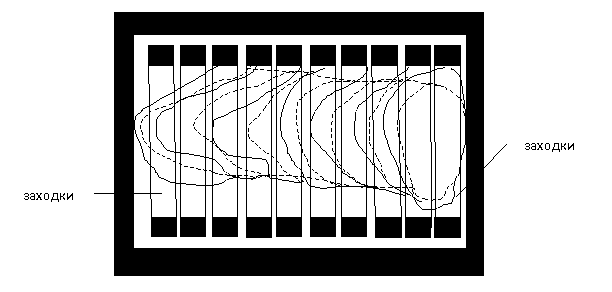

Fig. 1. Scheme of the destruction of roof rocks in the steep seam plane When a steep drop as departing from the rear pillar increase host rock outcrops , and hence the stacking order of deformation is largely similar to those of the canopy of the fall, but only in the upper half of the roof and partially expose the bottom .Sliding rocks in the soil bedding plane prevents the holding force ( frictional force ) Руд, determined from the expression :
 (2)
(2)
where in the Рн - the force acting normal to the bedding soil rocks ( the normal force); fтр - the coefficient of friction on the surface of the rock crawl.
Bibliography:
1.
1. Artemiev, B. V. Mining mechanical
/ B. V. Artemyev, G. I. Korshunov, A. K. Loginov [et al.] – St. Petersburg:
Nauka, 2011. – 102.
2.
2. Egorov, P. V. Geomechanics / P.
V. Egorov, G. G. Stumpf, A. A. Renev [and others]. – Kemerovo, 2002. -239 C.