Master in Natural
Science Gulmira Abileva
Department of Biology and Chemistry, A.
Baitursynov Kostanay State University, Kostanay, Kazakhstan
BIOMORPHOLOGICAL
ANALYSIS OF HIGHER VASCULAR PLANTS OF THE STATE NATIONAL NATURAL PARK “BURABAY”
The
extensive impact of the anthropogenic factor on the flora and vegetation leads
to the global problem of conservation of biodiversity, which is the most
important biological indicator of the biosphere state and biomes, its
components. The loss of biodiversity is one of the most complex issues, as it
is impossible to renew extinct species. The conservation of biological
diversity is recognized as one of the most important priorities of the
transition to sustainable development of Kazakhstan. When studying biodiversity
of the flora of regions, different floristic researches are conducted. Here the
important role is with the analysis of plants life forms, which is one of the
main characteristics giving an opportunity to estimate current state of flora
and an important indicator of estimation of the research of biodiversity of
floristic object.
The
life form concept is used in scientific research specifically as a separate
category [1-3] and as one of the evaluation criteria of flora in floristic
works in Kazakhstan [4-6] and near and far abroad [7-9].
Presently
in the world is widespread using of two main classifications of plants life
form: 1) by K. Raunkiaer, who is author of the most common plants life form
system based on the landscape and bionomic geography of vegetation [10],
offered by K. Raunkiaer life forms types gave basis for
contemporary system of life forms, its most developed variant was created by D.
Myuller-Dembua and G. Ellenberg [11]; 2) I. G. Serebryakov’s ecological-morphological
classification [12].
I.
G. Serebryakov’s system of life forms is convenient for regional usage when
studying life forms composition of individual region’s flora, when a limited number of ecomorph found in the
studied area is selected. For reviews on a global scale or a scale of entire
continents using Myuller-Dembua – Ellenberg’s compact system or more
generalized systems of plants functional types are more convenient [11].
Life forms indicate features of
the environment, e.g. climate or soil, through the specifics of the growth and
development of plants in the prevailing soil-climatic and coenotic conditions.
Environment influences the form by changing the life of an organism, especially
through changes in the intensity and direction of growth and life span of its
vegetative organs [12].
Life
form is the aggregate of a grown up individual of the given species in the
certain growth conditions, having a kind of general appearance (habitus) including above-ground and underground
organs (underground shoots and root system). Ontogenetically this habitus
occurs as a result of growth and development in certain environments, and
historically it appears in specific soil-climatic and coenotical conditions as
a result of plant adaptation to these conditions [12].
Life
forms have a significant difference from environmental groups because they
reflect the adaptation of plants not to a single environmental factor, but to a
historically formed complex of factors.
The
objective of this study is to research the biomorphological structure of
vascular plants flora of the Natural Park “Burabay”. In order to achieve the
objectives, the following tasks were solved:
-
to study the distribution of higher plants species of the studied area according
to K. Raunkiaer’s life forms "biological spectrum";
-
to identify the distribution of higher plants species in the studied flora
according to I. G. Serebryakov’s life forms system.
The
object of this research is flora of the State National Natural Park “Burabay”
(SNNP).
The
subject of the study is plants life forms comprising biomorphological structure
of the under reserach object’s flora and their analysis.
SNNP
“Burabay” has status of environmental and scientific institution and is
included in the system of specially protected natural territories of Republican
importance, intended for the conservation of biological and landscape
diversity, also for using of unique natural complexes and objects of the state
natural reserve fund in the environmental, scientific, ecological, educational,
tourist and recreational purposes, which have special ecological, scientific,
historical, cultural and recreational value. The total area of the SNNP
“Burabay” is 129 935 ha [13].
In
the geomorphological respect the area is the most elevated part of the northern
margin of Central Kazakh Upland. Relief of this territory represents a complex
combination of the low mountains, hills and plains, which are rarely crossed by
small river valleys and lake basins, the formation of relief occurred in the
continental conditions during Meso-Cenozoic time and on the basis of
correlative analysis of the sediments can be subdivided into the following
stages of relief formation: before Eocene; middle-upper Oligocene and
Quaternary. The territory forms a unique for the Northern Kazakhstan landscape
represented by low mountains, freshwater lakes, pinery or mixed
deciduous-coniferous forests. The area is characterized by a sharply
continental climate with harsh, little snow winters and hot summers but in the
oasis “Burabay” it is considerably softened due to the influence of mountains,
lakes and forests [14].
Studies
were performed using route-reconnaissance method and method of concrete flora.
During the field work the area of 10 forestries of the Natural Park:
Akylbayskoe, Borovskoe, Katarkolskoe, Zolotoborskoe, Mirnoe, Barmashinskoe,
Priozernoe, Temnoborskoe, Jalaiyrskoe and Bulandinskoe forestries were
examined; four expeditions were organized and carried out. As a result of the
field work more than 2000 herbarium sheets of higher vascular plants were
collected.
The
processing, determination and comparison of plants were conducted using
taxonomic [15], herbarium methods, biomorphological analysis according to I. G.
Serebryakov, K. Raunkiaer and R.V. Kamelin’s [16] classifications and
morphological-geographical method.
The
basis of the research is the materials and results of field-based data and
laboratory research carried out from 2011 to 2014, generalization of all the available scientific sources and herbarium collections, which
are stored at the Department of Biology and Chemistry of A. Baitursynov KSU.
On
the basis of source data [15] and our own collecting, 636 species of higher vascular plants were found on the territory of the
SNNP “Burabay”.
As
a result of the research, plants were analyzed according to K. Raunkiaer’s
biological spectrum of vegetation and I. G. Serebryakov’s
ecological-morphological classification.
The
analysis of plants life forms of the Natural Park “Burabay” by I. G.
Serebryakov is represented in Figure 1 and in Table 1.
Fig. 1. The proportion of life form types according to
I. G. Serebryakov’s
system
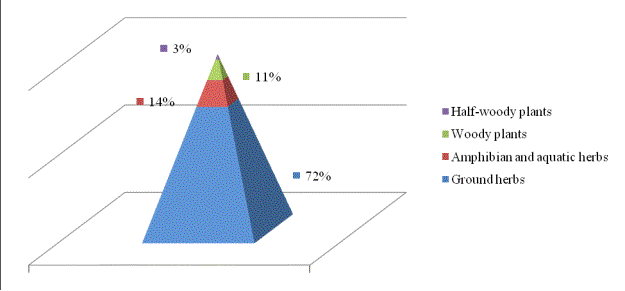
Table 1
The biological spectrum of plants life forms of the Natural Park
“Burabay” according to I. G. Serebryakov
|
№ |
Life form |
Species number |
% from the total number of species |
|
1 |
2 |
3 |
4 |
|
|
I. Woody
plants |
69 |
10.8 |
|
1 |
Deciduous monocormic
trees |
12 |
1.9 |
|
2 |
Evergreen trees |
2 |
0.3 |
|
3 |
Bush trees |
16 |
2.5 |
|
4 |
Deciduous erect
shrubs |
28 |
4.4 |
|
5 |
Deciduous crawl
shrubs |
1 |
0.2 |
|
6 |
Evergreen
shrubs |
2 |
0.3 |
|
7 |
Creeping-rooted shrubs |
3 |
0.4 |
|
8 |
Deciduous subshurbs |
1 |
0.2 |
|
9 |
Evergreen
subshurbs |
4 |
0.6 |
|
|
II. Half-woody
plants |
19 |
3 |
|
10 |
Erect half-shrubs
(ПКП) |
3 |
0.5 |
|
11 |
Crawl half-shrubs (ПКС) |
3 |
0.5 |
|
12 |
Evergreen
crawl half-shrubs |
1 |
0.2 |
|
13 |
Erect
half-subshrubs |
7 |
1 |
|
14 |
Crawl
half-subshrubs |
4 |
0.6 |
|
15 |
Evergreen
half-subshrubs |
1 |
0.2 |
|
|
III.
Ground herbs |
458 |
72 |
|
16 |
Horsetails |
8 |
1.3 |
|
17 |
Ferns
|
13 |
2 |
|
18 |
Club mosses |
3 |
0.5 |
|
|
Polycarpics |
323 |
50.7 |
|
19 |
Taproots |
91 |
14.3 |
|
20 |
Fibrous roots |
19 |
3 |
|
21 |
Shot rhizomes |
41 |
6.5 |
|
22 |
Long rhizomes |
94 |
14.8 |
|
23 |
Tufteds |
13 |
2 |
|
24 |
Loose-bunchs |
20 |
3.1 |
|
25 |
Above- and
under-ground stoloniferous |
16 |
2.5 |
|
26 |
Creeping-rooteds |
2 |
0.3 |
|
27 |
Tuber forming |
9 |
1.4 |
|
28 |
Bulbous |
9 |
1.4 |
|
29 |
Lianoids |
9 |
1.4 |
|
|
Monocarpics |
105 |
16.5 |
|
30 |
Perennials
and biennials |
40 |
6.3 |
|
31 |
Annuals |
65 |
10.2 |
|
32 |
Half-parasitical
and parasitical |
6 |
1 |
|
|
All
of the ground vascular plants: |
546 |
85.8 |
|
|
IV.
Amphibian herbs |
79 |
12.4 |
|
33 |
Fibrous
roots |
6 |
1 |
|
34 |
Shot
rhizomes |
20 |
3.1 |
|
35 |
Long
rhizomes |
30 |
4.7 |
|
36 |
Tufteds |
7 |
1.1 |
|
37 |
Loose-bunchs |
6 |
1 |
|
38 |
Above- and
under-ground stoloniferous |
1 |
0.1 |
|
39 |
Tuber
forming |
2 |
0.3 |
|
40 |
Perennials
and biennials |
1 |
0.1 |
|
41 |
Annuals |
6 |
1 |
|
|
Aquatic
herbs |
11 |
1.7 |
|
42 |
Floating
|
11 |
1.7 |
|
|
All
of the amphibians and aquatics: |
90 |
14.1 |
|
|
Total: |
636 |
100 |
The
life forms spectrum according to I. G. Serebryakov’s system is presented by 42
classes of plants, 9 classes of them are woody, half-woody plants comprised 6
classes, ground herbs - 17 classes, amphibians and aquatics – 10 classes.
Among
4 life form types ground herbs prevailed strongly - 458 species comprised 72%
of the total species number, followed by amphibians and aquatic herbs with 90 species
(14.1%). Next type of amphibian and aquatic herbs consists of 14.1%. In the
third place are woody plants such as rare species Alnus glutinosa – 10.8%, and
the lowest percentage belongs to the half-woody plants – 3%.
In
the first type woody plants type shrubs are prevailing with 5.3%. They are more
developed near the continental borders of woody vegetation and are presented by
Juniperus sabina, Berberis oblonga, Amelanchier ovalis, Rosa majalis, Spiraea
hypericifolia, Grossularia acicularis and other species.
The
second type occupies only 3% of the total species number and is represented by
half-shrubs and half-subshrubs, the inhabitants of arid regions spreading along
the banks of rivers and streams such as Thymus asiaticus, Thymus marschallianus,
Onosma simplicissima, Artemisia absinthium, Oxycoccus palustris and many other
species.
The
third type is ground herbs represented by wide spectrum of classes, among their
polycarpic herbaceous plants are dominant – 50.7% and characterizing moderately
cold zone with continental climate, next follow monocarpic herbs – 16.5%
spreading in arid regions of the temperate zone of northern hemisphere, classes
of ferns - 2%, horsetails – 1.3%, club mosses – 0.5% and parasitical and
half-parasitical such as Euphrasia pectinata, Melampyrum cristatum, Odontites
vulgaris - 1% .
Among
polycarpic plants long, rhizomes herbs dominate – 14.8% they are characterized
by forest, meadow habitats with aerated, moist soil (Cypripedium calceolus,
Thalictrum simplex, Pyrola chlorantha, Galatella divaricate, Inula britannica).
Taproots herbs comprise 14.3% and are characterized by steppe and meadow
habitats with permeable oxygen soils (Pulsatilla flavescens, Eremogone
koriniana, Oberna behen,
Moneses uniflora, Potentilla approximata). Shot
rhizomes take 6.5%, they are are meadow plants of forest zone (Adonis vernalis,
Adonis wolgensis, Myosotis sylvatica, Iris sibirica, Polygonatum odoratum).
Loose-bunch polycarpics get 3.1%, they are meadow plants of forest zone too
growing in light aerated soils (Carex pediformis, Leymus akmolinensis, Poa
nemoralis, Puccinellia distans). Fibrous roots (3%) are meadow perennials of
forest zone, which grow in damp meadows with poorly aerated heavy soils with
high humifying (species of genus Ranunculus, Tephroseris integrifolia, Geranium
sylvaticum, Primula longiscapa). Above- and under-ground stoloniferous plants
(2.5%) indicate wet, excessively humid habitats with loose, marginal, becoming
peaty soil – forests and marshes (Ranunculus repens, Viola mirabilis, Fragaria
vesca, Fragaria viridis, Potentilla anserina). Tufted herbs (2%) characterize
habitats with poor soil aeration - steppes, strongly turfing meadows and
marshes (Dianthus acicularis, Koeleria cristata, Stipa pennata, Stipa
capillata, Festuca valesiaca). Bulbous (Tulipa patens, Fritillaria meleagris,
Allium pallasii, Allium rubens) (1.4%) and tuber forming polycarpics
(Dactylorhiza majalis, Dactylorhiza fuchsia, Valeriana tuberosa, Filipendula
vulgaris) (1.4%) characterize arid habitats. A small percentage of lianoid
polycarpics (1.4%) indicates climate of temperate zone (Humulus lupulus,
Convolvulus arvensis, Lathyrus palustris, Lathyrus pratensis, Vicia cracca).
Creeping-rooted herbaceous plants occupy the smallest share of 0.3%. These plants
are capable of vegetative reproduction (Anemone sylvestris, Galega orientalis,
Lactuca tatarica).
The
type of amphibian and aquatic herbs occupying 14.1% indicates humidity of
climate, which is associated with a large number of wetlands. They include the species such as Drosera rotundifolia, Nymphaea candida, Caltha palustris, Veronica
anagallis-aquatica, Utricularia intermedia, species of Potamogeton genus and
others.
Thus,
the results indicate that the largest percentage (50.7%) is occupied by polycarpic
plants, then follow monocarpic herbs (16,5%), next amphibian and aquatic herbs
(14.1%), woody (10.8%) and half-woody (3%), that corresponds to the moderately
cold zone with continental climate and with the degree of aridity and humidity.
For
botanical and geographical analysis, the system of life forms offered by Danish
botanist K. Raunkiaer is used. K. Raunkiaer’s life forms separation system is
based on one feature - difference in the plants adaptation to the experience of
unfavorable seasons that is the location of the buds or the tops of shoots
during unfavorable time of year regarding the soil surface [12].
In
the flora of the Natural Park “Burabay” according to K. Raunkiaer’s system, the
following life forms were allocated:
phanerophytes –
with reproduction buds 30 cm above the soil;
chamaephytes –
with reproduction buds above the soil or not higher 20-30 cm;
hemikryptophytes – with reproduction
buds in the surface layer of soil and often are covered by litter;
kryptophytes –
with reproduction buds during unfavorable time hidden in the soil or under
water; including geophytes - reproduction
buds in the soil, helophytes - vegetative
shoots usually are air and hydrophytes
- vegetative shoots are submerged;
therophytes –with reproduction only by seeds after an
unfavorable time of year.
 The biological spectrum of plants life forms of
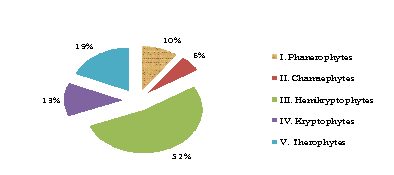
the Natural Park “Burabay” accordign to K. Raunkiaer is described in Figure 2 and in Table 2.
The biological spectrum of plants life forms of
the Natural Park “Burabay” accordign to K. Raunkiaer is described in Figure 2 and in Table 2.
Fig. 2. The biological spectrum of plants life forms of the Natural Park
“Burabay”
according to K. Raunkiaer, main groups
Table
2
The
biological spectrum of plants life forms of the Natural Park “Burabay”
according to K. Raunkiaer
|
|
Life
forms types |
Species number |
% from the total number of species |
|
1 |
I. Phanerophytes - Ph |
64 |
10 |
|
2 |
II. Chamaephytes - Ch |
39 |
6.1 |
|
3 |
III. Hemikryptophytes - HK |
335 |
52.7 |
|
|
IV. Kryptophytes - K |
80 |
12.6 |
|
4 |
Geophytes
- G |
52 |
8.2 |
|
5 |
Helophytes аnd
Hydrophytes - НH |
18 |
2.8 |
|
6 |
Helophytes аnd Hydrophytes
- НH |
10 |
1.6 |
|
7 |
V. Therophytes - Th |
118 |
18.6 |
|
|
Total: |
636 |
100 |
According
to Raunkiaer’s biological spectrum hemicryptophytes – 335 species (52.7%) take
the leading position. That type corresponds to the climate of temperate zones.
Therophytes have the large percentage (18.6%) and characterize the territory of
the ancient Mediterranean. They are followed by cryptophytes – 12.6% indicating
a dry and water-saturated climate. Small number of species of phanerophytes 10%
and chamaephytes 6.1% also indicate the temperate zone climate as phanerophytes
are most widely extended in the tropical areas while chamaephytes in the arid
and cold polar areas.
Thus,
analysis of plants life forms according to I.G. Serebryakov and Raunkiaer’s
systems confirms that the territory is located in the zone of continental
moderate climate with Mediterranean features. There is a degree of climate
aridity and anthropogenic impact. The object of the research is located in the
zone of forest-steppe with high humidity due to the large number of wetlands
(lakes, marshes and rivers). Thus, the type of the territory climate
corresponds to the boreal-steppe nature of flora.
References:
1 Inelova, Z. А., Muhitdinov, N. М. The analysis of life forms flora of valley of the middle and lower
reaches of the r. Ile. Bulletin KazNU, Series Ekol. – Аlmaty, 2010. - N 2. – P. 58-61
2 Nesterova, S. G.,
Inelova, Z. А., Aydosova, S. S., Basygaraev, J. М., Erubaeva, G.К., Chyldybaeva, А. J. Life forms flora of Balkhash deserts of the Ile-Balkhash region.
Bulletin KazNU, Series Ekol. – А., 2010. - N 3. – P. 38-41
3 Juravleva, I. А. Life form of Solanum dulcamara L. From the position of woody-herbaceous
plants: mat-ls of All-Russ. conf. with the intern. particip. (Ekaterinburg May
28 - June 1, 2012).– Е.: Goshchitskii, 2012. – P. 116-117
4 Durmekbaeva, Sh.,
Muhitdinov, N., Aydosova, S. Structure feature of shoots of some shrubs due to
the activity of alpha and beta rays of soil of the Semipalatinsk nuclear test
site. Scien.
journ. Search MES
of the RK –
1999. - N 3. – 42 p.
5 Sadyrova, G. Some
features of flora of valley of the river Chu. Scien. journ. Search MES of the
RK - 1997. – N 2. -P. 60-63.
6 Sadyrova, G. Wormwoods
of valley of the river Chu: Scien. journ. Search MES
of the RK.
– 1999. - N 1. – P. 34-35.
7 Haritonova, О. V. Features of the formation of aquatic vegetation in the water bodies
of the Cis-Ural region: mat-ls of All-Russ. conf. with the intern. particip.
(Ekaterinburg May 28 - June 1, 2012). – Е.: Goshchitskii, 2012. –
P. 245-246
8 Hamada, Y., Stow,
D.A., Roberts, D.A. Estimating life-form cover fractions in California sage
scrub communities using multispectral remote sensing – USA, 2011, P. 3056-3068
- http://www.sciencedirect.com
9 Klimes, L. Life-forms
and clonality of vascular plants along an altitudinal gradient in E Ladakh (NW
Himalayas): Basic and Applied Ecology V. 4, Is. 4 / Institute of Botany,
Section of Plant Ecology. - Trebon, Czech Republic, 2003, P. 317–328. -
http://www.sciencedirect.com
10 Wikipedia, the free
encyclopedia. - http://ru.wikipedia.org/wiki/
11 Мirkin, B. М., Naumova, L. G., Solomesh, А. I. The modern science
of vegetation – Moscow: Logos, 2001. – P. 9-11, 15
12 Serebryakov, I. G.
Ecological morphology of plants. Life forms of angiosperms and conifers. – М.: high school, 1962. – P. 30-119
13 President’s
Administrative Department of the Republic of Kazakhstan. - http://www.udp-rk.kz
14 Project Nature
Chronicle: President’s Adm. Dep. of the RK SNNP «Burabay». – Burabay: 2010. –
P. 5-21
15 Flora of Kazakhstan. Т. 1-9 – Аlma-Ata: Science, 1956-1966.
16 Kamelin, R.V. Florogenetic
analysis of the natural flora of the mountainous Central Asia. – L.: Science,
1973. – P. 52