COMPARATIVE STUDY OF POLISH SME SECTOR ON THE BACKGROUND OF THE EUROPEAN
UNION COUNTRIES
Katarzyna Brożek
Summary
On the modern business arena
there are a variety of units and economic organizations which are closely
linked with the economy of each country. The principal economic actors are
companies which underpin the economic system of each country. A specific group
of these entities are small and medium-sized enterprises, which is one of the
leading sectors of European economies. For this reason, this article is devoted
to analysis of the activities of European small and medium-sized businesses,
with particular examining the state of the Polish SME sector. Using statistical
data, the basic information characterizing the development of these entities
has been presented.
Keywords : enterprise, SME sector ,
the countries of the European Union
1 INTRODUCTION
The discussion on the problems of the SME sector
should start from the definition of the company which, according to Schweitzer,
is the technical, social and economic unity
(unit) whose task is to satisfy the needs of others with the decision-making
autonomy and its own profit [Schweitzer, 1988, p. 15]. Furthermore, it is worth
noting that all developed countries recognize the essence of entities belonging
to the SME sector; therefore, the interest in this sector has been taking place
continuously for many years [Wolak - Tuzimek, 2010, p. 105]. The polemic
primarily focuses on the following issues: creation of economic growth, job
creation, participation in export and also the effectiveness the improvement of
which may occur, among other things, through the implementation of control
mechanisms [Lament, 2014, p. 22-25]. An undeniable fact is that the largest
part of the national income is formed within companies. A convergent
characteristic of the economies of the European Union countries is the presence
of a very large number of small and medium-sized enterprises. Approximately
99.8 % of registered business entities in Europe belong to this sector , which
constitutes a motor of the European economy and the main source of employment.
Undoubtedly, entities that are included in this category are a priority
for improving the competitiveness [Howaniec, 2014, p. 40] and employment, thus
awakening the spirit of entrepreneurship and innovation in the EU Member
States. On the basis of these arguments, it cannot be denied that the SME
sector occupies a very important position in national economies.
The purpose of this article is to examine the situation of the Polish
sector of small and medium-sized enterprises on the background of selected
countries of the European Union. Therefore, indicators describing the state of
European entrepreneurship have been analyzed. The results of the study will
also indicate which of the European countries performs best in this regard,
which on average, and which is the worst and thus has the most to catch up as
compared to the best European economies.
2 COMPARATIVE ANALYSIS OF EUROPEAN SME SECTOR
The study
examines the state of European small and medium-sized enterprises on the basis
of the statistical data from 2011-2013. For this reason, 8 indicators
characterizing the level of the sector in selected EU countries were chosen.
These indicators are:
• the share
of gross value added generated in the corporate sector in the EU;
• number of
enterprises in selected EU countries;
• number of
newly established and liquidated enterprises;
• number of
employees in enterprises;
• average
employment indicator per company;
• indicator
of entrepreneurship;
• turnover
per employee in European companies;
•
investments in fixed assets for one company in the EU.
2.1 Participation of European companies in the
creation of GDP
On
the basis of data published in the latest report on the state of PARP SME
sector it can be concluded that in Poland in 2011 the share of the corporate
sector GDP was exactly at the same level as the average characterizing the EU
countries (47.8 %). Poland compared to selected EU countries in this regard was
ranked in the middle of the pack but, after all, it is a relatively
good/satisfactory result even from the point of view of the degree of
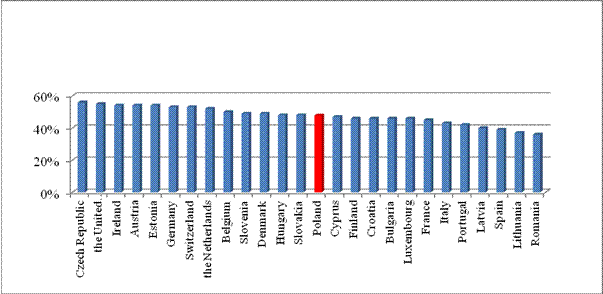
development of the Polish economy and its potential for development. Chart 1
below shows the percentage shares of twenty-six EU countries in the gross added
value generated in the corporate sector. In the ranking, the leading positions
are occupied by Czech Republic, the United Kingdom and Ireland. Poland,
however, is ahead of the countries such as Slovenia, Denmark, Hungary and Slovakia.
Also, Poland outclasses in this respect e.g. France, Italy and Spain.
Chart 1. Share of gross value
added generated in the enterprise sector in Poland and selected EU countries in
2011.
 Source: Report on the state of the sector of small
and medium-sized enterprises in Poland in the years 2012-2013, PARP, Warsaw
2014, p. 14
Source: Report on the state of the sector of small
and medium-sized enterprises in Poland in the years 2012-2013, PARP, Warsaw
2014, p. 14
2.2. Number of enterprises in selected EU countries
The second part
is devoted to empirical analysis of the number of active companies in Poland
compared to other European countries. It is one of a few very important
indicators to conclude on the state of Polish entrepreneurship in comparison
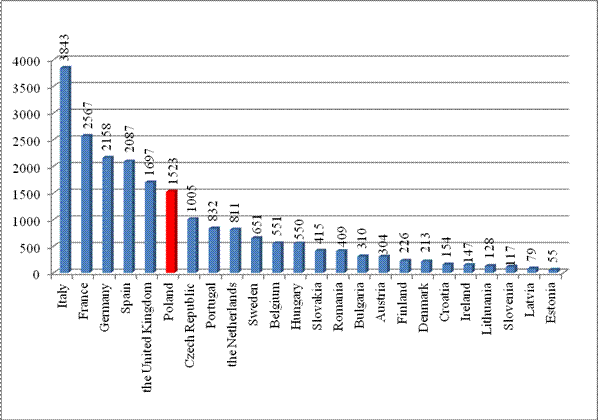
with the European one. When analyzing chart 2, we can conclude that the Polish
economy in 2011 in this respect occupied a place at the forefront pack. Sixth
place in the ranking certainly speaks for Polish optimistic situation in this
area in the coming years.
Nevertheless,
the clear leader among the European countries was Italy. In 2011, approximately
3.8 million companies functioned in this country, which means that in Polish
economy in comparison with the Italian one about 2.5 times as few actually did.
The second position, also with very good results (about 2.6 million companies),
belonged to France, while the last place on the podium was occupied by Germany
(2.2 million). Poland was preceded by only two other countries: Spain (2.1
million) and the United Kingdom (1.7 million). The latter, however, had a
slight advantage over Poland , since the difference that separated the two countries
amounted to exactly 174 thousand companies. By far, the greater
difference in values occurs when comparing Polish number of firms
with other EU countries. Subsequent place belongs to the Czech Republic which
loses as many as 518 thousand economic entities to Poland. Countries that
follow had not been able to launch a million companies. The closest were
Portugal (832 thousand) and The Netherlands (811 thousand). Further follow such
countries as Sweden, Belgium and Hungary. The second half of the pack is opened
by Slovakia with the result of 415 thousand, followed by Romania and Bulgaria.
Yet the fewest number of enterprises in 2011 functioned in Slovenia - 117
thousand, then in Latvia - 79 thousand and Estonia- only 55 thousand economic
entities.
Chart 2 Number of enterprises in Poland and selected EU
countries in 2011. (in thousand)
 Source: Report
on the state of the sector of small and medium-sized enterprises in Poland in
the years 2012-2013, PARP, Warsaw 2014, pp. 17-18
Source: Report
on the state of the sector of small and medium-sized enterprises in Poland in
the years 2012-2013, PARP, Warsaw 2014, pp. 17-18
When examining the number
of enterprises in European economies it should be borne in mind that in this
area the number of newly established enterprises is extremely important but not
more than the negative aspect regarding the number of liquidated companies.
These two indicators have a direct impact on the total number of companies;
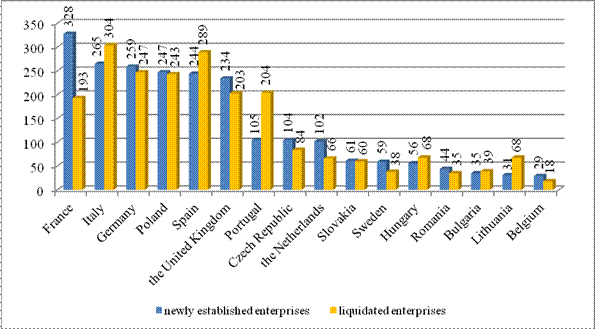
therefore, chart 3 depicts data describing both values (to facilitate the
analysis). It should be noted that, as it was in the case of the previous
measures and analysis, this time Poland again performs very well as compared to
its European competitors - the fourth position in terms of the number of newly
created entities in 2011 (247 thousand). The three countries that obtained a
better result than the Polish economy was France (328 thousand), Italy (265
thousand) and Germany (259 thousand). On the other hand, the remarkable success
is probably the fact that Poland managed to overtake the economies of Spain
(244 thousand) and the UK (234 thousand) with its number of new entrants. The
smallest increment of new economic entities in 2011 is noted for Bulgaria (35
thousand), Lithuania (31 thousand) and Belgium (fewer than 30 thousand). The
analysis should also cover the number of liquidated entities in the EU - which
are presented in Chart 3. The first conclusion to be drawn when interpreting
the chart below is that the largest number of liquidated entities in the
analyzed year was reported by Italy - 304 thousand, and Spain - 289 thousand.
In these two countries, the number of liquidated entities was higher than the
one of the newly established. Germany, with the number of 247 thousand, and
Poland, 243 thousand, followed, then Portugal, the United Kingdom and France.
In the middle of the classification were the Czechs and the Dutch, and to close
the pack: Bulgarians - 39 thousand, Swedes - 38 thousand, Romanians - 35
thousand and Belgians - only 18 thousand.
Chart 3 Number of newly established and liquidated
enterprises in Poland and selected EU countries in 2011.(in thousand)
Source: Report on the state of the sector of small
and medium-sized enterprises in Poland in the years 2012-2013, PARP, Warsaw
2014 , p. 21
However,
when analyzing the individual situation of individual EU countries in terms of
the greatest difference between the number of newly established entities and
the number of the liquidated it should be noted that in this regard France has
the best performance with the difference in question of 135 thousand entities
in favor of the emerging ones. On the other hand, Portugal found itself in a
diametrically different situation in 2011 with up to nearly 100 thousand
recorded liquidations over the emerging ones. The relatively smallest
difference of these two indicators refers to Poland - (4 thousand) and Slovakia
- (only 1 thousand).
2.3 The number
of people working in enterprises in selected EU countries
The
indicator characterizing the European corporate sector is the number of people
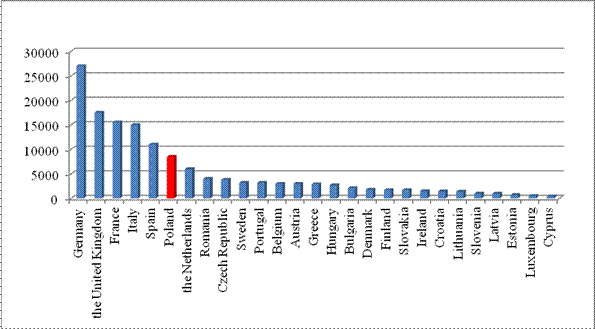
working in it – as presented in chart 4. The number of people working in this
kind of entities in 2012 stood at 133 million people [Eurostat data for 2012].
The largest contribution to the employment rate was held by the most numerous
in terms of population EU countries. These are mainly five European economies:
German (more than 26 million working in enterprises), British (about 18
million), French (15 million), Italian (15 million) and Spanish (almost 11
million ) . It is worth noting that the results of these five countries account
for less than 2/3 of the total number of persons employed in the EU -28. Poland
, which occupies sixth position, ranks just behind this group of countries. Its
employment rate outnumbers countries such as The Netherlands, Romania and the
Czech Republic. Subsequently, there go Sweden and Portugal. At the end of the
classification there are 16 EU countries, mostly considered small in terms of
population as well as the number of the employed. It is therefore necessary to
mention e.g. Belgium, Hungary, Ireland, Slovenia, Estonia, Luxembourg and
Cyprus.
Chart 4 The number of the
employed in 2012 (in thousand) in companies in Poland and EU Member States
Source: Report on the state of the sector of small
and medium-sized enterprises in Poland in the years 2012-2013, PARP, Warsaw
2014 , pp. 24-25
Another part of the
research in this subgroup is devoted to the analysis of the average level of
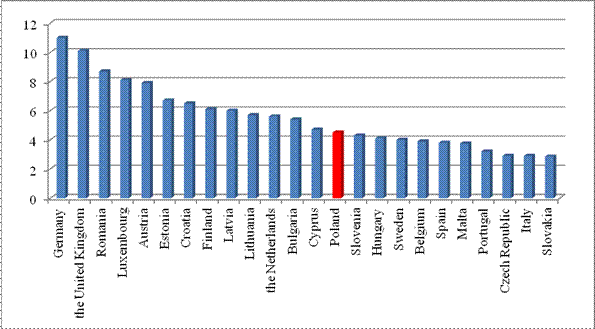
employment at one company in Poland and selected EU countries in 2012 - chart
5. Based on Eurostat data, Poland, with the result of about 4.3 persons
employed in a single economic entity, occupies 14th place among 24 European
countries. However, in the EU, one company is on average workplace for approx.
5.4 employees. Certainly the undisputed leader in the presented ranking is
Germany with a score of 11 employees on 1 company during the year. The second
position with the result of 10 employees came in the United Kingdom. Key
positions of these two countries are mainly due to the share of large companies
(both German and British) in their employment structures. Third place went to
Romania, and the following places were occupied by the following countries:
Luxembourg, Austria and Estonia. However, half the rate belonged to Bulgaria
and Cyprus, and Poland was behind them. The rate, however, is closed by the
following countries: Czech Republic, Italy and Slovakia, which received the results
very close to each other - (less than three employees per one economic entity).
Chart 5 Average
employment per one company in Poland and selected EU countries in 2012
Source: Report on the state of the
sector of small and medium-sized enterprises in Poland in the years 2012-2013,
PARP, Warsaw 2014, p. 26
After analyzing the number of employees in the
European corporate sector and the average level of employment in one company, we
should also examine the rate of entrepreneurship that characterize selected
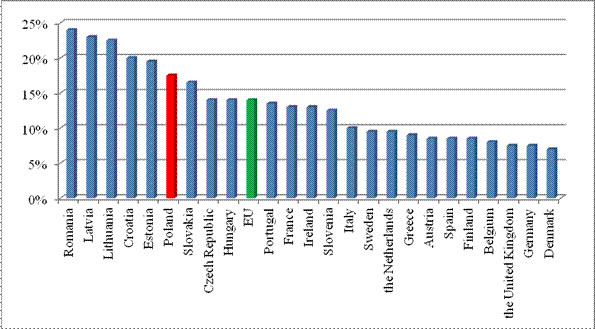
countries of the Union - graph 6. It should be emphasized that the level of
entrepreneurship is measured as the number of adults intending to start a
business within the next three years.
In 2013 the rate of entrepreneurship in the
Polish economy was above the EU average. This reflects the fact that the Poles
tend to act, search for new solutions, make changes in the previous activity,
use emerging opportunities [Wolak-Tuzimek et al., 2015, p.13]. A very high
sixth position of Poland certainly affects the favorable situation of this
country in the future. However, the best results in terms of the rate of
entrepreneurship noted Romania, followed by Latvia. The third and fourth place
was taken by Lithuania and Croatia. In contrast, Slovakia came in just behind
Poland. It is worth noting that the Czech and Hungarian economy achieved the rate
of entrepreneurship at the level of EU average. Portugal was only slightly
worse, closely followed by France and Ireland and Slovenia. Nevertheless, the weakest
level of the entrepreneurship indicator is characterized by the following
countries: United Kingdom, Germany and, with the worst result, Denmark.
Chart 6 Entrepreneurship
rate (% of adults who intend to start their own company in 3 years' time) in
selected EU countries in 2013
Source: Own calculations based on European Commission Press Release
Database Sheet SBA 2014 Brussels: 2014. Figures for 2013.
Http://europa.eu/rapid/press-release_IP-14-655_pl.htm, [Access 12.05. 15]
2.4 Financial and investment situation of enterprises operating in Europe
In view of the Eurostat data, Polish corporate sector productivity, measured using the results attributable to one employee - Figure 7[1], is significantly lower than the average in EU countries. Analyzing the chart below one can conclude that, according to company turnover per an employee, Polish companies take 20th place (with the result of approximately 100 thousand EUR in 2012), in the presented European countries ranking. Poland in this aspect stayed ahead of only five countries, namely: Latvia, Lithuania, Croatia, Romania and Bulgaria. In contrast, the companies from Switzerland did the best (almost 700 thousand EUR), Luxembourg (over 570 thousand EUR), Norway (approximately 450 thousand EUR) and Belgium (approximately 360 thousand EUR).
It may be noted that Polish companies stand out from economic entities from more developed countries in Europe. This is mainly due to the fact of ownership and disposition of poorer technological equipment and the use of unsuitable organizational solutions that translate thereby at a relatively low share of added value in production value.
Figure 7 Turnover per an employee (in 2012 in
thousand EUR) in enterprises in Poland and in selected European countries

Source: Report on the state of the sector of small
and medium-sized enterprises in Poland in the years 2012-2013, PARP, Warsaw
2014, pp. 33-34
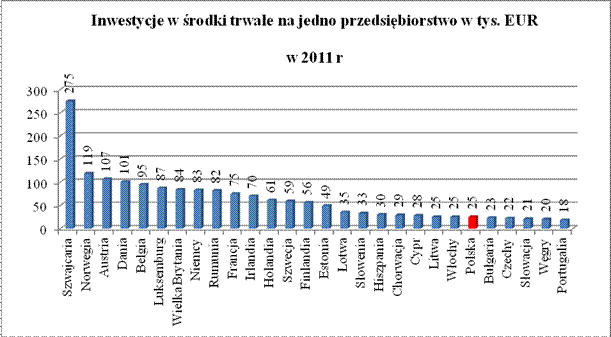
The appropriate level of investment is essential for the proper development of businesses, so that this indicator is extremely important when comparing the Polish economy against the of selected European economies. Unfortunately, just as it occured with the previous analysis, again, the Poles can not be satisfied with the level of investments allocated to fixed assets in 2011 - this fact is confirmed by Figure 8.
In Poland, investments in fixed assets of the average company is only 25 thousand EUR. This result is significantly different from those obtained by the more developed countries of Europe. There is a gap between the leader of the classification - Switzerland - and the Polish economy, as this country got the result of more than 275 thousand EUR. The second position belongs to Norway, however, it has got the result of over two times smaller than the leader (119 thousand EUR). Only third place described the country of the EU - Austria (over 107 thousand EUR). Just behind the podium came in Denmark, followed by Belgium, Luxembourg and the United Kingdom. The top ten also includes the following countries: Germany, Romania and France. While the middle part of the classification was reserved for Ireland, the Netherlands, Sweden, Finland, Estonia, Latvia, Slovenia and Spain. However, a few countries managed to stay ahead in the ranking of Poland, the former is Croatia - 29 thousand EUR, Cyprus - 28 thousand EUR, Lithuania - 25 thousand EUR or even Italy also 25 thousand EUR. Poland in terms of size of fixed assets for 1 company takes 21st place of presented EU countries, which is certainly not a satisfactory result. Poland in this ranking stays ahead only of countries such as Bulgaria (23 thousand EUR), Czech Republic (22 thousand EUR), Slovakia (21 thousand EUR), Hungary (20 thousand EUR) and Portugal (18 thousand EUR).
Figure 8 Investments in fixed assets for one company (in thousand EUR) in Poland
and selected European countries in 2011.
 Source: Report on the state of the sector of
small and medium-sized enterprises in Poland in the years 2012-2013, PARP,
Warsaw 2014, p. 40
Source: Report on the state of the sector of
small and medium-sized enterprises in Poland in the years 2012-2013, PARP,
Warsaw 2014, p. 40
3 SUMMARY
At the present time, no one denies the role of SME sector in economic development. Undoubtedly, small and medium-sized enterprises are seen, throughout the whole European Union, as the driving force of the economy, both of individual countries as well as the Union as a whole. However, it should be noted, that the importance of the examined sector in the economy of the EU countries is varied and thus depends on the level of socio-economic development of the country.
Comparing Poland to other EU countries, it must be concluded that it is doing on average, and in some rates relatively well in terms of entrepreneurial activity. In 2011, the Polish enterprises sector share in GDP was exactly at the same level as the average characterized by the countries of the European Union. However, due to the growth potential of the economy it is not a good result.
In 2011, Poland in terms of number of enterprises was sixth out of 24 EU countries - and got a result of 1,523 entities. However, Italy has proven to be the leader of the classification (2.5 times more companies than in Poland), while the least well in this respect did Estonia where, in the audited year, there were only 55,000 functioning economic entities.
Poland did very well also against the number of newly established enterprises, as out of 16 EU countries, it won fourth place (only France, Italy and Germany were moving ahead of Poland). The rate was closed by Bulgarians, Lithuanians and Belgians.
Polish companies won a high sixth place in terms of the number of employed in enterprises persons in 2012. However, in this indicator undeniable winner was Germany, followed by the British, the Italians and the French. The worst in this ranking were the following countries: Estonia, Luxembourg and Cyprus.
The Poles are certainly enterprising people, because their rate of entrepreneurship in 2013 exceeded the EU average, and consequently they won sixth place out of twenty-four European economies. Unexpectedly, Romania won in this combination, while Denmark came in last.
Poland did much worse in terms of the rate of turnover per an employee in 2012, taking one of the last of places. Among the countries belonging to the EU Luxembourg did the best, and Bulgaria the worst.
Poland, in terms of investments in fixed assets in 2011, also did unfavorably against EU competitors - position in third top ten of the classification, which does not bode a positive future perspective in this regard.
Sources
1.
EUROPEAN COMMISSION Press Release
Database, Database Sheet SBA 2014, Brussels: 2014. Figures for 2013. http://europa.eu/rapid/press-release_IP-14-655_pl.htm,
[accessed 12.05.15]
2.
EUROSTAT,
Structural Business Statistics.
Figures for 2012.
http://ec.europa.eu/eurostat/web/structural-business-statistics, [accessed
10.05.15]
3.
HOWANIEC, H. SMEs Support in Phases of Early Development of Enterprises in Poland,
pub: MANAGEMENT 2014. BUSINESS,
MANAGEMENT AND SOCIAL SCIENCES RESEARCH. STEFKO R., FRANKOVSKY M., VRAVEC
J. (Eds.). Presov: Bookman s.r.o. for Faculty of Management, 2014 p. 40. ISBN
978-80-8165-052-9.
4.
LAMENT, M., Internal audit as a tool of fraud management, Journal of
Internediscyplinary Reaserch AD ALTA, 2014, No 4, Issuse 2, pp. 22-25, ISSN 1804-7890.
5.
PARP, Report on the State of the Sector of Small and Medium-sized Enterprises
in Poland in 2012-2013. Issue I. Warsaw: Publisher of Polish Agency for
Enterprise Development, 2014 p. 14, 17-18, 21, 24-16, 33-34, 40. ISBN 978-83-7633-285-7.
6.
SCHWEITZER, M. Gegenstand der Betriebswirtschaftslehre,
pub: Allgemeine Betriebswirtschaftslehre,
Bd. 1. Gustaw Fischer, Stuttgart: 1988, p. 15.
7. WOLAK-TUZIMEK, A., Determinants of the Development of Small and Medium-sized Enterprises in Poland. Warsaw: PWN, 2010 p. 105. ISBN 978-83-01-16332-7.
8. WOLAK-TUZIMEK, A., DUDA, J.,SOŁOMA, A., LAMENT, M., The Management of Small to Medium-sized Enterprise. Selected Problems. Radom: Institute of Scientific Publishing "Spatium", 2015 p. 13. ISBN 978-83-62805-57-0.
Contact
Katarzyna Brożek
Kazimierz Pulaski University of Technology and Humanities in Radom
Street: Malczewskiego 29, 26-600 Radom, Poland
Tel: +48 504 174 290
email: kania6669@wp.pl