Биологические науки/7.Зоология
Dr. Shilovа S.A., PhD Shekarova O.N., Savinetskaya
L.E.
A.N. Severtsov Institute of Ecology and Evolution
Applied issues of small pest-
mammals control as groundwork for basic research
Small pests -mammals control is carried out in almost
all countries over the world, that can significantly reduce economic damage
caused by these pest-species, can provide population health and welfare and
reduce the risk of zoogenous infections morbility.
The modern pest control is based on extensive basic
research on the structure, dynamics, population cycles and other biological
parameters of pest species. Animals reaction to damaging factors (poison baits,
poisons of acute and prolonged action) is detailed studied; the areas of the
most inflicted damages and injury is identified, etc. (Prakash, 1988; Shilova
et al, 1993). These data allow us to increase the deratization efficiency
significantly and to provide the preservation of pest-animals biological
diversity even being under constant target pest control pressure (Rylnikov,
2010; Shilova, 2011).
However, another important problem, concerning the
study of possibility to detect previously unknown general biological patterns
of pest species populations under target pest control pressure (another aspect
of consequences of target pest -population reduction), has scarcely ever
concerned in publications.
Some unknown in usual condition adaptive (deposited)
biological features can appeared in animal populations, being under extreme
conditions (disastrous habitat destruction, critical number decreasing, etc.).
For example, the study of survived after exterminative
pest control measures small mammals allowed to reveal significant changes in
different forms of their social behavior that doesn't appear under normal
condition. Investigations were carried out in natural plague foci on the
territories of Russian alpine steppes and semi-deserts (Tuva, Kalmykia), during
pest control measures against rodents and pikas - carriers of this infection
(Shilova, 1993 Shchipanov 2001, Shilova, Tchabovsky 2009, etc.)
After deratization 10-15% animals survive in the
treated areas and they possess individual resistance to poisons or increased suspicion
to baits. Survived
animals cattered around the territory and be deprived of their usual social
partners. Then strangers began to migrate from neighboring to treated
territory. These animals are also separated, not familiar with the territory
and are being under stress outside of well-known habitat. Stable population
capable of reproduction groups restoring is possible only through these animals
agregations.
Significant changes of social behavior after critical
number decreasing caused by pest control treatments in the natural foci of
plague have been happened in the settlements of Mongolian pikas (Ochotona pallasi Gray 1867). Considered
as leading behavioral pattern high aggressivity of Mongolian pikas towards
their conspecifics determines optimal forage use under food shortage in
inclement extreme alpine conditions. This
species have practically no any friendly forms of contacts. There no overlapping of individual home ranges,
animals live ne by one and strongly protect their home territories from
neighbors.
After the complete elimination of settled population
from the study site the number of aggressive contacts between migrant Mongolian
pikas has much reduced compared with the control (0.03 and 1.1, respectively,
per 100 min. P> 0,999). Individual home ranges of
strangers overlapped completely. Any territorial protection was absent. Investigating behavior increased: the time for
territory investigation was 10.2% but in the control group –only 4.1% (Shilova,
Orlenev, 2004; Shilova, Tchabovsky, 2009).
On another experimental site where only 29.31% of
survived pikas has remained. Investigation activity of survived animals
increased in 4.7 times and the frequency of territory marking - about 10 times
(before and after the experiment it was 0.5 and 4.9 interactions per 100 min
respectively.). Even on their own home ranges pikas stopped to
protect their territory: number of aggressive interactions with neighbors
declined from 1.4 to 0.6 interactions per 100 min. A trend to survived animals integration appeared: the
number of integral contacts was before and after experiment 0.6 and 1, 5 per
100 min. respectively.
Comparative analysis of social behavior in closely
related species after large-scale pest control treatment shows that the
intensity of the stable population structures restoration is depended on the
changes of survived animals behavior. Thus, the Mongolian gerbil (Meriones unguiculatus) is highly social
species. After neighbors extermination survived animals need for social
contacts very much, that allowed them to form reproductive capable
intrapopulational group in a short time, that resulted in rapid population
number recovery. Some forms of social behavior of survived Mongolian gerbils
changes abruptly, that contributes to the animals integration, aggressive
contacts replace on friendly ones etc. (Fig.1).
Unlike Mongolian gerbil social contacts between Midday
gerbil (M. meridianus) are not the
leading factor supporting population groups autonomy. After the extermination
of the most part of the settled animals survived Midday gerbils don't show any
modifications of their social behavioral patterns (Fig.1). Accordingly, the
process of population number restoration in the cleared out of settled animals
areas is very slow (Shilova, Orlenev, 2004; Shilova, Tchabovsky, 2009).
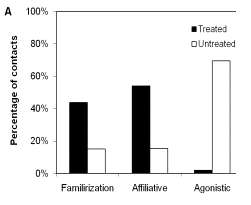
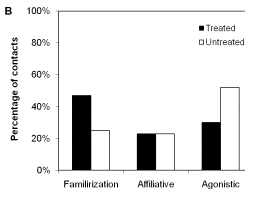
Fig.1 Proportion of different behavioral
contacts in Mongolian (A) and Midday (B) gerbils in treated and untreated
colonies (after Shilova and Tchabovsky 2009)
Study of the social behavior of small mammals after 80
- 90% population extermination as a result of deratization allowed
N.A.Shchipanov (2001) to ground the conception of population structure recovery
rate depending on the level of species sociality. According to this author there are two types of residual populations
functioning after the critical number decreasing: "restoring" and
"controlling». In the first case the animals number quickly increase after
extermination to its original level. Population of "controlling type" slowly restores its original population structure. The reason of these functioning
differences is in the specifics of their social organization forms.
A classic example of applied zoological studies
application to solve fundamental ecological problems is the modern concept of
density - dependent mechanisms of rodents number regulation. Back in 1948,
having analyzed the disinfection station in Baltimore materials on the Brown
rat control D. Davis (1951) showed that after sharp rats decrease as a result
of control measures , the reproduction level of survived animals much increased
that caused the number recovery in a short space of time.
Eco - physiological, behavioral and biochemical
patterns of density - dependent regulation of different small mammals species
number is now well studied and considered as one of the main traditional population
ecology thesis (Christian 1971; Stenseth et al. 2001, etc.). For example, on
the model of Mongolian gerbils it was shown that after 90% of the population
extermination by zinc phosphide the age structure of breeding gerbils had much
changed. Young females with an average weight of 31.0 g
had already begun to take part in breeding (control - 58.0 g). After 4 weeks on the treated areas 91.4% of females
were pregnant. At the same time on control areas breeding
stopped. On the treated
area spermatogenesis was registered in 92% of males (Shilova, Tchabovsky 2009).
Sometimes the data on the small pest-mammals state
after pest control treatment successfully used to develop advanced statistical
research methods. Thus, by the example of the bank vole (Myodes glareolus) after irrevocable animals removal in nature N.A.
Shchipanov et al (2011) developed a model of estimation the ratio of settled
and wandered parts of the population.
Thus, the analysis of population processes of animals,
being under target pest control treatment as pests can reveal new adaptive
patterns that conserve the biological systems stability.
We are grateful to N.A.Shchipanov, A.V.Tchabovsky,
A.A.Kalinin , D.P.Orlenev, B.V.Krasnov . I.V.Khokhlova and many others members
of the laboratory of population ecology IPEE RAS who much and constant helped
us in the work on aforesaid problem. The study was supported by the Basic
Research Program of The Presidium of RAS “Wildlife: Current Status and Problems
of Development ", subprogram "Biodiversity:
Literature.
Rylnikov VA 2010. Brown rat (Rattus
norvegicus Berk) Ecological bases and approaches to managing numbers. M.
RAS 365 p (In Russian)
Shilova S.A. 1993. Population ecology as a basis for
small mammals control. M. Nauka. 203 p. (In Russian)
Shilova S.A. 2011. Current problems in rodent pest
population control and biodiversity cobservation. Russian Journal of ecology.
V.42(2). P.165-169 (In Russian)
Shilova SA, Orlenev D.P. 2004. Some patterns of the
small mammals behavior under social environment destruction. Biology Bull. RAS. Biol. Ser. No 4. P.358 - 366. (In Russian)
Shchipanov NA 2001.Ecological bases of small mammals
management. Selected lectures. M. Grif IK. P. 182 (In Russian)
Shchipanov N.A., Lyapina M.G. 2011.Evaluation of
abundance of residence and immigration by irretrievable requisitioning of the
Bank vole (Myodes glareolus Shreber
1780). Biology Bull. RAS. Biol. Ser. No 6. P. 747 -758. (In Russian)
Christian J. 1971. Population density and reproductive
efficiency. Biolody Reprod. V.4. p. 248-294.
Davis D.E. 1951. A comparison of reproductive
potential of two rat populations. Ecology v. 32 p. 469 – 475.
Prakash I. 1988. Rodent Pest Management. Boca Ration
(Fla) CRC Press. 480 p.
Stenseth N., Leirs H., Merselis S. 2001. Comparing
strategies controlling an African pest rodents: an empirically based
theoretical study. J. Applied Ecology 38. p. 1020 – 1031.
Shilova S.A., Tchabovsky A.V. 2009 Population response
of rodents to control with rodenticides. Current Zoology 55(2). p. 81-91.