PhD in Geography
V.V. Minenkova
Kuban State University, Russia
Admissible recreational load and restrictions for natural complexes
Natural
complexes and constituent elements are significantly different from the
potential resistance to recreational load. Resistance of a natural territorial complex to recreational load
can be identified as ability of a complex to resist these loads up to defined
restrictions beyond which there is a loss of self-renewal ability.
Average annual
recreational load can be specified by the following formula:
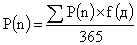
where
P(r) – a single average annual recreational load (per capita hectare average
annual);
P
(n) – average for the registration period single load during different seasons
of a year in the working and non-working days with comfortable and
discomfortable weather (person/hectare);
f
(д) – average long-term number of the non-working and
working days with comfortable and discomfortable weather during different
seasons of a year (days).
Admissible
recreational load is defined as a number of vacationers per square meters in a
unit of time when no serious damage is caused to a natural complex and it
continues to function as before, keeping its structure. Norms of maximum
admissible load, offered by various Russian authors, strongly differ within
themselves, and the absence of universal normative documents on this matter
sometimes leads to serious defects when designing development of recreational
landscapes.
There
are many calculation methods of admissible load for various natural complexes
at their mass occupancy rate. At the bottom of many Soviet researches of
recreational load for natural territorial complexes there is a provision of a
recreational digression proposed by N. S. Kazanskaya. This technique shows and
describes 5 stages of recreational digression. The limit of natural complex resistance beyond the bounds of which irreversible
alterations occur is between the 3rd
and 4th stages. Accordingly, the maximum admissible
load corresponds to the 3rd stage
of digression. Thus, the actual load
refers to the number of people who visit
this landscape which leads to a state of the 3rd digression
stage.
Among
contemporary national researches
of recreational load on the natural
one, there is a well-known method of
calculating admissible load
maximum on recreational areas
(research team of D.R. Abdullina,
N.N. Maltsev, and I.M. Potravnyy):
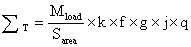
∑Т – an index of the natural
recreational capacity of a territory,
pax per ha;
М load – an index of the maximum area load associated with human influence (number of people);
S
area – total land area, ha;
k,
f, g, j, q – a system of correctional factors that take into account a degree of
environmental infrastructure and recreational area development.
According
to this technique, maximum admissible load is calculated
per unit of area and must conform to natural recreational capacity.
Presenting
an overview of the procedures for determining admissible
recreational load on natural complexes, one cannot overlook a great attention
paid to concentration on forest landscapes. At the same time important natural
recreational resources include water bodies
(natural and artificial), and the waters and coast of which are used for a
variety of recreational activities: beach-related rest, wind and kite surfing,
boating, hydrocycling, water skiing, sailing, yachting, various types of
fishing and hunting.
At
present, there is intensive and not always justified commercialization of
tourist and recreational activities in aquatic territorial complexes which
primarily focuses on the biological resources withdrawal, including fishing and
hunting, resulting in the destruction of habitats and ecosystem degradation. This
leads to involving the most valuable natural areas into economic turnover and
the loss of unique natural potential. Recreational activities stimulate the
intensification of changes in natural complexes. The inevitable conflict arises
between use and protection of water resources and coastal areas.
Coastal recreational areas of natural
and artificial water bodies are overburdened with
recreational influence and need to have a restricted number of visits,
as well as a system of environmental protection
measures.
Load
standardization on aquatic as well as on ground complexes is conducted on the
basis of the results of various recreational activities effect on the
components of the environment. However, its specific character is determined by
the effect of the recreational activity. Thus, in case of a forest landscape
the matter concerns trampling but in case of aquatic complexes it is a question
of water contamination.
Recreational
“supply” of some polluting substances into a water body and their general
number should not lead to the excess of the certified admissible concentration
limit (ACL) or hygienic regulations on these elements. Not only the “supplies”
of recreational activity but also the existing concentration of these elements
in a water body should be taken into account. Load standardization can be achieved
by both calculations and experimentally or combining these two methods.
Being
aware of the fact that there is a particular set of polluting substances for
each type of recreation and knowing the content of these substances in water,
we can calculate the admissible recreation load on contamination of an aquatic area using the following formula:
Сrecr. + Сwat.< ACL,
where
Сrecr. is the concentration of a
particular polluting substance coming from a particular type of recreation;
Сwat. is the concentration of the given polluting substance in a water body.
If
a polluting substance comes from several kinds of recreation, the following
formula is used:
∑
Сrecr. + Сwat.< ACL,
where
∑ Сrecr is the sum of concentration of a polluting substance coming from a number
of recreations, Сwat. is the concentration of a polluting
substance in a water body.
Recreation
load (Da) can be calculated using the following relations:
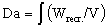 ,
,
where
V is the volume of a shallow part of a water body with the depth up to 2m
adjacent to a beach area.
Wrecr.
is the total mass of polluting substances coming from all the tourists (of this
recreation type). It is calculated as follows:
Wrecr.
= С1Na,
where
С1 is the supply of the given polluting substance from
one tourist,
Na
is the number of tourists in an aquatic area.
Recreation
load on aquatic complexes can be also estimated as coastal complexes load in
terms of the measuring units head per hectare of aquatic area (in case of
bathing) or boat per hectare (table 1).
Table
1 – Admissible anthropogenic recreation load (head per hectare) on a water body.
|
Type
of a water body |
Criterion |
|
|
technological |
psychological |
|
|
Defined water area for
bathing (in shallow waters, with the change of swimmers) |
300-500 |
100-200 |
|
Defined water area for
going by: rowing boats (2
persons in a boat) |
2-5 |
0,5 |
|
motor boats and water
skis |
0,5-1 |
1 (per 10-20
hectare) |
|
sail
boats |
1-2 |
1 (per 5-10 hectare) |
|
Space for tent camps
placement at the seaside (persons per kilometer) |
250-300 |
15-30 |
While estimating the holding capacity of the water area for sailing, it
is also essential to consider the technological and psychological criteria of
recreational load. Thus, for instance, 1-2 sail boats are technologically
admissible per 1 hectare, while the psychological comfort requires the range of
5-10 hectares per each boat.
While locating holiday camps and camping sites on the banks of water
bodies, it is recommended to take into account the rate of the admissible recreational load along
the coastline depending on certain ecosystems. Anyway, the amount of holiday-makes cannot
exceed 200 people per 1 km of coastal area.
Besides, it is necessary to consider the load on sea bank landscape
which results in the negative consequences of dune cuts-off created by
recreational enterprises so as to improve access to the beach area.
The utilization process of coastal territories for recreational purposes
has to comply with the principles of ecological recreational environment
preservation. Recreational planning is to provide their stability with the
assigned recreational load. The studies of popular tourist water areas point
out that the existing load often exceeds the admissible range. Thereby, it is
necessary to establish the main principles and take a number of measures so as
to preserve and control the coastal area resistance to recreational influence.
It is possible to provide ecological-recreational safety only by means of a set
of legal, scientific-technical, ecological-landscape, economic and educational
measures.
In
order to efficiently maintain coastal territories in a recreationally
appropriate condition, it is possible to take basic security steps – primarily,
to preserve biogeocenoses by means of fencing a shore sector for the period of
grass layer restoration as long as the elements of root phytocenosis are
conserved.
For
the last decades an onward process of the priorities change in the sphere of
admissible recreational load estimation has been evident. As an alternative to
traditional methodology based on the quantitative approach, there is a tendency
to resort to the method based on determining a qualitative scope of admissible
landscape variations. The outcome of this is a set of managerial decisions
which allow not only to sustain landscape and biological diversity of the
territory, but also contributes to the further development of
touristic-recreational environmental management.
thus, the mathematical
approach is being replaced by the administrative approach, which in the first
place implies planning long-term goals and tasks, a range of recreational
facilities, types and forms of recreational activities, different models of
recreational development rather than just planning the number of tourists and
holidaymakers. The basis of such planning lies in analyzing the demand for
recreational services, the tourists’ impact on the ecosystems, etc.
Overall, the above-mentioned approach is
manifested in the admissible variations scope methodology. In some way this
methodology presents an alternative for the admissible recreational load
methodology. As we can see, the main index in the admissible load methodology
is the admissible number of visitors at a time unit per unit area, whereas in
the admissible variations scope methodology we rely on ultimate variations of
the given landscape as the main index. At the same time, the admissible
variations scope methodology makes it possible to switch from the
conventionally addressed and ambiguously solved problem of determining
quantitative load to solving the problem of determining the quality of those
natural settings which should be conserved in the protected area.
References
1.
Ermakova A.A. The issues of
determining recreational load and recreational capacity // VSU Bulletin.
Geography. Geoecology, 2009. №2. – pp. 16-20.
2.
Ivanov A.N., Chizhova V.P.
Safeguarded Landscapes: learning aid. – M.:
MSU publishing house, 2003. – 118 p.
3.
Klyukin M.A., Rotanova I.N. The
recreational load issues of waterside territories: Aya Lake, Kolyvanskoe Lake
and Novosibirskoe reservoir.// Tomsk State University Bulletin, 2011. – № 347.
– pp. 185-190.
4.
Kolotova E.V. Recreational resources
science: learning aid. – M.: RMAT, 2004. – 136 p.
5.
Chizhova V.P. admissible recreational load in
Kamchatka’s conservation areas // Geography and tourism: collected papers. – Perm:
Perm University, 2006. – pp. 239-253.
6.
Chizhova V.P. Determining admissible
recreational load (the Volga delta) // Moscow State University Bulletin.
Geography, 2007. – № 3. – pp. 31-36.
7.
Chizhova V.P. Recreational landscapes:
sustainability, standardization, management. – Smolensk: Populated Universe,
2011. – 176 p.