Senichev V.Yu., Tereshatov
V.V., Makarova M.A., Yakushev R.M., Vnutskikh Z.A., Fedoseev M.S. , Volkova E.R.
Institute of Technical
Chemistry of Ural Branch of the RAS, Perm, Russia.
Strain-stress
dependencies of real polymer networks on the base of polybutadiene liquid rubbers
One of the main problems of high-elasticity theory is an adequate
understanding of stress-strain relationship over the entire range of strain
values. Usually, strain-stress plots for elastomer on simple stretching are convex,
but sometimes these plots are with inflection. The last curves contain initial a
concave-shaped part and a part exceedingly marked by convexity-shaped at the
last strain stages of a material on its essential hardening. The description of
such curves is complicated [1].
Modification of the elasticity theory, while taking into account steric constraints
in the strain process (the Erman-Monnerie MCC-model) and the finite chain
extensibility conception has allowed to describe strain-stress dependencies
with abrupt rise in stress under high strain values (usually λ>5). This approach was recently used for describing simple extension
of polyurethane samples [2]. The task of this work is to show applicability of the
developed approach for cross-linked elastomers that does not contain urethane
bonds.
Two elastic materials on the base of liquid oligomers with two terminal
carboxylic groups were investigated. Polybutadiene-nitrile SKN-10-KTR (Mn~3000,
nitrile groups), and polybutadiene SKD-KTR (Mn~3000) were obtained from FSUE NIISK(Russia,
Saint Petersburg). Compositions based of these oligomers were obtained via
mixes of the Epotec YD 127 epoxy resin from Aditya Birla Chemicals (Thailand),
4,6-tris(N,N-dimethylaminomethyl)phenol and zinc oxide.
Cross-linked elastomers were obtained using one-stage process. The
following components weight ratios were used (phr): SKN-10-KTR 100, Epotec YD 127-13.9 , 2,4,6-tris(N,N-dimethylaminomethyl) phenol -0.53, and zinc oxide –
1.53, for SKN-1; SKD-KTR 100, Epotec YD 127-11.1, 2,4,6-tris(N,N-dimethylaminomethyl) phenol -0.53,
and zinc oxide 1.53 for SKD-1. The compositions
were cured for 2 days at 100 oC.
Glass transition temperature Tg of the elastomers was determined by
means of the DSC 822e calorimeter (Mettler-Toledo) at the heating
rate 0.08K·s-1. Mechanical tests were performed on the Instron 3365
tensile-testing machine at low strain rate 0.0028 s-1, 25±1 oC. The values of effective network density NC
resulting from chemical cross-linking were determined by the Cluff-Gladding-Pariser
method using toluene as a solvent.
Preliminary evaluation of the equilibrium swelling value was conducted in
toluene and dioxane-1,4 using samples before strain and after strain and
relaxation. Experimental results have shown that equilibrium swelling values do
not vary after the strain, that excluding the necessity to take into account
the Mullins effect. The glassing temperatures values were -65oC (for
SKN-1), and -74oC (for SKD-1). They were significantly lower than
the temperature of mechanical tests.
Stress values σ under simple strain for polyurethane samples were
calculated as per the following equation using data on effective network
density (Table) [2]:
|
|
(1) |

where k-Boltzmann constant, b-parameter of corrected MCC-model [3], λ –strain ratio, d=0.2- parameter of corrected
MCC-model [3], gs-structural parameter, related
with the part of chains that are overstressed under high strain ratios, a-
inextensibility
parameter, .
.
Comparison of
calculated and experimental data shows (Fig.1) that the proposed combined
approach describes the s=f(l) dependence practically adequately in the entire
strain range at parameters values given in Table.
Fig. 2 presents visualization of the contribution of the MCC-model and
the contribution of the finite chain extensibility effect to the total stress
of SKN-1 sample under strain. The shaded area shows the contribution of this
effect to the free energy of high elasticity.
|
|
|
|
|
Fig. 1 Strain-stress plots for the sample SKN-1
and SKD-1. line – experiment, calculated data (dots) produced as per
equation(1). |
Fig. 2
Strain-stress plots for the sample SKN-1. line – experiment,
calculated data (dots) obtained as per equation(1): 1–the contribution of the
MCC-model, 2–the contribution of the finite chain extensibility effect,
3–total stress values for the combined model. |
|
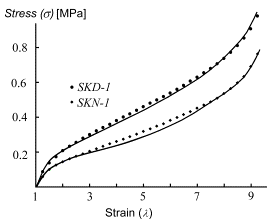
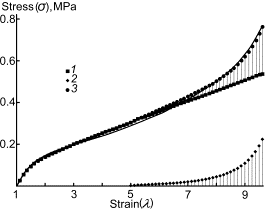
Table. Values of parameters in equation (1)
for investigated elastomers
|
sample |
|
NC×10-24, m-3 |
|
gs |
a |
b |
|
SKN-1 |
5.0 |
0.1 |
0.09 |
0.11 |
||
|
SKD-1 |
6.0 |
0.1 |
0.09 |
0.11 |
||
This work was financially supported by the Ural Branch of the Russian
Academy of Science, the program “Creation and investigation of macromolecules
and macromolecular structures of new generation” (project 12-T-3-1005), and the
Russian Fund for Basic Research (projects 13-03-00101, 13-03-96000).
References
1. Christenson
E.M.; Anderson J.M.; Hiltner A.; Baer E. Relationship between nanoscale
deformation processes and elastic behavior of polyurethane elastomers.
Polymer 2005, 46, 11744–11754.
2. Tereshatov V.V.;
Senichev V.Yu. A generalized approach for describing curves stress versus
strain for cross-linked elastomers. In: Materials of the IX Conference “Advanced science news”. BialGRAD BG. Sofia, Bulgaria.
2013, 8-10.
3. Tereshatov,
V.V.; Senichev, V.Yu. Stress-strain behavior of cross-linked polybutadiene
urethanes. Polym. Sci. 1995, A37, 702-705.