Tereshatov
V.V., Makarova M.A., Slobodinyuk A.I., Vnutskih Zh.A.
Institute of Technical Chemistry Ural
Branch Russian Academy of Science,
Perm, Russia
Prospective segmented elastomers with diverse
urethane and urethane urea hard segments
Polyurethanes
are a unique class of polymers which structure and properties are regulated in
wide limits due to using of various polyols, diisocyanates and chain extenders
at synthesis. Polyurethane materials with different combination of properties
can be obtained depending on chemical structure and quantity of components
[1-2].
Segmented
polyurethanes (SPU) consist of alternating soft and hard segments (blocks) of
different chemical structure and polarity. Chemical structure of soft segments
of SPU is determined by structure of olygomers used for their synthesis [3-5].
Hard segments are formed at the reaction of diisocyanate with
low-molecular-mass bifunctional compositions, for example diols or diamines.
Investigation
of oligodiisocyanates mixes on the base of various oligomers allows to expand a
rang to regulate properties of SPU. It
was shown that elastomers with diverse soft segments can significantly exceed
block-copolymers on the base of individual oligodiisocyanates [3,4], for
instance, for strength and moisture resistance.
The
behavior of SPU with diverse hard segments is still poorly investigated. Hence new
combination of properties of such materials could be expected while using mixes
on the base of low-molecular-mass diamine and diol as hardener for prepolymer.
This work
presents results of the investigation of the behavior regularities of segmented
elastomers (SE) with the same polyether soft segments and diverse hard segments
(urethane and urethane urea ones).
The aim
of the work is development of properties of heterogeneous segmented elastomers
with hydrogen bonds.
The table
presents data on the physical-mechanic properties of SE at the strain rate 0.28
s-1, the glassing transit temperature of the soft phase Тgs, and the softening
temperature of the hard phase Th
for various molar concentration of methylene-bis-orto-chloroaniline (MOCA) х1 in the mix with Butanediol-1,4 (BD) used within
the synthesis of polymers.
Table. Properties of SE with urethane and urethane
urea segments
|
х1 |
fp, MPa |
lр |
Е100, MPa |
Tgs, °C |
Th, °C |
Ch, % |
|
1.0 |
248 |
5.58 |
14.7 |
-51 |
202 |
36.6 |
|
0.8 |
274 |
5.87 |
11.4 |
-50 |
202 |
35.2 |
|
0.7 |
307 |
6.16 |
9.5 |
-48 |
199 |
34.5 |
|
0.5 |
360 |
6.42 |
7.2 |
-44 |
193 |
33.0 |
|
0.4 |
278 |
6.64 |
5.4 |
-41 |
185 |
32.3 |
|
0.3 |
201 |
7.02 |
3.4 |
-40 |
173 |
31.6 |
|
0 |
114 |
10.10 |
1.9 |
-37 |
- |
29.1 |
It is evident
that properties of investigated materials are significantly changed. For
example, the ultimate strain ratio changes in 2 times, the conventional elastic
modulus Е100 changes more than in 7 times in the range of the molar fraction х1 of MOCA in the mix
with BD (from 0 to 1). The total concentration of hard blocks (urethane and
urethane urea ones) in investigated materials varies a little. The composition of hard blocks influences the
properties of SE in the higher degree. The low content of urethane urea hard blocks
(х1>0.5) leads to
increase in the glass transit temperature of the soft phase, and decrease in
the glass transit temperature of the hard phase. This effect may be a result of
formation of the more defect friable structure.
An analysis of IR-spectra
of SE shows that increase in fraction of urethane segments in the composition of diverse hard segments leads
to increase in the intensity of the band at 1710 cm-1 for vibration of carbonyl of urethane groups bonded with ether oxygen via H-bonds. This confirms the increase of fraction of urethane hard blocks in the soft phase of a polymer. In the ultimate case
(х1=0) two bands can be
seen for carbonyl: the band for free carbonyl at 1731 см-1 and urethane group absorption band (1710 cm-1)
associated with the H-bonded oxygen polyester. The band 1700 – 1731 cm-1
for carbonyl of urethane groups’ self-associates bonded by H-bonds is absent.
Thus, the material has only a one phase with presence of urethane hard segments
only (Fig. 1).
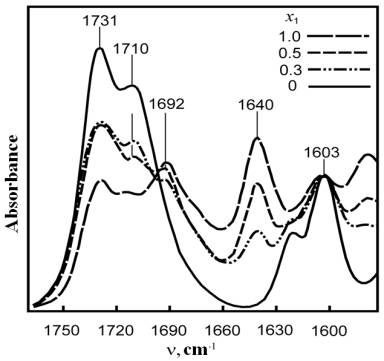
Fig. 1. IR-spectra of SE with various fraction of aromatic
diamine in the mix with Butanediol-1,4.
An intensive
absorbance band of carbonyl of self-associates of urea groups at 1640 cm-1 shows
that the degree of microphase separation between soft polyether segments and
hard urethane ones is high while х1=1 (Fig.1). The assignment of bands was made according to [6].
The glassing
transit temperature of the soft phase Тgs should increase and
the Е100 value decrease because
solubility of hard blocks in the soft phase of SE increases as the fraction of BD
increases in the mix with MOCA at the synthesis of a polymer. This effect is
shown in experiments.
The maximum
true tensile strength fp of SE is shown at the same fraction of
urethane and urethane urea hard segments in them (х1=0.5). This value
is higher the same for the classic polytetramethylene oxide urethane urea in 1,5
times. The high tensile strength of SE is combined with the significant
increase in the ultimate strain ratio lр of a material (Table).
|
Figure
2 shows an inverse relationship of the true tensile strength fp on the strain rate u for polyurethane
urea (х1=1) and SE with the same fraction of urethane and urethane urea
blocks. According [6, 7]
this effect relates to the process of strain of hard blocks when they don't
have time to orient in the strain direction at the high rates. Decrease in
this rate leads to increase in the orientation degree of hard blocks at high
strain ratios, this allows to increase the tensile strength of SE. |
|
|
Fig. 2. True
tensile strength versus strain rate for SE:1 – with diverse hard blocks (х1=0.5), 2 – without urethane blocks (х1=1). |
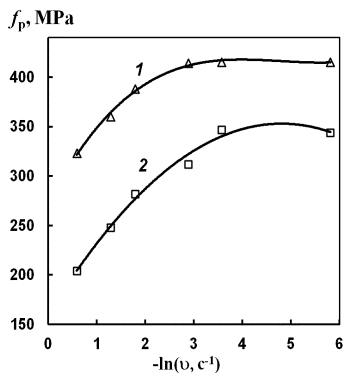
On the
contrary, relaxation of labile physical network allows to decrease in tensile
strength of a material. The influence of the orientation factor of hard
segments on the strength of SE leads to the great difference between maximal
and minimal value of strength fp (in 1.7 times). Interchain
interaction is amplified in the soft phase of SE when one half of urethane urea
hard blocks replaced by urethane ones, soluble in the soft phase of a polymer.
Therefore the dependence of strength of SE on the strain rate becomes weaker (Fig.3).
This is a remarkable property of a material with diverse hard blocks.
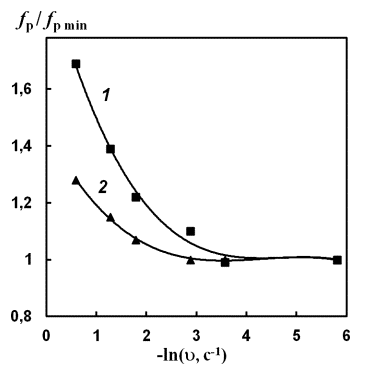
Fig.3. The ratio true
tensile strength fp /minimal value of true tensile strength
fp min versus strain rate: 1 – without urethane blocks (х1=1),
2 – with diverse hard blocks (х1=0.5).
Therefore,
use of mix with aromatic diamine and low-molecular-mass diol for SE synthesis allows
to regulate physical-mechanic properties of urethane-containing elastomers in
wide limits.
An extreme
dependence of strength on the mix composition is a result of combination of two
factors: increasing in the interchain interaction in the soft phase due to the
dissolution of urethane hard segments in it, and the microphaase segregation of
hard and soft segments. The forming hard phase is a reinforcing filler. The
increase in the microphase segregation degree leads to the decrease in the
interchain interaction.
Experiments
carried out at different strain rates allowed to show a fundamental feature of
behavior of SE with mixed hard blocks. The
balanced influence of hard and soft phase on the physic-mechanical properties
of such materials allows to weakening of the influence of a material strength on
the strain rate. High values of strength of SE are achieved in a wide range of
strain rate.
The work was carried out with the financial
support of the program of Branch of Chemistry and Material Sciences of RAS «Creation
and investigation of macromolecules and macromolecule structures of a new
generation» (project 12-Т-3-1005), and the
Russian Foundation for Basic Research with the Government of Perm kray (project
13-03-96000).
References
1. Prisacariu C. Polyurethane
Elastomers. From Morphology to Mechanical Aspects. NewYork: SpringerWien, 2011.
255p.
2. Randall D; Lee S. The polyurethanes book. New York: Wiley; 2003. 494p.
3. Tereshatov V.V., Tereshatova E.N., Makarova M.A.,
Tereshatov S.V. Influence of chemical structure and
composition of mixed soft segments on the properties of elastomers with
urethane-urea hard blocks // Polym. Sci. 2002. Vol. 44A, No 3. С. 275-281.
4. Tereshatov V.V., Strel’nikov V.N., Makarova M.A.,
Senichev V.Yu., and Volkova E. R. Structure and Properties of Segmented
Polyurethane-Ureas with Dissimilar Soft Blocks // Russian J. of Appl. Chem.. 2010. Vol. 83, No. 8. P. 1380-1384.
5. Petrovic
Z.S. and Ferguson J. Polyurethane elastomers // J. Polym Sci. 1991.Vol. 16. P.695-836.
6. Vasiliy V. Tereshatov, Marina A. Makarova, Valeriy
Yu. Senichev & Alexey I. Slobodinyuk. Interrelationship between ultimate mechanical properties of variously
structured polyurethanes and poly(urethane urea)s and stretching rate thereof
// Colloid and Polym. Sci. 2012. V. 290, Issue 7. P. 641-651.
7. Yeh F., Hsiao B.S., Sauer B.B., Michel S., Siesler H.W.
In-situ studies of structure development during deformation of a segmented
poly(urethane-urea) elastomer // Macromolecules. 2003. Vol. 36, No 6. P.1940-1954.