UDC 378.147: 009
CHYZHYKOVA O.V.
Researcher
of Kryvyi Rih
Pedagogical Institute of State Higher Educational Establishment "Kryvyi
Rih National University", Teacher of Kryvyi Rih Institute of Economics of State Higher
Educational Establishment
"Kryvyi
Rih National University",
FORMATION OF
THE FUTURE LEGIST’S CREATIVE PERSONALITY BY MEANS OF CREATIVE EDUCATION IN THE PROCESS OF FOREIGN LANGUAGE
TRAINING
The article reveals the theoretical aspects of the future legist’s
creative personality formation in the process of foreign language training. The article highlights the basis for the development of the future
legist’s creative abilities by means of creative education. The role of
creative abilities in professional self-determination of a future specialist is
defined in article.
Key words: creative
personality, creative abilities, foreign language, future specialist, creative
education.
Problem identification. An important requirement
of modern society is the demand for creative personality of a future specialist.
There is an evident need for professionals capable of permanent personal self-development.
All this creates an objective necessity of implementation in the higher
education system fundamentally new approaches, centered not on the gradual linear
accumulation of knowledge and skills in the student’s mind, but on the
development of creative abilities, which provide the opportunity to apply
acquired competencies in unusual situations, to act creatively.
Analysis of recent researches. J. Guiford, C. Rogers, P. Taylor, P. Torrance, G. Wallas dedicated
their works to the research of the problem of a creative personality formation.
J. Flanagan studied the measurement of ingenuity, H.G. Gough and F. Barron –
the measurement personality traits relevant to creative achievement, P.
Torrance studied creativity in schoolchildren and the effect of the educational
system upon the development of potential creativity.
The creative
individuality’s properties studied A. Andreev, Maslow, K. Platonov, S. Sysoeva,
O. Shcherbakov. The necessity of creative abilities development as an integral
part of a future specialist personality is examined in works of such scientists
as N. Basova, H.Berehova, R. Gareev, J. Drach, V. Nagayev, V. Noskov, A.
Sologub and others. Considerable experience has been already accumulated and
different approaches to the creative personality and creative skills have been
thought about. However, analysis of the scientific literature shows that the
problem of future lawyers’ creative abilities development, in the process of foreign
language education in particular, yet has not been studied
enough.
The objective of the article is the theoretical substantiation of essence of a future specialist’s creative
personality formation by means of creative education in the process of foreign
language training.
The main material exposition. Modern pedagogy emphasizes the need for comprehensively developed
personality, including creative abilities of future specialists.
Creativity in
general can be defined as an ability or an occurrence. It refers to developing
an alternative way of solving a problem or dealing with some other subjects.
The distinctive aspect of a criteria alternative is that it is better on
whatever criteria are considered relevant than the alternatives that were
previously being considered. A special kind of creativity involves not merely
finding a better way of doing things, but of finding a way that exceeds the
best initial expectations of whatever sides or viewpoints may have been in
connection over how to deal with the problem. This so-called super-optimizing
creativity does more than just finding a new better or best alternative. It
finds an alternative that is better than the previous ones [4, p. 3].
In the scientific
literature, personality is defined as a concrete, integral human individuality
in the unity of the natural and social qualities. It is pointed out that today the
goal of education and training is changing. It is aimed not to give a certain
complex of knowledge and skills, but to provide a free development of
personality [1, p. 243]. S.O. Sysoyeva in her turn emphasizes that a person
should be treated as a systemic social individual quality, which is formed in a
joint activity and communication. Based on this definition, a creative personality
is a subsystem of personality, which is characterized by a set of creative
qualities of the individuality, that ensure the success in creative activities.
The boundaries of personality’s creativity vary from an extraordinary solution of
a simple task to creation of a new objective in a particular area [2, p. 46].
Scientists today
stress upon the necessity to develop creative skills as an integral part of a
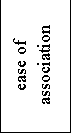
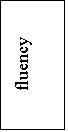
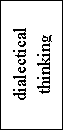
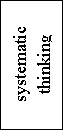
future specialist personality. Among the basic creative abilities researchers
refer fluency and flexibility of thinking, mental performance, abstraction,
search for analogies and associations, systematic and dialectical thinking,
originality, creativity, self-control, ease of generating ideas and creative
imagination.
A number of
leading psychometricians undertook test-development efforts in the general domain of creativity abilities. Undoubtedly
important contributions were made by J.P. Guilford. He was the first to
introduce the concept of divergent (creative) thinking (that is flowing in
different directions). However, the latter does not provide a specific number
of answers; non-trivial search and unexpected solutions are encouraged. Among
the 16 factors of creativity the researcher singled fluency (word, associational,
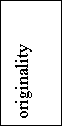
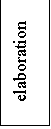
expressional, ideational), flexibility (spontaneous, adaptive), originality, elaboration,
thinking (reflective, rigorous, autistic), esthetic activities (esthetic
appreciation and esthetic expression) etc. [6]. Creative abilities, therefore,
is a complex of personal traits, which is a system of interconnected components
arranged to form a complex synthesis of knowledge and skills based on past
experience.
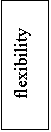
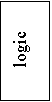
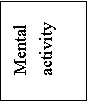
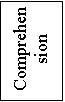
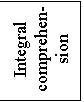
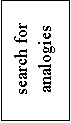
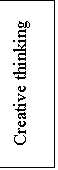
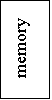
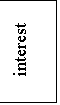
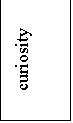
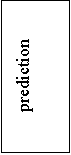
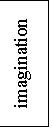
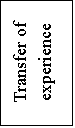
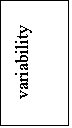
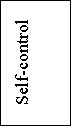
Thus the
structure of creative thinking of a future professional can be schematically
presented:
Component
structure of creative thinking







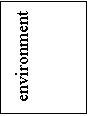
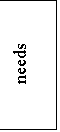
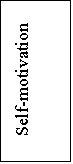


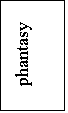




Development of
creative abilities is one of the important tasks of specialists’ training. It
is particularly important to develop these qualities in the process of a future
legist’s education. In addition to fundamental scientific skills such qualities
of a future specialist are essential: 1) professional (respect for the laws,
love to the profession, the ability to evaluate the activity in a critical
way), 2) ethical (morality, high ethical views, integrity, responsibility for
work performed, humanity, tolerance), 3) intelligent (the ability to
distinguish the essential from the inessential, the depth and flexibility of
thinking, independent judgment, observation, productive memory), 4) emotional
qualities (ability to remain tolerant in conflict situations), 5)
organizational ones (ability to organize his or her own work and teamwork
effectively) [3].
Creative learning
is the effective way of creative abilities’ development of a personality and
promotes education efficiency, initiative, independence, ability to analyze,
transform educational information, involves the development of creative
thinking, imagination and intuition. The methods of creativity intensification include
brainstorming, synectics, conference of ideas, debate, heuristic conversation,
problematic lecture, training, case-method, role playing and others. It is
proved that the problem-situational and role playing technologies are aimed to
optimize the foreign language education, productive development of creative abilities;
contribute to the formation of creative thinking; develop skills to advance
arguments and to make decisions. Communicative problematic situations, that
simulate professionally oriented situations of a future specialist, provide an
active acquirement of foreign language competence, form motivation of cognitive
activity, enrich foreign language vocabulary and develop the ability to think
analytically and independently, to penetrate into the structure of the language
and so on.
The following
tasks can be the examples of creative learning implementation in the process of
foreign language training:
І Problem
solving:
1) A French businessman is going to sign a contract with
a company in the USA. It is a very significant contract for the French company
and Managing Director wants to conduct negotiations himself. The only problem
is that he is afraid of flying by plane. 2) An average American family is going for a holiday. But the members
cannot agree upon the place of the vacation. Children want to go to the
seaside, mother prefers visiting Europe, father is dreaming of a quiet place
near the forest. Advise how to solve the problem.
ІІ Points for
discussion: 1. The courts sometimes make mistakes, and innocent people are found
guilty. Is this an important point in the argument against the death penalty? 2. Some people say the death penalty is against the constitution of the
USA, because the constitution forbids “cruel or unusual” punishment. Do you
agree?
3. In the USA, different methods of execution are
used, e.g. the electric chair, lethal injection,
gas. Which do you find the most/the least acceptable? 4. The last woman to be
executed in Britain was Ruth Ellis. She was hanged in 1955. She had shot her
lover because he had another girlfriend. It was a “crime of passion”. Do you
think the death penalty should be used for this type of crime?
Conclusions. Thus,
an essential prerequisite of a future professional determination is development
of students' creative personality. The
development of legists’ creative skills should become an integral part of
future specialists’ training.
References:
1. Гончаренко С.У.Український педагогічний словник / С.У. Гончаренко. – Київ:
«Либідь», 1997. – 374 с.
2. Сисоєва С.О. Педагогічна творчість
/ С.О. Сисоєва; АПН України. Ін-т педагогіки і психології проф. освіти. — К.,
1998. — 151 с.
3.
Юридическая
деонтология: Учебник / О.Ф. Скакун, И.Н. Овчаренко. - Х.: Основа, 1999. - 304 с.
4. Creativity plus: The journal / The
National Policy Studies Organizations. – Illinois. – 2000. – Publ. quarterly.
5.
Cropley
Arthur J.. Education [Electronic recourse] / Encyclopedia
of creativity. - Vol. I. - The USA:
Academic Press. 1999. - P. 629 – 643. - available at:
http://books.google.com.ua/
6.
Guilford J.P. Analysis of
intelligence. McGraw – Hill, 1971.
7.
Starko A. J.
Creativity in the classrooms: schools of curious delight [Electronic recourse] / Alan Jordan Starko: Lawrence Erlbaum
Associates– second edtion. – 2001. – 455 p. - available at: http://books.google.com.ua/books/creativity+in+pedagogical+science