Педагогика /
4. Стратегические направления
реформирования
системы образования
Shastova I.V.
Educational centre
“Greenly”
Common
European Framework of Reference for Languages: Structure of the Communicative Language Competence
The category of
communicative language competence is widely discussed among Ukrainian
educators. Researchers develop various, sometimes contradictive, structures of
this language phenomenon while Ukrainian National Curriculum in teaching
Foreign Languages strongly recommends coordinating foreign language teaching
issues with Common European Framework of Reference for Languages: Learning, teaching,
assessment. Thus, according to both documents communicative language competence
has three components: linguistic competence, sociolinguistic competence, and
pragmatic competence. The structure is presented in Figure 1.
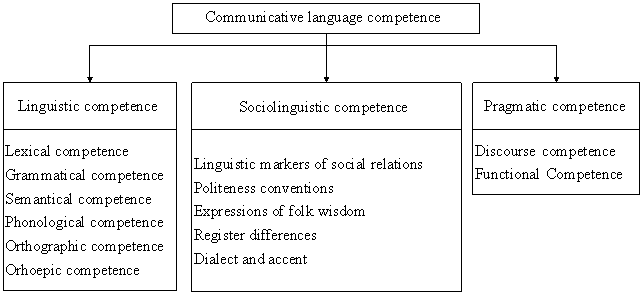
Figure 1. Structure of the communicative language competence
Communicative language
competence contributes to the language user/learner’s ability to communicate,
however it is not the only factor to develop language skills as learners draw a
number of other competences which are based on their previous general
experience. Thus, communicative language competence is a part of the user’s competence.
Figure 2 presents the place of communicative language competence among the
other competences, as it is mentioned in Communicative European Framework of
Reference for Languages: Learning, teaching, assessment.
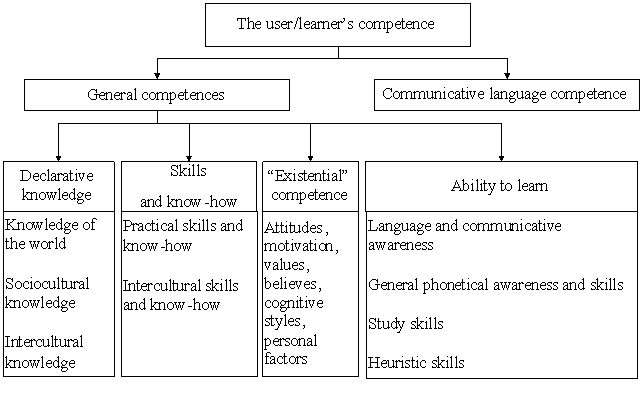
Figure 2. Structure of the user/learner’s competence
It is noteworthy, that this structure needs a very careful consideration
while translating the terminology from English into other languages. Thus, term
“communicative” should be distinguish from the term “speech” as the first one
has much broader connotation. Furthermore, term “phonological” and “phonetical”
can be confused and replaced while translating them into Russian or Ukrainian.
Likewise, term “sociocultural” (in sociocultural skills) should be
distinguished from “sociolinguistic” (in sociolinguistic competence). Moreover,
the defitions of “skills” and “know-how” consider investigation and wise
translation.
Indeed, communicative language competence cannot be forms without general
competences – without, for example, language and communicative awareness, as
well as general phonetical awareness and skills. At the same time it is
necessary to remember that communicative language competence is activated in a
number of communicative activities (such as production, perception, interaction
and mediation) and learners also have to operate communicative strategies.
References
1.Communicative European Framework of Reference for Languages: Leaning,
teaching, assessment : [Електронний ресурс] – Режим доступу : http://www.coe.int/t/dg4/linguistic/source/framework_en.pdf