#Malyukova
L.S. , Kozlova N.V. , Velikiy A.V. Effect of boron and zinc-containing
fertilizers on yield of tea leaf on Russian Black Sea Coast
Сельское
хозяйство / 3. Земледелие, грунтоведение и агрохимия
L.S.
Malyukova, N.V.
Kozlova, A.V.
Velikiy
The All–Russian Scientific and
Research Institute of Floriculture and Subtropical Crops, 354002, Krasnodar region, Sochi, Yana Fabritsiusa
str. 2/28
Effect of boron and zinc-containing fertilizers on yield of tea leaf on
Russian Black Sea Coast
Industrial cultivation of tea on the Black Sea coast
of Russia, accompanied by the prolonged use of mineral fertilizers, has led
(due to the increased soil acidity) to the increase in the mobility of some
elements (Ca, Mg, Mn, Fe, Al, Cu, Zn), changed the balance of nutrition
elements in soil-absorbing complex and some other soil properties [2, 5-8]. In
this regard, the task is to develop the most effective agrochemical methods of
increasing yield, quality of tea leaves as well as to preserve fertility in
unique soils [1, 7, 10]. Multicomponent mineral nutrition of tea plants is
considered as one of the most promising areas, including the use of
micronutrients. The most significant role in ensuring
high productivity and quality of tea raw material is experimentally proved by
many tea-producing regions and belongs to such micronutrients as boron and zinc
[1, 3, 9, 11]. Boron and
zinc play an important role in the physiological and biochemical processes
concerning plant growth, particularly in phenolic and carbohydrate metabolisms,
respiration and plant resistance to abiotic stress factors [4, 9]. The aim of this research was to study the effect from
soil fertilizers containing boron and zinc on yield of tea raw material, in
conditions of Russian Black Sea coast.
The studies were conducted during 2008-2013 based on the field
experiment, which was pledged on a tea plantation in 2003 and included a
regionalized cultivar called Colkhida (planted in 1983) on the Russian Black
Sea coast. Zinc sulfate (Zn - 4,3 kg/ha of active substance) and boric acid
(B - 6 kg/ha of active substance) were added to the soil surface on the background nitrogen rate (240 kg
N·ha), phosphorus (70 kg P2O5·ha) and potassium rates (90
kg K2O ha). As a control,
there was an option with the introduction of macrofertilizers nitrogen rate
(240 kg N·ha), phosphorus (70 kg P2O5·ha) and potassium
rates (90 kg K2O ha). The size of experimental plots was
10 m2. The frequency - 3-fold. The soil
is brown forest acidic with low humus content and powerful, on eluvium-deluvium
of mudstone. Before setting the experiment, the soil was characterized by
acidic reaction of medium of the soil solution ( pH 3,2-3,3 ), average supply
with hydrolyzable nitrogen ( 80-100 mg/kg), mobile phosphorus (300-400 mg/kg)
and potassium (200 - 300 mg / kg). Уield
was considered as an integral indicator of plants growth and was recorded from
May to October (6-10 harvests) on the test options during the periods of
complete formation of 3-leaf tea fleches. In order to assess photosynthetic activity
in tea plants, the content of photosynthetic pigments (chlorophyll a, b and
carotenoids) in green tea leaves was determined after extraction with with
acetone (100%) by Shlyk method using computational formulas of Tsingler and Egle [12].
On average, the studied
years were characterized by relatively favorable weather conditions for cultivating tea culture in Russia (no return
of winter cold in spring, sufficient rainfall during the vegetation season - on
average - 800 mm), which contributed to high yield of tea leaves for a given
zone (Table).
Table
- Effect of boron and zinc-containing fertilizers
on the
yield from tea cultivar Colkhida, kg/ha
|
Option |
Observation
years |
On
average for 2008-2013 yy. |
Addition to the control, % |
|||
|
2008 |
2010 |
2011 |
2013 |
|||
|
control |
4150 |
4720 |
5900 |
9200 |
5993 |
– |
|
B |
4680 |
5940 |
9200 |
11600 |
7855 |
34 |
|
Zn |
3530 |
5090 |
7700 |
10000 |
6580 |
10 |
|
LSD 0,05 |
346 |
541 |
623 |
755 |
– |
– |
However, the optimal hydrothermal
conditions in 2011 and 2013, including the summer period, contributed to the
formation of a higher yield from tea leaves, approaching potentially possible
(maximum) for the cultivar called Colkhida (10 000-12 000 kg/ha). The most
significant increase in their harvest during the analyzed period was marked on
the option with the introducing boron into the soil on the background of
macrofertilizers (Table ), due to its element’s ability to intensify
shoots-formation in tea plants (fig.1). The option with
applying zinc-containing fertilizers also exceeded the control, but was a bit
worse in productivity growth than that with boron. Analysis on the content of photosynthetic pigments (chlorophyll
a, b) in mature leaves showed minor differences in absolute values for the test
variants, with a tendency to reduce their content if boron and zinc were
applied to the soil (2,01-2,85 and 2,24-2 99 mg/g of chlorophyll a and b,
respectively) compared with the control (2,42-3,02 mg/g amount of chlorophylls
a and b), which is probably due to the more intensive use of these pigments in
the options with higher yields. However, these options had a stronger process
of accumulation of chlorophyll a, b and carotenoids in physiologically mature
leaves from July till September; their content was significantly increased in
1,3-1,4 times (1,2 times when in the control), indicating more intensive
activity of plants photosynthetic apparatus.
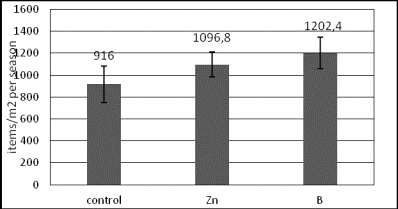
Figure 1. The effect of boron and zinc on the shoot-forming
ability of tea plants during the growing season, pcs. / m2.
Shoot-forming ability in this embodiment may
also be activated due to the increased synthesis of growth stimulants, such as
auxin and cytokinin, and due to the speed of their movement within a body or on
the boundary of different organs. Zinc also intensified shoot-forming activity of tea plant, thereby
increasing productivity. There is some data on the effectiveness of this type
of fertilizers, associated with its influence on the complex redox processes,
including enzymatic defining an adequate defensive response and, therefore,
resistance to stress of different nature.
The research has shown that soil fertilization with boron and zinc (6
and 4,3 kg/ha of active substance,
respectively) on the Black Sea coast of Russia provided tea plantation
productivity to 34 and 10%, respectively, increasing shoot-forming and
photosynthetic activity.
REFERENCES
1.
Barabadze L.A. (1984): Effect of long-term application of mineral fertilizers
on the state of microelements (B, Mn, Fe, Cu, Zn) in the system red soil - tea
bush: Author. dis. ... Cand. Agr. Sci. – Tbilisi.
2.
Besedina T.D. (2004): Agrogene transformation of soils in Russian humid
subtropics containing culture. - Krasnodar: Kuban State Agrarian University.
3. Gohian T., Barbora A.C. and Deka A. (2000): Effect
of boron on yield and quality of tea. Journal of Plantation Crops. 28(1):
67-71.
4. Upadhyaya H., Biman K., Dutta B.K., Lingaraj Sahoo, Panda S.K. (2012):
Comparative Effect of Ca, K, Mn and B on Post-Drought Stress Recovery in Tea [Camellia
sinensis (L.) O Kuntze. American Journal of Plant Sciences.
3: 443–460.
5.
Kozlova N.V. (2008): State of brown forest acidic soils with tea plantations if
mineral fertilizers are used in Russian subtropics for a long time: dis. ...
Cand. Biol. Sci. - Moscow.
6.
Malyukova L.S. (2011): Microelements in the system soil - tea plant in Russian
subtropics. - Sochi: The State Research Institution All–Russian
Scientific and Research Institute of Floriculture and Subtropical Crops of the
Russian Academy of Agricultural Sciences.
7.
Malyukova L.S. (1997): State of microelements (Mn, Cu, Zn) in the brown forest
soils of tea plantations on the Black Sea coast of Krasnodar region: dis. ...
Cand. Biol. Sci. - Moscow.
8. Owuor P.O., Othieno C.O., Kamau D.M., Wanyoko J.K. (2011-2012):
Effects of long-term fertilizer use on a high-yielding tea clone AHPS/10: soil
pH, mature leaf nitrogen, mature leaf and soil phosphorus and potassium
//International journal of Tea Science. 8(1): 15-51.
9. Pathak S.K. and Pradhan, S.K. (2005): Effect of
Boron and Manganese sulphate in yield and quality of Darjeeling Tea (Camellia
sinensis L.). proc. 34th Tocklai conference.Held in 28th to 30th Nov. 267-273.
10.
Pritula Z.V. Malyukova L.S., Kozlova N.V. (2011): Influence of fertilizers on
biochemical indicators of tea leaf qualities for Colkhida cultivar in Russian
subtropical conditions. Agrochemicals. 3: 33-40.
11.
Shavishvili L.M. (1973): Effect of magnesium and microelements B, Zп, Co and Mo
on some physiological and biochemical processes of tea plant: Author. dis. ...
Cand. Biol. Sci. – Tbilisi.
12.
Shlyk A.A. (1971): Determination of chlorophyll and carotenoids in green
leaves. Biological methods in plant physiology. - M.