#Глазкова Н.Г.,
Землянская С.В. Recommendations for Improving the Effectiveness of Government
Incentives and Politics of Foreign Direct Investment in the Oil Sector
Economic science 2. / Foreign economic activity
Candidate of Economic Sciences, Associate
Professor Glazkova N.G.,
Candidate of
Economic Sciences, Associate Professor Zemlyanskaya S.V.
Volgograd State
University, Russia
Recommendations for
Improving the Effectiveness of Government
Incentives and Politics of Foreign Direct Investment in the Oil Sector
In 2014, Western countries imposed sanctions on
Russia. Some of the restrictions affect one of the most
important parts of the Russian economy – the oil sector. Sanctions apply to the
exploration of deep-sea and Arctic oil deposits. They limit the access of
Russian oil companies to modern technology and foreign loans.
Russian oil companies are heavily dependent on foreign
technology – in fact, the sanctions affect 68% of imported equipment.
Restrictions on the import of technology also extend to those spare parts that
are not produced in Russia. Due to the sanctions Western companies have had to
suspend their participation in projects intended for future oil production in
Russia and cancelled their participation in exploration of new oil deposits and
stopped providing modern technology for geological studies and for production
of heavy oil [2].
Financial difficulties caused by the sanctions have
reduced the interest of Russian oil companies in projects requiring major
investments, e.g. in the Arctic or in deeper geological formations.
Restrictions on foreign credit are forcing them to focus on increasing the
productivity of existing oil deposits. However, such productivity increases
requires the use of modern technology – which is provided by foreign owned oil
service companies.
Restrictions have forced Russian oil companies to
request help from the government or from financial institutions of those
countries that have not imposed sanctions. In 2015 Russia's Industry and Trade
Ministry's Development Fund granted low interest long-term loans to a few dozen
industrial companies for import-substituting projects. Despite their announced
plans Russia's government and businesses have not succeeded in starting or
restoring the import-substituting production of required equipment for oil
sector.
The impact of financial restrictions on the oil sector
is already being felt as the scarcity of funds is forcing Russian oil producers
to cut down planned investments which inevitably lead to the fall of production
and export of oil and to the decrease of tax revenues. Experts estimate that in
2014-2017 the Russian economy will lose approximately 170 billion USD due to
the combination of financial sanctions and cheap oil [3;45].
Restrictions on the import of technology will have a
long-term impact. The existing equipment fleet enables Russia to maintain
current production levels. However, with the increase of the share of heavy oil
in production the demand for new technologies also increases. Due to sanctions Russian
oil companies have to make do with existing equipment because of their
inability to replace Western technology with domestic equivalents. Import from
non-aligned countries or buying up Western companies with necessary know-how
will not solve the problem for the Russian oil sector in the long run.
The current system of government regulation does not
create reliable motivation of oil producers for constant technological updates,
and does not stimulate the inflow of foreign direct investments in the sector.
The shortcomings of the government FDI attracting
policy in the oil sector:
- the system of subsoil
use restricts the activities of foreign investors in the oil sector;
- the taxation system
does not stimulate investment in exploration and R&D;
- non- systematic
policies of technological development [1].
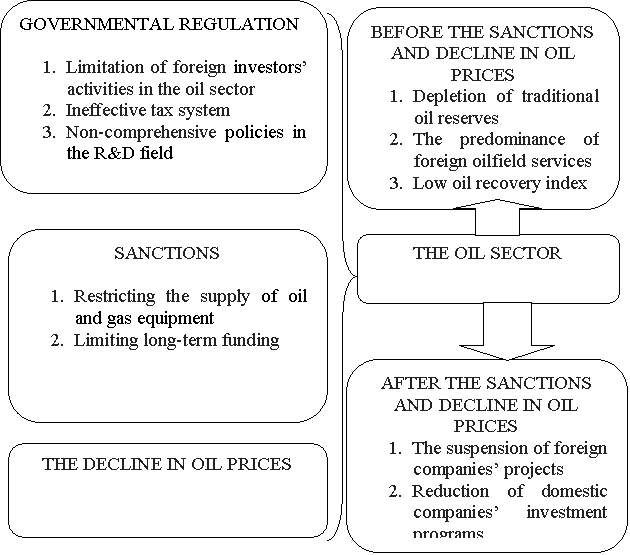
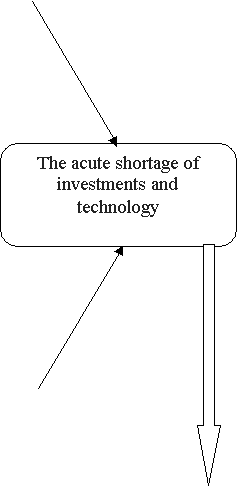

Pic. 1. Problems of Russian oil-producing sector and
its regulatory systems
In order to attract significant investment to develop
the Russian unconventional oil reserves, it is necessary to create joint
ventures with foreign companies, and to use production
sharing agreements (PSAs),
similar to those in Brazil and China, for stranded oil, as well as
hard-to-reach fields located in difficult climatic and geological conditions.
However, to minimize negative effects the terms of the agreements should
be carefully studied before contracts’ conclusion based on international investment practice.
Implementation of high-risk and capital-intensive large-scale projects is
possible only in the framework of companies’ syndicate that has access to
international debt capital market. In turn, for foreign companies the PSA acts
as the guarantee of
investment regime stability. The implementation of the agreement leads not only
to direct economic effects, but also to indirect effects.
Based on the Brazilian experience in the Russian
legislation the following changes should be taken: to modify the fields’
inclusion criteria in the list of subsoil for development under a PSA; to alleviate restrictions
on foreign investments; to allow Russian private companies develop the Arctic
shelf.
The national tax regime based on the tax on mineral
extraction, needed to be changed with the introduction of a single flexible
system of taxation, based on the financial results of oil companies that will
contribute to the creation of joint ventures with foreign companies. Also the
mechanisms of special tax regimes for foreign investors should be implemented,
taking into the account the key importance of oil and gas revenues for the
Russian state budget. In the framework of the subsoil system, which is based on
production sharing agreements, it is necessary to
establish a differentiated system of taxation, depending on the production
characteristics of the field, similar to the Brazilian tax system.
It is also possible to approve in the
Russian legislation the list of
encouraged, limited and prohibited activities for foreign investors, which can
restrict foreign investment to such segments of oil production, where there is
a shortage of modern high-tech equipment and highly qualified specialists [4].
Table 1
Recommendations for Improving the Effectiveness of Government Incentives and Politics of Foreign Direct Investment in the Oil-Producing Sector
|
POLICIES |
EXISTING
CONDITIONS |
RECOMMENDATIONS |
|
Policy
of subsoil use |
Licensing system of subsoil use (Federal law) Non-performing investment regime of PSA |
The removal of barriers to concluding production sharing agreements The establishment of the concession system of
subsoil use |
|
Tax
policy |
National tax regime based on the mineral extraction
tax and export duty The special tax regime is only valid within 3 PSA |
The creation of a single
flexible system of taxation under the national tax regime The creation of a differentiated system of taxation
under the PSA |
|
Limitations on foreign investors’ investment
activity |
Limitation of the companies’ activity in the
strategic fields |
The easing of restrictions for foreign investors on
the development of strategic deposits |
|
Policies
to encourage FDI |
Federal law «On territories of
advancing socio-economic development in the Russian Federation» |
The creation of the Chinese analogue of the list of
encouraged, limited and prohibited investment activities Introduction of benefits to encourage the types of
investment activities |
|
Policy in the field of technology and innovation |
Preferences for mineral
extraction tax and export duty Exemption from payment of the VAT, land tax,
property tax Preferences for import of equipment Policy for usage of domestic components and
materials for PSA |
The introduction of an additional tax revenue for
the development of research and development The activation policy of the domestic components and
materials use |
Literature:
1. Arbatli E. Economic Policies and FDI Inflows to Emerging Market
Economies [Electronic
resource] // IMF Working Paper. – 2011. – August. – URL:
http://www10.iadb.org/intal/intalcdi/PE/2011/08863.pdf
2. Dmitrievcky A.N. The
fundamental basis of the oil and gas industry in Russia. [Electronic resource].
– URL: http://oilgasjournal.ru/2009-1/4-rubric/dmitrievsky-f-b.html
3. Katisheva E.G. The
analysis of structural changes in the Russian oilfield services market //
International research journal. – 2015. – № 5. – P. 44–46.
4. Sechin I.I. Report
on the Summit "A New balance in the oil market and its implications"
within the framework of SPIEF 2015. – URL: http://www.rosneft.ru/news/today/190620152.html