The
Technology of Micro-Powders from Pulp and Peel of
Wild-Growing Rose Hips in Georgian Conditions
Varden
Khvedelidze, Doctor of
Technical Science, Professor
Dodo
Tavdidishvili, Candidate of
Technical Science, Professor
Manana Pkhakadze, Candidate of Technical Sciences, Professor
Akaki Tsereteli State University,
Kutaisi, Georgia
The main requirements to the technology for processing rose hips consist
in a maximum preservation of biologically active substance.
Rose hip is a seasonal product, so in medicinal agents it is recommended
to use the dry products from hip rose pulp and peel, which are characterized by
high nutritional values and biological stability during storage. Due to their
small volumes, the powders are acceptable in transportation and production of
medicinal agents.
Proceeding
from the set goal, the object under study is represented by micro-powders of
rose hips (Fructus Rosae) wild-growing in Georgian conditions.
The
production cycle of hip rose micro-powders comprises dehydration and grinding.
The
best result has been obtained in processing of fruits by activation method at a
low temperature (up to 20-25 оС). The loss of C vitamin, whereupon,
does not exceed 10-12%. We note that when applying existing technology (drying
to 70 оС, relative air humidity – up to 50%) the loss of C vitamin
exceeds 24-25%.
The
process of producing micro-powders from rose hip is a significant factor for
preservation of organoleptic, physio-chemical and other parameters, since they
impact to the quality of the finished medicamentous means and food additives.
We
have proposed an optimal technological scheme for producing powders from rose
hips (Fig. 1).
According
to this technology it is possible to produce micro-powders as from rose hips as
a whole, so from its seeds and pulp with peel. To achieve this set goal it is
also possible to use the powder from rose hip pulp and peel as a vitaminic
filler.
Following the drying process in the conditions ov intensive
air supply at a temperature of no more than
50 оС, the rose hips are cooled down, ground and subjected to
separation, pulp and peel are separated from seeds. Then, in micro-grinder,
there is formed the micro-powder with particle size of no more than 50 microns
(75%). Then the micro-powder is passed through the sieve, weighted and
packed.
Micro-powder produced from rose hip pulp and
peel is a homogeneous bulk brown mass having moisture conent of no mre than
10-12%.
For
determining the optimal expiry terms of rose hip processing products, there
were conducted studies of dynamic changes in indicators of rose hip powder
composition and microbiological parameters during 12-month storage. The powders
were stored in a dry well ventilated area, where the necessary sanitary
requirements were met: temperature - 18-20 оС, and air relative humidity – 60-70%.
The wieght content of humidity in rose hip
peel and its pulp powder decreased 0,3%, but acidity after the period of 8
months increased by 10% (after the period of 12-month storage, acidity
increased by 21%). The loss of C vitamin after the period of 8-month storage
was 6,5%, but after 12-month period of storage it was 22,0%.
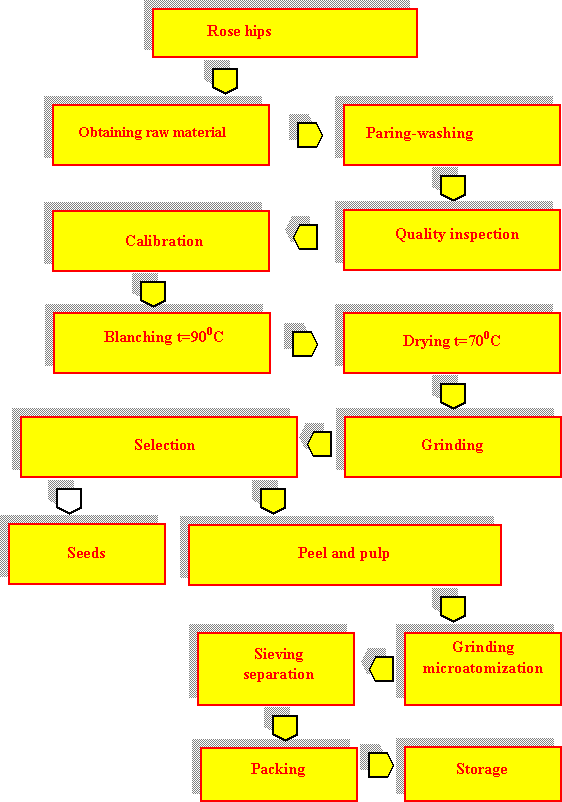
Fig. 1. Technological scheme for producing micro-powder from rose hip pulp and peel
The results of studies of powders
mocroflora composition have shown that an increase in the number of
microorganisms after the period of 12-month storage is slight and does not
exceed the permissible normal standards envisaged by methodological and
biological requirements during the fruit and berry raw materials
processing.
The
analysis of the performed studies has shown that the dry rose hip micro-powder
is desirable to store no more than 8 months, since with long-term storage the
loss of C vitamin goes up.
For
chraracterizing the friability of rose hip pulp and peel micro-powders the
followinf formula was used:
Kv = µd / 4α(1- sin β) =
1,371,
where, Kv – are
friability criteria; α =400 kg/m3 – the volume weight of
rose hip micro-powder; d = 43 x 1,5 =
65 microns; d – extrusion inner
diameter and 1,5 – adaptation coefficient; α
– initial shearing resistance; sin β = sin 310
201
– angle of shearing resistance.
Thus, Kv
= 1,37>1 indicates high friability of rose hip pulp and peel
micro-powder.
In an object under study we have determined the
content of: lipids, ascorbic acid, dry matters – in compliance with standards;
proteins – by using Kjeldahl analyzer (BUCHI К-424, Switzerland); flavonoids – by using GF XI; carbohydrates, C vitamin and organic acids – by method
of high-performance liquid chromatography (HPLC); carotenoids – by
spectrophotometric method; the content of lipids – by thin-layer
chromatography; fatty acid content of lipids – by method of chromatography
using chromatograph “Carlo Erba Strumentazione”, HRGC 5300 Mega Series
(Italy) and integrator “C-R6A Chromatopac”
(manufactured by “Shimadzu” Company); the content of sterols – by HPLC method;
dietary fibers – by fermentation-gravimetric method; macro- and micro-elements
- by atomic-adsorption method,
accordingly.
Total phenol compounds have been determined by
using the Folin-Ciocalteu reagent, but the fractional content of flavonoids –
by HPLC method.
For the technological purposes, it is important
to determine chemical composition of micro-powder of air-dried wild-growing
rose hip pulp and peel. The data are given below (the weight content, %):
|
Water |
12,5 |
|
Proteins |
4,1 |
|
Lipids |
1,30 |
|
Ash |
3,40 |
|
Dietary fibers: indissoluble dissoluble |
33,36 |
|
20,72 |
|
|
12,64 |
|
|
Carbohydrates: glucose fructose sucrose |
30,4 |
|
14,2 |
|
|
9,2 |
|
|
7,0 |
|
|
Organic acids: malic acid citric acid |
6,1 |
|
0,65 |
|
|
5,45 |
Evidently,
the main fractions of rose hip micro-powder are the dietary fibers.
Lipid
complex of rose hip pulp and peel micro-powders are represented as different
groups, from which the main fractions are triglycerides.
The results
of this study are given below (total %):
|
Polar lipids |
12,5 |
|
Monoacylglycerols |
3,2 |
|
Diacylglycerols |
1,1 |
|
Sterols |
7,4 |
|
Free fatty acids |
19,0 |
|
Triacylglycerols |
47,9 |
|
Waxes |
3,0 |
|
Sterol ethers |
2,6 |
|
Carbohydrates |
0,7 |
|
Higher alcohols |
2,8 |
The fractional contents of powder sterols from rose hip pulp and peel
are given below (mg/kg):
|
Campesterol |
24 |
|
Stigmasterol |
13 |
|
β-sitosterol |
419 |
|
24-ethyl-caprostanol
|
14 |
|
Cycloartenol
|
25 |
|
Cholesterol |
29 |
The main fraction of rose hip powder sterols is represented by β-sitosterol.
The rose hip powder is a source of significant physiological-functional
ingredients, such as C vitamin and carotenoids, which are characterized by high
antioxidant activity. Their content in rose hip pulp and peel powders is as
follows (mg/g): carotenoids – 0,25-0,26; vitamins - 13,0-14,0.
The rose hip pulp and peel micro-powder contains a significant amount of
ascorbic acid and carotenoids, and consequently, is a good source of antioxidants.
Among biologically active substances of plant raw materials, of special
importance are polyphenols, which have the different biological and antioxidant
activity. It is shown that the rose hip pulp and peel micro-powders contain a
large amount of polyphenolic compounds.
A quantitative difference of various phenolic compounds in rose hip
powders present in equivalence in the total composition with trihydroxybenzoic
acid pronounced in comparison with trolox, is conditioned by a composition.
Evaluation of antioxidant activity of rose hip pulp and peel powder by
amperometric method (standard – in terms of trihydroxybenzoic acid) gives the
values as follows: 14,30±0,65 mg/ g of
dry matter.
The amount of polyphenols in the
rose hip pulp and peel powders in equivalence with trihydroxybenzoic acid is
11,0 -11,2 mg/g of dry matter, but in
equivalence with trolox - 40,5-41,0 mg/g of dry matter.
The amount a flavonoids in the rose hip pulp and peel powders in terms
of rutin is 5,20 mg/g. Flavonoids in the rose hip powders are represented as:
flavonoid aglycons – quercetin (1,3-11,5 mg/100g) and kaempferols (0,3-6,5
mg/100g); flavopnoid glycosides – rutin (3-4,9 mg/100g) and hyperoside (1-3
mg/100g); catechins in the total amount (58-78 mg/100 g) – such as
epigallocatechin, catechin, epicatechin, epigallocatechin-gallate,
gallocatechin-gallate and epicatechin-gallate.
For powders, it has been established that catechins prevail in the total
amount of flavonoids.
Comparative studies of chemical composition of wild-growing rose hips in
Georgia have shown that by the content of biologically active substances, the
wild-growing rose hip is not inferior to sorted one that creates the
prerequisites for developing its processing technology and applying in the production
of pharmaceutical preparations and foods.