LETHALITY
AT CHILDREN WITH HEAVY HEAT INJURY
V.A. Shalygin, D.D. Melnik, A.V. Shalygin
Siberian State Medical University, Tomsk, Russia
Introduction. The problem of treatment of heat injury attracts more and more
attention of experts of different profile, confirming its interdisciplinary
value. It is caused by the increase in number of burn injuries of the severest
degree, the increase in material costs for treatment which ends with a failure
or disability quite often [1,13]. According to the World Health Organization
(WHO) and Children's Fund of UN (UNICEF), the rate of children’s death of heat
injuries took the 3rd place among all traumatic factors after accidents on
roads and drowning [3]. The problem of lethality is the most actual at children
with critical heat injuries of any degree exceeding 20% of the surface of body,
or burns of the IV degree more than 10%, any burns of eyes, face, ears, hands, legs
and perineum, burns of respiratory
tract at accompanying heavy
damages and diseases [8]. Therefore the study of the reasons for lethal
outcomes, identification of mistakes in assistance to patients with burns,
search of ways of decrease in failures among victims with extensive thermal lesions represents
practical interest for the doctor.
Main
part. Material
and research methods. During 1998-2013, 294 patients aged from 8 months till 16
years, with an area of burns more than 20% of body surface were treated in intensive care department and reanimation of children's city hospital №4 in Tomsk. During this
period 20 children died, the lethality in this group made 6.8%. They comprise
12 (60%) boys and 8 (40%) girls, aged from 10 months till 14 years, with an
area of burn wounds of 49,3±1,5% (from 30 to 80%) body surfaces. The median age
of patients with lethal outcomes made 3 years (interquartile interval is10 months – 14years). At 14 victims burn is got by hot
liquids, 6 cases were characterized by combined defeat of plamenevskiia of
thermoinhalation injuries of lungs. All patients got infusion – transfusion, respiratory, antibacterial
therapy, nutritive and inotropic
support, anesthesia and local treatment of wounds.
Children with
an extensive thermal trauma were estimated by features of assistance, intensity
of syndrome of systemic
inflammatory response, biochemical
researches, microbiological blood picture. 65 patients from intensive therapy department
and reanimation of children’s hospital №4 in Tomsk were examined for
aggregative state of whole blood with the help of the device ARP-01 "Mednord" (non-governmental organization
«Mednord», Tomsk, Russia). Blood volume for research is 2 ml. The
main stages of a fibrillation, processes of a retraktion and grume lysis were fixed. Blood sampling was done right after hospitalizing, then in the morning, on the 1-3rd and the 5-7th
days after receiving a trauma. Patients were divided into two groups. The first
group included 45 patients with a favorable outcome of a burn disease, the
second comprised 20 patients with a lethal outcome. 45 children aged from 1
year till 15 years belonging to the 1st group of health were examined for
defining normal indicators of aggregate state of blood for the child population
of Tomsk. Results of researches were
processed on computer IBM/PC with the help of standard statistical packages
("SPSS-11.5 forWindows" and Excel). Mann — Whitney — Wilcoxon
U–test and
student’s t-test were used for defining the statistical importance of distinctions
of continuous quantities. Continuous variables are presented as М±m
(a selective average ± an error of the mean). In this research the critical level
of "р" was used where it didn't exceed 0,05 (р< 0,05). It meant the reliability of the received differences.
Results
and discussion.
One of criteria of an assessment of adequacy and
efficiency of treatment is lethality at a certain type of a trauma. At the same
time the lethality indicator at a thermal trauma at children depends not only
on quality of medical process, but also on the number of other objective and
subjective factors, and first of all on injury severity.
Localization of burns influences on the outcome of a burn disease. Injured
children with lethal outcomes, according to our data, have combined defeats of
various parts of body. So, head and upper extremities was the most frequent
localization of injuries of skin – 10 patients, rarer is the upper extremities
and trunk – 6 children, and the rarest case is head, neck, trunk and lower
extremities –4 patients. Such localization of burn wounds, apparently, causes
heavier current of burn disease, and leads to the development of pneumonia
which was stated at 16 people on autopsy.
As our observations showed, the lethality depends on
the area of burn defining the
severity of current and the outcome of burn disease. At burns of
30% of body surface the lethal outcome came at 2 patients, at burns from 30 to
45% - at 4 patients, from 45 to 50% - at 2, from 50 to 60% - at 4, more than
60% - in 8 cases. 12 children had extensive burns over 50% of body surface.
Children of preschool age got the most extensive burns
more often. In our research this group
was presented numerously. So, the
lethality among separate age groups comprised:
till 1 year – 2 patients, from 1 year to 3 years – 10patients, from 3 to
4 years – 4patients, from 10 to 12 years – 2 patients, from 12 and older - 2 patients.
The severity of injury, the terms of entrance of the patient into medical specialized
institution, the quality of medical care on pre-hospital stage, complications
have a certain impact on lethality indicators at heat injury [2,13,15].
Such factor as the terms of entrance of the patient
into medical specialized institution, i.e. an interval from the moment of
receiving a trauma to the beginning of adequate treatment (pre-hospital time)
plays an important role in defining the outcome at children with a heat injury.
The most favorable term of the beginning of adequate treatment for patient is the
1st -2nd hour after receiving a heat injury [4,13,15].
Four patients were transported from rural hospitals of the Tomsk region 17 - 96
hours after the moment of receiving an injury. Patients were delivered in a poor
condition after carrying out antishock therapy on places. The average
pre-hospital time of patients transported from the regional center and nearby
regions of oblast made 1hour 20 minutes ±40 minutes (30 min. – 2 hours 30
min.). Entering the children's hospital № 4 in Tomsk 1 day later after receiving
trauma even if an antishock therapy was carried out in rural hospitals, reduced
the chances of favorable outcome of thermal trauma considerably. In our
opinion, such conditions cannot be met always taking into account the
peculiarities of the territory of the Tomsk region where there is a
considerable remoteness of the majority of rural hospitals from the regional
center, insufficient development of highways and sharply continental climate, not
allowing to provide patients with hi-tech help. In this regard, qualified and
specialized aid was given some hours later after receiving trauma. Similar
situation was registered in Sverdlovsk and Tyumen regions, as S.P.Sakharov reports
with co-authors [13].
We noted the daily
volume of infusion therapy which was inadequate to severity of injury:
so, the volume of infusion therapy prescribed to 4 patients in the departments
of rural hospitals was always less, and comprised in average 3.70±0.15 ml/kg/h,
whereas in the resuscitation and
intensive therapy department
of the hospital № 4 of Tomsk – 10,60±2,44 ml/kg/h (p<0,05). Similar
disturbing tendency of "underestimation of the condition severity of
a patient at hospital entrance and insufficient hydration in unspecialized
hospitals" is noted by S.P. Sakharov with co-authors [13]. At patients
with lethal outcome a day after hospital entrance and the beginning of
intensive therapy, the condition remained very severe. 4 patients had a
vomiting with blood impurity. Hourly dieresis at 9 patients in the period of hospital entrance was equal 3.25±0.4
ml/kg/h. However, 10 patients had an anury – there were no dieresis more than 12 hours from the moment of
receiving a burn trauma, and one patient had dieresis equal to 0.61 ml/kg/h.
The average duration of shock made 22.7±3.4 hours (20–74). Early necrectomy
as the method of surgical treatment of burn wounds of patients
in children's hospital No. 4 of Tomsk wasn't applied to present day. Multidirectional approach for preventive
application of ALV was marked: the majority of children were put on
ALV, as a rule, only after the development of the expressed signs of respiratory
failure. An average time of putting
on ALV comprised 34.2±6.9 hours (1 - 92 hour), however the area of defeat over
30% is the indication for preventive transfer ALV [6, 7].
The last decade, in the Tomsk region children die in the
period of burn toxaemia,
but not in the period of burn shock. In 1998-2001, 6 children had lethal
outcomes in the period of burn shock. According to our data, 6 children lived
to 3 days, 10 children – to 8 days, 4 children died during burn toxaemia.
It emphasizes the efficiency of such moments in therapy as preventive
artificial pulmonary
ventilation, infusion therapy with application of modern colloids (hydroxyethylstarches), restriction of transfusion therapy, early nutritive support. The reserve
of decrease of lethality rate at a thermal trauma of children is, in our
opinion, the period of late terms – multiple
organ failure and septic complications. In these terms provided burn
wounds closing with autografts or synthetic coverings, processes of recovery can start earlier.
Dynamics of lethal outcomes at children with extensive thermal defeats during
1998-2013, is presented in pic.1 which shows, that there were no lethal
outcomes in children's hospital No. 4 in Tomsk during the last 3 years
(2011-2013).
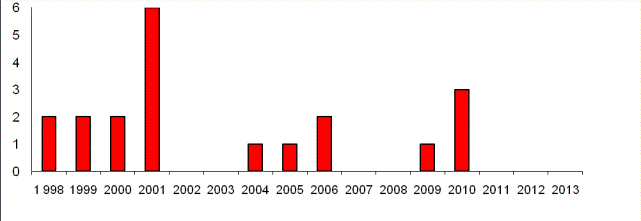 Pic.1. Children’s lethal outcomes at severe burns
during 1998-2013.
Pic.1. Children’s lethal outcomes at severe burns
during 1998-2013.
Efficiency of carrying out intensive therapy was compared
according to some criteria: existence
of number of cases of SIRS development, early sepsis and complications of a
burn disease. The heavy thermal trauma was accompanied by the development of
organ dysfunction, and involvement of two and more bodies led to the development
of syndrome of multiple organ failure
which was present in both groups. So, organ dysfunctions of 2-3 bodies
(2.33±0.17) systems prevailed in the group with a favorable outcome, and sepsis
was verified at 35% of patients. In group of patients with a lethal outcome the
development of specific dysfunction in the first days is noted – neurologic,
cardiovascular and respiratory dysfunctions prevailed. The second and next days
are marked by prevalence of hematologic and renal dysfunctions that emphasized severity
of thermal trauma - 5,3±0,1 (4–7) systems. Sharp respiratory failure, in the form of ARDS was the indication for prosthetics of respiratory
function. Our data coincide with data
by S.P. Sakharov with coauthors [13].
Sepsis, along with bacteremia, was diagnosed during lifetime for 15(75%)
patients of this group. Bacteremia is
revealed by us at 12 patients (60,6%), i.e. at every second patient. Among activators Ps was in the lead. Aeruginosae – 8 cases (40%), on the second
place was S. Aureus – 6 positive results (30%), the third place was taken by
Acinetobacter revealed at 4 people (20%), further there were Enterobacteriacea
family activators – 1 case (5%) and Klebsiellae – 1 case (5%).
Reserve of decrease in a lethality at a thermal trauma at children is,
in our opinion, the period of heavy burn shock and the period of a burn toxemia
which are accompanied by essential pathological changes in all links of a hemostasis,
the speed and the development severity of which are closely connected with an outcome of a burn disease
[13,14]. It is possible to look at this category of patients from the point of
view of changes of their hemostasis.
According to the results of hemostasis study patients
were divided into two groups. The first group included 45 patients with a
favorable outcome of a burn disease; the second group included 20 patients who
died in different stages of a burn disease: 6 – in the period of burn shock, 10
- in the period of a sharp burn toxemia (5-8 days after a thermal trauma), 4 - in later terms. In real time the
graphic curve was constructed, chronometric and amplitude indices were calculated and estimated. On the
basis of our own experience, as criterion for assessment of a condition of
initial phases of a fibrillation and intensity of activation of system of
hemostasis the coagulation constant "by r + k" — the sum of the
period of reaction and the thrombin constant, equal according to the data
obtained in group of control - was chosen to 10.97±0.19 minutes. If during
hospital entrance value of the index "r+k" was less than 6 minutes,
it corresponded to burn shock of the 3 degree [12]. The development of
frustration of hemostasis on hypercoagulation
type formed the basis for carrying out operated
hypocoagulation [9, 11].
Table
1
Dynamics of an integrated indicator "a constant
of coagulation r+k" (min.) in the group with a favorable and lethal
outcome (М±m)
|
Groups |
Entrance |
A day later |
3 days later |
5-7 days
later |
|
Control
|
10,97±0,19 |
10,97±0,19 |
10,97±0,19 |
10,97±0,19 |
|
Patients with favorable outcome (n=45) |
5,88±0,20* |
7,70±0,49* |
7,42±0,20* |
9,06±0,44* |
|
Patients with lethal outcome (n=20) |
4,68±0,58** |
5,46±0,34** |
6,88±0,33** |
6,74±0,20** |
* - reliability of differences in comparison with normal
indicators, р<0.05.
** - reliability of differences between groups of research, р<0.05.
According to the dynamics of an indicator
"r+k", high pro-coagulative potential was seen to remain at patients
with lethal outcome throughout the sharp period in the hemostasis system, and the
group of patients with a favorable outcome of burn trauma was characterized by gradual
recovery index against a background of operated hypocoagulation and volume
corrected therapy (tab. 1).
Differences in the functional condition of all
components of hemostasis and, in particular "r+k" indicator, in
compared groups of children with severe burns during entrance, a day later, 3
days later, and 5-7 days after the beginning of intensive therapy of shock and
a toxemia,
were becoming even more significant. The group of patients with favorable
outcome of a burn disease was characterized by the signs of relief of hemostasis disorder
and reliable tendency to the restoration of coagulation constant. The patients
with lethal outcome of thermal trauma, in considered terms, had hemostasis disorder
in progress, despite intensive therapy: hyper - hypocoagulative syndrome
held out, there were progressing clinical symptoms of multiple organ failure.
All dead patients had critical deep burns more than
30% of body surface. Six patients died in shock. Changes in the internal, found
on autopsy, were various. Almost all dead patients (18 of 20 patients) had hypostasis
of brain substance and pia
mater. There was a plethora of vessels
and the microthrombi, loosening
and hypostasis in pia mater.
In brain tissue there was uneven blood
volume, capillaries spasm and arteriole.
These changes, it is frequent (at 16 of 20), were replaced by dystonia and hyperemia
of small vessels in which sludge
and stasis
of blood corpuscles were
found. Bronchus
of lumen in lung
tissue are narrowed, teethridge
are fallen down, dilated
in some places. Capillaries of interalveolar septum were
full-blooded. The diagnosis of pneumonia was verified at 16 patients. With
thermoinhalation injuries of lungs, 6 patients had parts of soot of black color
and concentrated
epithelium
in small bronchial tubes. Partial dystrophies of myocardium,
liver and kidneys were frequently found at autopsy. In the mount of heart there
was cloudy degeneration of cardiac hystiocyte. Capillaries and small vessels of
heart were full-blooded. There was a decrease in concentration of a glycogen up
to its total disappearance with expressed hyperemia
of capillaries and small vessels. Dystrophy and necrobiosis of epithelium
of convoluted renal tubule were found in
kidneys. Homogeneous or light pink mass was found in the lumens of glomerule
capsules. Even patients who died on the 3d -5th -8th day after a burn had these
changes. Dystrophy of specified organs was not found only in one case - death of
13-year-old patient in the first day after burn. The most evident changes were
found in gastrointestinal tract. Erosive gastritis, duodenal ulcer, bleeding from stress ulcer [Curling's],
expressed enteroparesis were diagnosed. Russian
clinical physicians and pathologists [5, 10, 2] connect all these disorders found
in organs on autopsy at children with extensive burns with disorder of intravascular coagulation or disseminated
intravascular coagulation of blood.
Thus, underestimation of the
severity of the condition of a patient during entrance into
unspecialized hospital, volume and quality of infusion therapy deserved
purposeful correction. The most numerous group of children with lethal outcomes
are patients with an area of lesion over 50% (12 cases - 60%). Such burn can be
considered critical.
Conclusion.
The results of scientific researches, improvement of
methodology of therapy of burn disease with use of methods of efferent therapy
in the conditions of operated hypocoagulation allowed reconsidering the indications
to transfusion of donor blood products,
to reduce hospitalization time due to the reduction of the number of superlative complications and improvement of
quality of treatment. The lethality in group of patients with an area of lesion
more than 20%, made 6.8%. The most numerous group of children with lethal
outcomes are patients with an area of lesion over 50% - 12 cases (60%). Such
burn can be considered critical.
The retrospective analysis showed that 20% of children
with the extensive burns transferred to hospital in late terms from the moment
of trauma had a higher risk of infectious complications and percent of lethal
outcomes, due to not enough antishock therapy. Timely adequate respiratory,
antishock and antibacterial therapy with objectifying
of a burn shock allowed carrying out surgeries depending on the severity of the condition of patients. It
is necessary to note, that there were no lethal outcomes during 3 years
(20011-2013).
Thus, the use of new technologies in clinical practice
in diagnostics and treatment of children with a heavy thermal trauma allowed lowering
lethality during the considered period of work.
Sources:
1. A.A. Alekseev, Yu.I. Tyurnikov. The main statistics of work of burn hospitals of the
Russian Federation for 2009. / A.A.
Alekseev//Collection of abstracts of III
conference of combustiologists. - Moscow. - 2010. - Page 4-6.
2. I.R Vazina, S. N. Bugrov. Lethality and cause of death of the burnt./I.R. Vazina//Russian medical magazine. – 2009. -
No.3. – Page 14-17.
3 . World report on prevention of children's
traumatism. - World Health Organization and UNICEF. - Geneva. - 2008. – 39p.
4 . Children's surgery: the national management /
under the editorship of Yu.F.Isakova, A.F.Dronova. - M.: GEOTAR-Mediya, 2009. –
1168 p.
5. D.D. Zerbino, L.L. Lukasiewich. Disseminated intravascular
fibrillation. - M.: Medicine, 1989. - 256 p.
6. V.M. Egorov, N. P. Nasonova, F.N. Brezgin, P. S. Tamakulov.
New methods of the prevention and treatment the stress-conditioned disorders at
children with burn disease / V.M. Egorov//Anesthesiology and resuscitation,
2003. - No.4. – Page 36-38.
7. V.M. Egorov, N. P. Nasonova, V. M. Odinak. Early respiratory support in antishock
therapy at children with a heavy thermal trauma. / V. M. Egorov//Anesthesiology
and resuscitation, 2000. - No.1. – Page 47 – 50.
8. Intensive
therapy in pediatrics/V.I. Grebennikov, V.V. Lazarev, A.U. Lekmanov,
etc.//Under the editorship of W.A. Michelson. – M.: GEOTAR-MED, 2003. - 552 p.
9. A.L. Kostyuchenko, A.N. Belsky, A.N. Tulupov. Intensive
therapy of a postoperative wound infection and sepsis. — SPb.: Volume, 2000. —
448 p.
10. Lethality at thermal lesion at children: state,
reasons and ways of its decrease / L.I. Budkevich, S. I. Vozdvizhensky, V.S.
Okatyev, V.V. Stepanovich//Ross.Vest.Perinat. and pediatrics. – 2004. - No.4. –
Page 51-54.
11. V. G. Lychev.
Diagnostics and treatment of disseminated
intravascular fibrillation/ G. Lychev. – 2nd issue, revised and supplemented – N. Novgorod, NMGA Publishing house, 2001. – 191 p.
12. D.D. Melnik, V.A. Shalygin, N.I. Trokhimchuk /
Conservative and operative treatment of burns of children//LAPLAMBERT Academic Publiching
Publishing house. Saarbrücken, 2013. - 59 pages.
13. S.P. Sakharov,
V.V. Ivanov, N. P. Shen, D.P. Suchkov / Lethal outcomes of a burn disease at
children: 18 years' experience//Emergency, 2011, No. 3. - Page 52-57.
14. M. N. Shpisman, I.I. Tyutrin, M.Sh. Eveskin / Instrumental diagnostics of disorders of a hemocoagulative
homeostasis at burn shock//The Bulletin of the Siberian medicine. - 2003. - No.4.
- Page 103-110.
15. N. Nakae, H. Wada. Characteristics of burn
patients transported by ambulance to treatment facilities in Akita Prefecture,
Japan. // Burns. – 2002. – Vol. 28, No. 1. – P. 73 – 79.