Master student
M.A. Lebedeva
Vologda State University, Russian Federation
Student N.A.
Lebedeva
Vologda State University, Russian Federation
SUSTAINABILITY AND
PROSPECTS OF THE DEVELOPMENT OF THE BABUSHKINSKY DISTRICT AS A BALNEOLOGICAL
RESORT OF THE VOLOGDA REGION
Deep, comprehensive changes in the human environment entail an increase
in health. According to the World Health Organization (WHO), the transfer of
chemicals can be a leading factor in the development of a significant number of
human diseases. It was also found out that the structure of morbidity is
primarily climatic conditions, as well as on the type of industry, the
qualitative composition of emissions and their concentration in airspace.
The aim of this work is to study the sustainability and prospects for
the development of the Babushkinsky district as one of the leading health
resorts in the Vologda region.
To achieve this goal, you must perform the following tasks:
1. Conduct an assessment of the natural and climatic conditions of the area;
2. Evaluate the impact of business entities in the region;
3. Analyze the activities of health care institutions.
Babushkinsky district – the municipal district of the Vologda region, is
located in the east of the area and occupies an area of 7761 square
kilometers.
The relief of the area is a hilly-morainic plain. The region is
partially located on the territory of the Galich Upland, the Unzha Plain and
the Northern Uval hills.
On the territory of the region the climate is temperate-continental, with
average January temperatures of -13 ... -15 оС, moderately warm, but relatively short in summer,
with an average July temperature of +16 ... +17 оС of heat. The average annual precipitation is 550 -
650 mm [2].
Hydrographic network of the district is rare. It includes Ledenga,
Yurmanga, Kema, Loimanga, Levashka, Old Totma and others rivers. Lakes – Babie,
Shipunovskoye, Gorodishchenskoye, Gavrino. According to the conditions of
feeding, the rivers are of the flat type with mixed atmospheric-ground feeding.
The Babushkinsky district is also rich in underground mineral waters.
Groundwater over most of the area lies deeper than 2 m from the surface. The
area is characterized by the development of poorly water-bearing aquifers,
associated with terrigenous rocks of the Upper Permian age of the Ufa and Tatar
stages. The prevailing production rate of wells is 0.5 - 20 l/ sec. Specific
production rate is 0.1 - 0.2 l / sec. Below are the depths of occurrence of
fresh groundwater waters of high salinity calcium sulfate (dry residue 4.3 -
7.8 g / l, total hardness 27.5 - 57.6 g / eq) and sodium chloride (dry residue
18.6 - 57 g / l, hardness 68.5 - 147 mg / eq). Chloride-sodium waters are used
for medicinal purposes.
The main types of soils for the region are: sandy-loamy and sandy
sod-medium- and strongly podzolic and marshy. Swamp mount post signs,
celebrations, high ash content and high acidity. Small ash content of peat bog
soils makes it possible to use it as a fuel material.
Babushkinsky district is a forest area. Forests occupy about 68%. The
main rocks are spruce, birch, pine, fir. Among the forests, spruce forests and
green-pine pine forests predominate, and green-cherry trees.
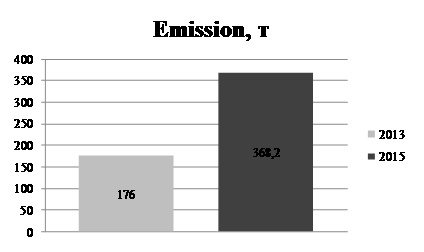
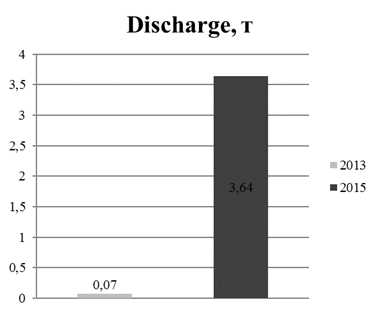
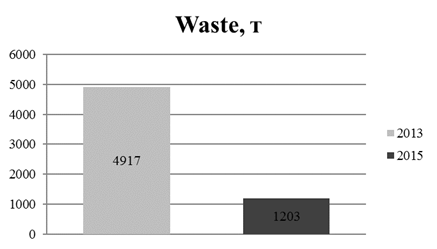
In 2013, the atmospfhere of the Babushkinsky district received 175,961
tons of pollutant emissions (Figure 1a), the discharge amounted to 0.07 tons
(Figure 1b), 4917.67 tons of waste were placed in the territory of the region (Figure
1c), and in 2015 the discharge was 3.64 tons, the release was 368.62, the waste
- 1203.1 tons. The data allow one to judge the deterioration of the quality of
atmospheric air and surface water sources.
Figure 1
a
b
c
When
assessing the demographic situation, the mortality rates were analyzed, the
dynamics of the population was characterized by a negative natural increase and
one of the high weather coefficients (Table 1).
Table 2 – Demographic
indicators of Babushkinsky district
|
Indicator |
Babushkinsky
district |
|
Birth rate |
144 people |
|
Death rate |
240 people |
|
Natural increase |
– 96 people |
The data given that all age groups of the population
of the Babushkinsky region are characterized by a lower incidence rate (Table
2).
Table 2 – Morbidity structure of
Babushkinsky district`s population
|
Index |
Babushkinsky district |
|
|
Rank place of sanitary and medical records |
Rate
of morbidity |
|
|
Infant
morbidity |
30 |
low |
|
Teenage morbidity (15 – 17 years) |
31 |
low |
|
Adult morbidity |
29 |
low |
When drawing up
the natural characteristics of the Babushkinsky district, it was revealed that
the sanatorium "Ledengsk" uses local therapeutic mud (peat) and
mineral waters, including drinking water, to provide health services. Ledeng
sources belong to the category of cold water table salt or brine. 17 peat
deposits are located on the territory of the district, the largest of them are
Gusinsky, Velikoye, Semen, Black. The sanatorium can accept up to 2500 patients
annually. The effectiveness of treatment reaches 75-80%. Thus, we can say that
the area is rich in recreational natural resources.
For the purposes
of balneotherapy, a brine is used that is strong enough and contains iodine
compounds, which is very important for medical purposes. Iodine-bromine water
is very valuable. In the nature of pure iodide-benign waters practically does
not exist. Iodine and bromine ions, along with other important microelements,
are most often found in sodium and chloride waters, their importance can`t be
overestimated, since iodine and bromine are biologically active substances (table
3).
Table 3 – Chemical analysis of Ledengsk brines
|
Chemical substance |
Content, g/l |
|
NaCl |
41,03737 |
|
NaBr |
0,02240 |
|
Al2O3 |
0,02309 |
|
FeO+Fe2O3 |
traces |
|
CO2 |
0,02428 |
|
Na2SO4 |
1,25840 |
|
CaSO4 |
3,44016 |
|
MgSO4 |
4,59309 |
Practice has
established that iodide-bromine baths, by their influence on the leading
physiological systems of the body, can create favorable conditions for the
formation of adaptive and restorative reactions of the organism and thereby
contribute to the improvement of health or recovery [6].
Thus, the low
incidence rate in the Babushkinsky district, to a greater extent, is due to the
natural characteristics and resources of the district. The increase in
anthropogenic load obliges enterprises to strengthen the green management of
production
References:
1.
Prachkina, T.
V. Analysis of the possibility to ensure the needs for drinking water Babuskin
settlement by existing artesian wells.– [Text of report]: Vologda. – 2003.
2. The integrated territorial cadastre of natural
resources in the Vologda region: stat. book/ Department of natural resources
and environmental protection of Vologda region. – Vologda, 2015. – 476 p.