Introduction
In discussing value change in Western societies, Russell Dalton audaciously states that “all politics involves conflict over values” (1996, p. 89). He was discussing political dynamics in domestic contexts. In the field of International Relations, it has been the general approach to posit politics among nations as reflecting undifferentiated striving to maximize the basic goals of economic and physical security of states, which reflect what theorists of value change in the West regard as “lower order” values. In the context of domestic politics, these values are now under challenge from emergent “higher order” values (see Maslow 1954). We propose that international relations will increasingly incorporate a similar conflict nexus, pitting so called “postmaterial” countries against materially oriented modernizing countries in a contentious struggle to universalize a system based on “higher order” values as a hegemonic regime.
“Post” Politics:
The Theory of Post-Materialism
Post-Industrial, Post-Material, Post-National,
Post-Modern: These are terms associated with fundamental changes to the basic
values of important demographic groups in the Western world. Such value change
has an impact on the interactions between Western based organizations,
including government agencies, heavily staffed and promoted by individuals who
hold such values, and the inhabitants and representatives of developing states
who favor economic development, material advancement, and ethno-national
political interests.
We put forward one theory of Western value change as an example of how values might effect relations between (most) different systems. The post-materialism thesis in its most basic form can be stated quite simply: “the values of Western publics have been shifting from an overwhelming emphasis on material well-being and physical security toward greater emphasis on the quality of life” (Inglehart, 1977, p.3). The reasoning behind this proposition is more complex.
The central proposal put forward in the theory of post-materialism is that macro-environmental changes in Western societies have effected a fundamental shift in individuals’ basic values. Primary among these profound changes have been rapid economic and technological development, the absence of total war, and rising levels of education. All have been proposed as contributing to a gradual shift in individuals’ hierarchy of personal concerns from an overwhelming emphasis on material and physical security to an increasing emphasis on the importance of individual rights and freedoms. Especially affected are post-war generations comparatively untouched by the material privations and insecurities common to the experience of their parents and grandparents. This development is posited to have had a number of system-level political consequences, including the growing importance of “life style” issues, the decline of social class as the axis of political conflict, a gradual erosion in support for national institutions, and for an increase in unconventional political action (ibid., p.5). The theory has the capacity to predict change in political behavior in that it is based on identifiable, predictable changes in the social and economic environment. Gabriel Almond has stated emphatically that “Inglehart’s work is one of the few examples of successful prediction in political science” (Almond, 1990, quoted in Abramson and Inglehart, 1995, p. 139).
Scott Flanagan has proposed that Inglehart’s materialist concept really taps two separate dimensions, a materialist dimension and an “authoritarian” dimension, as opposed to a “libertarian” dimension that he equates with Inglehart’s post-materialism. A preoccupation with “order” and an inclination toward xenophobia are personality characteristics central to authoritarianism (Adorno, et al, 1950; see also Lipset, 1981, Chapter 4; Bluhm, 1974; see Middendorp, 1993, on feelings of nationalism as central elements delineating the concept of “ideological authoritarianism”). Hyper-nationalism and xenophobia have been proposed as central to political disorder in much of the non-West, from the former Yugoslavia to Indonesia, Fiji, Rwanda, Russia and many more. Conversely, Western “Postmodern” societies are marked by a tendency to be culturally “open” (Buzan, 1998, p. 222) and marked by a decline in support for the notion of the nation-state and basic concepts associated with it, such as the sovereign right of nations to act as political authorities see fit within the confines of the state.
The theoretical capacity of the post-materialism concept to generate predictions about gradual, long-term political change is important in regard to anticipating conflict trends in post Cold-War international politics, which some theorists have attempted to identify (see, e.g. Huntington, 1993). International Relations theorists should seriously evaluate the usefulness of applying this theory in their own work.
Constructing Post-Materialist Foreign Policy
Theories
referencing basic values and value change lend themselves to an examination of
political and policy-making dynamics as unique to social settings. In the West, pluralist, democratic political
arrangements and the rise in political participation reconfigured the notion of
“national interest”. Fifty years ago it was suggested that pluralism “eats away and erodes the attachment of
people, indeed of whole groups, to their governments and political regimes.
Group interests are never synonymous with the national interest. By definition
the interest of a group is less than the interest of the nation as a whole. Nor
is the sum of the interests of the groups within a nation to be equated to the national
interest. If the national interest is to be grasped as a concept, it must be
regarded more as the product than as the sum of the interests of the
individuals and groups which comprise the nation”(Blaisdell,1958, p155; see also Allison, G. 1971; Allison, G., and P.
Zelikov, 1999).
When coupled with value preferences this can lead to the emergence of non-governmental organizations and other more loosely organized political forces that constrain government decision makers in regard to the substance and methodology of foreign-policy agenda setting. NGOs and INGOs have been characterized as able to influence “nation-states, intergovernmental agencies and associations, and international organizations such as the United Nations”; furthermore, “the NGOs of the 1990s represent a shift away from the supreme power of the nation-states to more citizen-based groups that often transcend national circumstances to embrace larger issues”. The vast majority of these groups originated in and have their headquarters in the West. The United States for example, has over 6,000 peace groups which apply pressure both domestically and abroad to pursue their objectives (Ziring, Plano and Olton, 1995, p. 425). Similarly, commentators have remarked on the demographic profile of demonstrators protesting and pressuring Western governments to adopt pro-environment and human rights political agendas at the global level, pointing out the relatively privileged background of these individuals (The Economist, April 15, 2000, p.25). And it is not only non-governmental organizations that reflect value change: Inglehart has provided evidence that post-materialism has penetrated deeply into Western bureaucracies (Inglehart, 1990).
None of this negates the continuing importance and even dominance of material self-interest in Western policy vis-à-vis the rest of the world. But post-materialism and compatible theories such as social constructivism, symbolic interactionism, or social identity theory offer a theoretically coherent explanation of change in Western foreign-policy agendas that is otherwise puzzling; additionally, explanatory schemas marrying Constructivism’s notions of “international norms” (see Risse-Kappan et al, 1999) to Post-materialism’s substantive analysis of domestic value change have potential predictive power. That is, one can utilize these theories to predict that environmental thinking (on “earth nationalism,” see Deudney, 1996) and issues will become a greater source of disagreement between the West and LDCs, combating human rights abuses will be a more prominent motive for intervention undertaken by the West (Finnemore, 1996), and economic sanctions and other forms of punitive actions or threats will be directed at LDCs that violate values the saliency of which is rising in Western societies. All of this is subject to understandable (Realist) misinterpretation by LDCs as a cover for the developed world’s continued pursuit of its material self-interest. While Constructivist logic pivots largely on the pragmatic construction of state identities via “symbolic interaction,” a social-psychological process in which ego’s empathetic attempts to view its prospective actions from alter’s perspective can induce a change in self-identity (Wendt, 1992, 1999), Social Identity Theory (SIT) cautions that selves have an innate cognitive proclivity to assume that others share their view of the situation and thus to confuse “ethnocentric projection” with perspective taking (Mercer, 1995, p. 249).
The Relationship between Social Structure and Theories of Value Change
For example, in developing post-materialism theory, Inglehart drew heavily on Bell’s (1973) post-industrial thesis as the basis for his work. What he proposed was that the profound structural changes taking place in highly industrialized societies were producing fundamental changes not just in ephemeral attitudes or transient behaviors, but also in the more deep-rooted, less mutable basic values of individuals in these societies. Inglehart employed Maslow’s psychological notion of needs hierarchies to suggest that Western publics were becoming less preoccupied with basic safety and sustenance needs and more concerned with aesthetic, intellectual, “belonging,” and esteem needs. Moreover, Mannheim’s (1952) sociological theory concerning the long lasting effects of formative years on adult orientations implied that this change in needs would be predictable and relatively resistant to change. Inglehart referred to this development as a “silent revolution” taking place in the Western world (Inglehart 1971; 1977). And Inglehart implied that although none of these interests were specifically political, they had obvious, and important, political implications. In essence, while Bell proposed that the fundamental structural changes that had been taking place in the West would have widespread ramifications for the very way that such societies would function in the future, Inglehart grounded this thesis at a more basic level with his value change proposal.
Inglehart uses surveys to tap value orientations. Respondents who consistently give top priority to order, price stability, high economic growth, strong national defense, a stable economy, and fighting crime are classified as materialists. Those who consistently give top priority to expanded political participation, freedom of speech, more democracy on the job and in the community, a friendlier, less impersonal society, a society less concerned with wealth and more with ideas, are classified as post-materialists. (Inglehart 1990 pp.74-75). Factor analyses of survey results have shown a distinct tendency for these items to load or be ranked together by respondents, with the exception of the beautiful cities item which was apparently subject to alternative interpretations by respondents (Inglehart 1990 pp.134-139)[i].
Pooled survey results from Western Europe indicate that in post-war generations post-materialists comprise a significant percentage of the general population, even, in some cases, outnumbering materialists. Thus, the structural changes that have taken place in Western societies since the end of World War II have allowed a significant segment of society to turn from a preoccupation with securing basic material needs and to focus instead on “higher order” needs. In contrast, the situation in the developing world should works to inhibit the expression of higher order needs.
To measure comparative national levels of post-materialism we analyze data from the World Values Surveys and utilize Inglehart’s basic four item scale to measure post-materialism – materialism levels in the “group of seven” countries (minus Canada due to lack of data) selected to represent post-industrial societies, and the five Central Asian countries – Kazakhstan, Kirgizstan, Uzbekistan, Tajikistan and Turkmenistan. The results of this preliminary analysis can be viewed in Table 1.
Table 1
Levels of Materialism, Post-Materialism and Mixed for Selected Countries
|
States/percentages |
materialists |
postmaterialists |
M-PM |
Mixed/Missing |
|
|
Western States* |
|
|
|
|
|
|
Germany |
24 |
36 |
-12 |
38 |
|
|
Japan |
37 |
36 |
1 |
27 |
|
|
United States |
31 |
29 |
2 |
41 |
|
|
Britain |
31 |
30 |
1 |
39 |
|
|
France |
28 |
20 |
8 |
52 |
|
|
Italy |
20 |
20 |
0 |
40 |
|
|
|
|
|
|
|
|
|
Central Asia States** |
|
|
|
|
|
|
Kazakhstan |
52 |
16 |
36 |
32 |
|
|
Kirgizstan |
68 |
14 |
54 |
18 |
|
|
Tajikistan |
44 |
20 |
24 |
36 |
|
|
Uzbekistan |
45 |
13 |
32 |
42 |
|
|
Turkmenistan |
13 |
7 |
6 |
82 |
|
*figures derived from World Values Survey data
2005-2006.
** figures taken from Spehr and Kassenova 2009, derived from Asian Values survey data 2005.
As one can see in Figure 1, a distinct pattern is readily apparent, with the group of seven nations demonstrating markedly lower levels of materialism minus Post-materialism than in the countries of Central Asia.
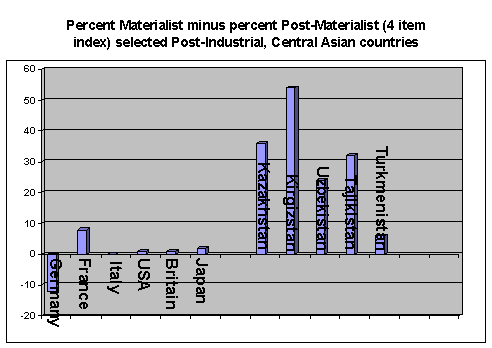 Figure 1
*Scores are the result of
subtracting the percentage of post-materialists from the percentage of materialists among survey respondents.
Percentages can range from -100% to +100%.
**Figures for Turkmenistan
are unreliable due to a large amount of missing data.
Post-Materialism and Political Conflict
The proposition that an important connection exists between post-materialism and the foreign policy of Western states has not been much investigated and provides a new avenue of research in both the area of value change and in regard to international relations. Indeed, the linkage between the emergence of post-materialism in post-industrial countries and political conflict is vitally important to the post-materialism thesis. Ronald Inglehart introduced this thesis into social science specifically in reaction to such observed political conflict, but geared to explain domestic political dynamics. Only in passing has Inglehart referred to the possibility that the rise of post-materialism might affect relations between states when he stated that post-materialists should hold differing views on foreign policy from materialists (Inglehart, 1990, p.76). Even at that he was most concerned with the implications of this difference in terms of domestic politics.
The Expanding Basis for Conflict in International Relations
The nature of the post-materialism thesis implies that societies should and do differ in regard to the extent to which post-materialism is prevalent in individual states; if so, it seems logical to assume that the same dynamics which might lead to new political fissures within states may also affect politics between states. The concept of post-materialism has been well developed, but conceptualizing the nature of conflict based on the new axis of value hierarchies is more problematic. Nevertheless, commentary on international relations and domestic political dynamics in less-developed countries provides us with material that lends a degree of “face validity” to the concept.
The fault line in the disputes over values may be reflected, for example, in the statement that, for third world policy makers, “feeding children takes precedence over the environment” (Funk, 1999), whereas environmentalists believe that economic growth, the production of and trade of “stuff” does not even come close to being as important as “protecting the environment” (Meadows, 1999). This view seems inexplicable to LDC political decision makers like former Mexican President Ernesto Zedillo, who once expressed puzzlement about Western environmentalists’ objections to efforts to promote economic growth in Mexico and other LDCs.
One commentator has noted that African culture for example is “hierarchical” and that the West engages in a “denial of social difference, respect for status, and ascriptive hierarchy”. Lee Kuan Yew, the long-time leader of Singapore, once stated that in the West, the “expansion of the right of the individual… has come at the expense of the orderly society” (Puchala, 1998, p. 140). Both of these comments were offered as a defense of domestic political arrangements in the face of Western criticism. Similarly, BBC online recently reported (2009) that “Amnesty International, which believes at least 25 alleged gays have been killed in Baghdad in the last few weeks, wrote to the Iraqi government last week seeking ‘urgent and concerted action’ to bring the culprits to justice and protect the gay community. The appeal has so far brought no response, and the government has yet to comment on the killings or take any visible action to combat them.” The implication is that the Iraqi government is uninterested in, and the Iraqi people unconcerned with, protecting the rights of these individuals or even recognizing them. The INGO Amnesty International, based in London, certainly is. One might also cite the United States’ attempts to impose trade sanctions against Mexico, India, Malaysia, Pakistan, Thailand, and other less developed countries for using fishing nets that drown dolphins and sea turtles, under pressure from domestic environmental groups; as DeSombre (1999) suggests, restraints on the methods and yields of Pacific tuna harvesting took hold not as a result of classical state-centric bargaining efforts to force conservation of a scarce resource, but because US consumers used their purchasing power to back their objections to the incidental kills of an “environmental amenity” valued for non-material reasons. Massachusetts attempted the same in regard to Burma in retaliation for human rights abuses perpetrated by that country’s government against its own citizens (Funk, 1999; Meadows, 1999).
In the case of Central Asia, there is an apparent widespread notion that NGOs exist to either promote the interests of the established political authorities or that they exist solely to advance the material and financial interests of the organizers or their clients (Shevtzova, 2008). In regard to INGOs they are viewed as “instruments” to advance the foreign policy objectives of Western powers, to promote specific values associated with the West such as human rights and democratic pluralism, or as shells employed by Western governments to subvert Central Asian civil organizations by linking them to their Western counterparts, or to propagandize in favor of political opposition forces (Ibragimov 2006). Such comments as “Washington in its policy in Central Asia employed 3 main methods. The first consists from the whole arsenal of “human rights” tools: accusation in human rights violations, criticism of the authoritarian style of ruling, demand to democratize the existing regimes, accusations of corruption, etc. The second one has a concrete character: it deals with the economic, military, technical and humanitarian aid. The third one possesses a deep strategic message: it is the enforcement of the informational-propagandist pressure by supporting the activities of various NGOs and opposition movements, providing different informational-propagandist programs with the official structures, such as USIS and USAID” (Laumulin, 2004), reflect this perspective. Similarly, it has been argued that in Kazakhstan for example, “cosmopolitans” (described as an urban, intellectual elite with an internationalist outlook) “staff mushrooming NGO’s, research centers, private universities, opposition parties, local branches of international governmental and non-governmental organizations etc. In a sense they act like as the local extensions of various international interests groups in Kazakhstan. They share an occupational interest to monitor and report practices of the political power, ethno-national relations, and a whole bundle of related issues sometimes for domestic but mostly for international consumption” (Surugu, 2006?). Others see non-governmental organizations as “financed from governments abroad… damaging the constitutional system, state order and national security” (statement attributed to the ombudsman for NGO activity control in Kyrgyzstan T. Bakir-Oglu, cited in Kassymbekova, 2006).
It has been asserted that much of what passes for foreign policy in the West is exercised on less developed countries because it is possible to coerce them (Neuman, 1988, p. 13). Due to power discrepancy, the international arena is hardly neutral. In the past, this has reflected the material security and economic concerns of the dominant countries. However, Inglehart believes, for example, that “post-materialists may favor both domestic and foreign [our italics] income redistribution for the sake of human solidarity” (1990, p. 302), while Miller states that controlling violence (often emanating from third-world governments), ameliorating economic disparities (at the global level), and promoting human rights and countering threats to the “biosphere” are “problems that need to be addressed by world order values” (1990, p. 67). However, LDCs also have foreign policies. Given their level of economic development, economic growth rather than income redistribution is of prime importance. Security issues are also critical to LDCs as the political powers in many of these countries are in the process of attempting to more firmly establish political institutions and consolidate their hold on power (David, 1998). Political order is thus seen as more important than the extension of individual liberties (see e.g. the recent statements of the Tajik president regarding the maintenance of order in that society – Radio Free Europe/Radio Liberty online 2009). Indeed, the two values are viewed as polar opposites. Sometimes, political struggle is over the very nature of domestic order itself. Thus, both in their dealings with the developed world in the past and in terms of their own political priorities, LDCs pursue and expect others to pursue their own economic and security interests, essentially economic growth and political order. Anything else is viewed with scepticism and the deepest suspicion (Miller, 1990, p. 67).
Increasingly a part of the West’s foreign policy now reflects the views of those who, for example, actively “seek justice for all… [through a] quest for universally applied [human rights] standards” (Miller, 1990, p. 197). Similarly, Western diplomats have begun to reflect a like approach, remarking that “national and international authorities have to take responsibility for the formal protection of the basic right to life and developmental potential of all human beings on the face of the earth” (Montville, 1991, in Volkan, Montville and Julious, p. 191). Additionally, it has been noted that “[E]nvironmental groups have become much more intensely engaged in foreign policy” (Nathan and Oliver, 1994). All of this “has provided states with… another issue to divide them [as] values compete for power” (Miller, 1990, p. 200). Invariably, this division is between the developed West and the rest.
Thus, the central thesis put forward for value change and long-term changes in Western foreign policy initiatives is rather straightforward. We propose a positive, significant causal relationship between Western Value change and foreign policies stressing post-national, post-industrial, post-modern or post-materialist issues, especially human rights and environmental issues. In short, the hypothesized path model depicting causal connections between value change in the West and relations between the developed and less developed worlds can be summarized in the following diagram (Figure 2):
A Path Model Linking Value Change and Conflict


 wealth elite penetration


 Western value change foreign
policy change conflict
Western value change foreign
policy change conflict
peace participation
Figure 2
Conclusion
Lynne Miller has noted that “dominant world order values do indeed change over time” (1990, p. 69, endnote), and that such values need to be “universally applied” (1990, p. 197). We propose that these values not only change but do so in response to fundamental conditions that persist over time. Thus one can predict that such change will conform to a coherent pattern, theoretically explainable. Abramson and Inglehart believe that the “shift from materialist to post-materialist values is potentially a universal process. It should occur in any country that moves from conditions of economic insecurity to relative security” (1995, p.123). In the last few decades some fundamental changes have taken place in the world. The Cold War is over. Economic integration and cooperation are advancing rapidly among the economically developed societies of the West. And, according to post-materialist theory, peace and prosperity have altered priorities of increasingly larger numbers of individuals in postmodern “zones of peace” (Brown, 1995; Buzan, 1998). These factors may be exerting a fundamental influence on foreign policy (just as they have on domestic policy)in these societies, moving it away from “materialist” concerns in the direction of “post-materialist” concerns such as human rights, environmental issues, and the like.
If we accept the possibility that politics in post-industrial
societies is revolving more and more around issues that reflect the discrepancy
between post-material goals and material goals, then the proposal that the
international arena will inevitably reflect such a dynamic is very
plausible. Security considerations and
economic factors will always play a very important role in relations between
nations, just as they do in terms of domestic politics. But the issue arena may be widening, and it may be that this
will lead to special problems in the future.
Less-developed countries have little domestic experience with social
forces pushing a post-materialist
political agenda. Those issues
that arise in their dealings with post-industrial societies and Western-based
NGOs that reflect post-materialist concerns may be dismissed as covers for a
hidden agenda. Viewing international
relations as reflective of “power politics” is certainly not misguided. But viewing these relations as solely reflective of such a dynamic
is. Nations that have not yet reached
the level of development and material security of postindustrial societies may
be inordinately fixated on power because, in relation to the developed West,
they have so little of it. For post-industrial societies, and their citizens,
conventional security considerations and material accumulation may be subject
to “diminishing marginal utility”. In
the short run, at least, this will be a source of confusion, conflict, and
animosity between the West and the rest.
References
Abramson, P., and R. Inglehart (1995) Value Change in Global Perspective. Ann Arbor: University of Michigan Press.
Adorno, T. et al. (1950) The Authoritarian Personality. New York: Harper.
Allison, G. (1971) Essence of Decision: Explaining the Cuban Missile Crisis. Boston: Little, Brown.
Allison, G., and P. Zelikow (1999) Essence of Decision: Explaining the Cuban Missile Crisis. New York: Addison Wesley.
BBC online 4-21-2009.
Bell, D. (1973) The Coming of Post-Industrial Society: A Venture in Social Forecasting. New York: Basic Books.
Blaisdell, D.(1958)
“Pressure Groups,
Foreign Policies, and International Politics”
Annals of the American Academy of Political and Social Science, 319: 149-157.
Bluhm, W. (1974) Ideologies and Attitudes. Englewood Cliffs, N.J.: Prentice-Hall.
Brown, C. (1995) “International Theory and International Society: “The Viability of the Middle Way?” Review of International Studies 21:183-195.
Buzan, B. (1998) “System versus Units in Theorizing about the Third-World.” In International Relations Theory and the Third World, edited by Stephanie G. Neuman, pp. 213-214. New York: St. Martins.
Dalton, R. (1996) Citizen Politics: Public Opinion and Political Parties in Advanced Western Democracies. Chatham, New Jersey: Chatham House.
David, S. (1998) “The Primacy of Internal War.” In International Relations Theory and the Third World, edited by Stephanie G. Neuman, pp. 77-102. New York: St. Martins.
DeSombre, E. (1999) “Tuna Fishing and Common Pool Resources.” In Anarchy and the Environment: The International Relations of Common Pool Resources, edited by J. Barkin, and G. Shambaugh, pp. 51-69. Albany: SUNY Press.
Deudney, D. (1996) “Ground Identity: Nature, Place, and Space in the National.” In The Return of Culture and Identity to International Relations Theory, edited by Y. Lapid and F. Kratochwil, pp. 129-145. Boulder: Lynne Rienner.
The Economist (2000) “Seattle Comes to Washington.” 15 April, p. 25.
Finnemore, M. (1996) “Constructing Norms of Humanitarian Intervention.” In The Culture of National Security: Norms and Identity in World Politics, edited by P. Katzenstein, pp. 153-185. New York: Columbia University Press.
Flanagan, S. (1982b) “Measuring Value Change in Advanced Industrial Countries: a Rejoinder to Inglehart.” Comparative Political Studies 15:99-128.
Funk, M. (1999) “Commentary: Sanctions Hurt Environment More Than Trade.” St. Louis Post-Dispatch On-Line Edition. 29 November.
Huntington, S. (1993) “The Clash of Civilizations.” Foreign Affairs 72:22-49.
Ibragimov, D. (2006), “International NGOs as an instrument of the Foreign Policy on the Example of the USA”.
Inglehart, R. (1971) “The Silent Revolution in Europe: Intergenerational Change in Postindustrial Societies." American Political Science Review 65:911-1017.
(1977) The Silent Revolution: Changing Values and Political Styles Among Western Publics. Princeton: Princeton University Press,
(1990) Culture Shift in Advanced Industrial Society. Princeton: Princeton University Press.
Kassymbekova, V., (2006) “Unsatisfactory Activity of NGOs in Central Asia”(В Центральной Азии недовольны деятельностью НПО) IWPR, № 39; http://www.centrasia.ru/newsA.php?st=1143177660 posted: 24.03.2006
Laumulin, M. (2004) “The West and Central Asia” (Запад и Центральная Азия)
Continent (Континент), №11 (123) June 9, 2004; http://www.freeas.org/?nid=304
Lipset, S. (1981) Political Man: The Social Bases of Politics. Baltimore: The Johns Hopkins University Press.
Mannheim, K. (1952) “The Sociological Problem of Generations.” In Essays on the Sociology of Knowledge, edited by P. Kecskemeti. New York: Oxford University Press.
Maslow, A. (1954) Motivation and Personality. New York: Harper and Row.
Meadows, D. (1999) “Commentary: WTO’s Record Explains Protests in Seattle,” St. Louis Post-Dispatch On-Line Edition. 29 November.
Mercer, J. (1995) “Anarchy and Identity.” International Organization 49:229-252.
Middendorp, C. (1993) “Authoritarianism: Personality and Ideology.” European Journal of Political Research 24:211-228.
Miller, L. (1990) Global Order: Values and Power in International Relations. Boulder: Westview.
Montville, J. (1991) “Psychoanalytic Enlightenment and the Greening of Diplomacy.” In The Psycho-Dynamics of International Relationships, edited by V. Volkan, J. Montville, D. Julious. Lexington, Mass.: Lexington Books.
Neuman, S. (1998) “International Relations Theory and the Third-World: An Oxymoron?” In International Relations Theory and the Third World, edited by S. Neuman, pp. 1-29. New York: St. Martins.
Nathan, J., and J. Oliver (1994) Foreign Policy-Making and the American Political System. Baltimore: Johns Hopkins.
Puchala, D. (1998) “Third-World Thinking and Contemporary International Relations.” In International Relations Theory and the Third World, edited by S. Neuman, pp. 133-157. New York: St. Martins.
Radio Free Europe/Radio Liberty online 4-21-2009.
Risse-Kappan, T., S. Ropp, and K. Sikkink (1999) The Power of Human Rights: International Norms and Domestic Change. Cambridge: Cambridge University Press.
Shevtzova D., (2008) “The Specifics of the Interaction between political Elites and Society in Central Asia”.
Spehr, S. and N. Kassenova (2008) “Kazakhstan: Constructing Identity In A Post-Soviet Society.” Paper presented at the 2nd Global International Studies Conference. Ljubljana, Slovenia, July 22-26.
Surucu, C., (undated working paper) “Western in Form, Eastern in Content: Negotiating time and space in Post-Soviet Kazakhstan” TOSCCA online publications. http://www.toscca.co.uk/publications.html
Wendt, A. (1996) “Identity and Structural Change in International Politics.” In The Return of Culture and Identity to International Relations Theory, edited by Y. Lapid and F. Kratochwil, pp. 47-63. Boulder: Lynne Rienner.
Ziring, L., J. Plano, and R. Olton (1995) International Relations: A Political Dictionary. Santa Barbara: ABC-CLIO.