Karachun V.V, Mel’niсk V. N., Chebotarjova
I.G.
National Technical University of Ukraine «KPI»
GENERATORS OF POWERFUL AERODYNAMIC NOISE
BASED ON THE ROTOR DYNAMIC SIREN
In practice, the study of properties of mechanical
structures, including on-board equipment, working in conditions of acoustic
effects of high intensity and wide frequency range, of domestic and foreign
scientists and engineers made significant progress. A methodology for
calculating approximate (for the infinite length) mechanical models and some
specified types (limited sizes) models. However, these calculations are
approximate in nature, with highly random and cannot show actual picture of the
influence of acoustic radiation on material of structures and elements of the
on-board equipment. Determinative and final in likelihood, at present, is still
experimental study of acoustic endurance of products on specially equipped for
the test stands.
When creating these stands, it is especially being
solved the issue of choice of acoustic radiation sources - with efficient, easy
to establish and operate and, of course, available with the possibility of
forming a sound field of the desired composition and close to natural
conditions. Most of these requirements, particularly for first and main parameter
are satisfied with sirens.
It should be noted that still have not been made
sufficient calculations of sirens, which have been brought to engineering
solutions. Not conducted a comparative analysis of properties and monorotor and
multiplerotor structures, not solved the problem of optimization which are of
practical interest. Finally, it is not covered in the literature the issue of
influence on working siren of kinematic and force excitation from the placement
location.
This part is devoted to the generalization of existing
data, systematization of methods of calculation and design of sirens, opening
of new features and properties. However, here it is not set the problem of
basic solving the issues of creation of sound field using sirens, but only some
aspects of theory and practice, which, according to the authors, either need
serious adjusting, or still not reflected in studies of creative professionals
are contemplated.
It is known that acoustic emission with intensity
above 150 dB, can serve as a reason of phenomena of fatigue in the material.
The development of cracks, of course, starts from a place of stress
concentration – in riveted joints, cutting-out and therefore similar to this
occurs even in the center panels.
The structural response to acoustic pressure, as
determined, largely depends on the frequency, spatial and temporal
characteristics of acoustic pressure. Thus, while experimental studying
aircraft ІЛ-18 fuselage it was found that the effect of loads due to propeller
operation leads to the emergence of strains in the material at a frequency of
72 Hz of pronounced pulsed character. In response, in the structure having its
own rapidly damping fluctuations, with no resonance forms that indicates a
significant distance on the right axis of natural-vibration frequency of
elements.
The main features of the load of the fuselage in
acoustic field of jet engines and turbulent boundary layer is a broadband frequency
spectrum, the random nature of changes in value of acoustic pressure in time.
This leads to that in the thin-walled elements of structure it is generated
lots of fluctuations, which may coincide with their own. Comparing the results
of experimental studies, it can be concluded that the most dangerous, in terms
of occurrence of acoustic fatigue in the material structure and promoting this
spatial-frequency resonance, is a wideband frequency load, that occurs, for
example in the area of jet stream in, in case of turbulence because of air flow
separation and so on.
Despite improvement in recent years, progress in
developing analytical methods for assessing the degree of influence of acoustic
radiation on the material of structures, the most reliable and the final face
is still experimental research. In this regard, first and foremost issue faced
is a choice of source of intense sound radiation.
Currently there are widely used powerful sources of
noise such as air spray, wind tunnel, jet flow engines, air screws, speakers,
sirens.
Noise spectrum of jet flow (hot and cold) best
represents the natural range of engines, and noise level, reproducible by them
is 150...170 dB. Essential defect of this method is low efficiency - about 1%.
Wind tunnel contribute the largest approximation to
the conditions of excitation of structures from turbulent boundary layer
(efficiency about 1…2%).
Speakers (efficiency 5...20%) have a wide frequency
range - up to 2000 Hz, while the sound pressure level does not exceed 150 dB in
small cells. In revibration cells, by the way, they can break from their
generable noise.
The largest spread among other types of sources of
noise received siren. Sirens allow to generate sound pressure 160...180 dB with
frequency range from 50 Hz to 5000 Hz. Their efficiency is the highest and is
about 4 ... 40%.
One of the first sources of broadband noise was
proposed in USA by von Hyrke multiplerotor siren. Along with the advantage -
the opportunity to generate noise to the overall sound pressure of 170 dB and
the acoustic power of 50 kW – multiplerotor siren has several disadvantages.
Neither theoretically nor experimentally, it is not ascertained the optimal
parameters of rotor to obtain a specified range, there are also significant
difficulties in the manufacturing, building and operation of these sirens.
The original siren design to create random noise is
suggested by staff of Southampton University. Modulation of air flow is
implemented here by using steel strips with holes that are located under residual
cyclic quadratic chain code. Stretching the strip with high speed, the air flow
is being broken, thus emerging sound vibrations, the level of which reaches 165
dB. To design deficiencies can be a complex operation of a steel strip
ascribed.
Thus, for this time a sufficient number of booths to
test products on the acoustic strength is created. In frequency principle they
can be divided into two classes - discrete and broadband. And, second, as
already noted, the best way reproduce natural conditions.
In domestic literature first and, apparently, quite
extensive information on the theory and calculation of sirens is in the works
of M.I. Karnovskiy, L.Ye. Matohnyuk. A mathematical model of rotary siren is
created, the influence of geometric parameters of windows and the distance
between the disk of rotor and stator on the structure of the spectrum and
intensity generable sound is researched.
At a later time a number of studies abroad and in
Ukraine were also dedicated to creating and describing the work of sirens.
Due to the rapid development of powerful drive units,
especially in rocket production, again facing a question of research elemenets
of structures and on-board equipment on the acoustic resistance, especially in
light intensity of 150 dB and above. Unfortunately, it occurred that it is a
small number of power generators of sound, and the theory, calculation and
design of pneumatic rotary sirens to generate broadband acoustic effects of
high intensity either partially researched, or have significant deficiencies.
Seeing early said, let’s formulate some aspects of the
principles of the theory, calculation and design sirens of broadband noise of
high intensity. Along with this, let’s give some details of work of sirens that
are related to kinematic effects, but not reflected in current research.
Let’s illustrate the work of monorotor siren by
example of its known technical implementation. Mechanical model is a two
coaxial discs with radial windows, one of which - the rotor - rolling, the
other - stator - immobile and rigidly attached to the body of siren. Stream of
air under pressure comes in the camera of siren, and then passing through the
window of the stator, is broken by suspending rotor and creates sound
vibrations of environment.
Taking discs of small size in comparison with
wavelength, we consider acoustic process subordinate to linear differential
equation.
For the chosen geometry of windows, air flow
modulation function f (t) will repeat the geometry of the windows of the rotor
and, therefore, can be represented in the form of periodic, quasi-trapezoid function
with period T = 2π / ω (fig.1). Here ω - angular speed of rotor
(sec-1). Duration of single pulse (t0+t1)
is defined by equation (t0+t1)=T/m, and m - the number
of equal parts which the circle of rotor is broken into. Thus, single pulse
duration will determine the minimum window of rotor size.
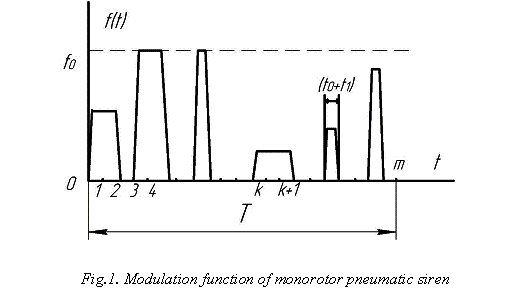
Generally speaking, a form of modulation function may
be slightly different and is determined in each case experimentally, as here,
among other things, a great role have parameters of the compressor system. For
example, the modulation function may take the form of commuted sinusoid,
triangular form, combined parabolic arcs and other more complicated
configurations.
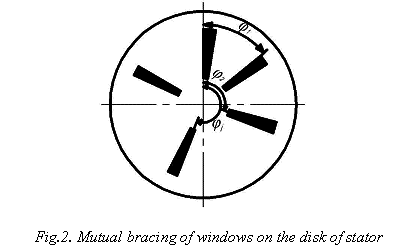
To obtain the necessary form of modulation function it
is necessary to ensure the pressure in the free stream, at least 2 ... 3 atm.,
so that further increase of pressure does not decisive influence on the
velocity of air in the exhaust stream that detects mostly acoustic power
(fig.2).
 On the other hand, during siren work it is available simultaneous flow
of air through the multiple windows that will be reflected on the size of
acoustic radiation. Therefore, we should ensure, for example, double or triple
reserve capacity of compressor to achieve the necessary continuity of pressure
flow environment that injected.
On the other hand, during siren work it is available simultaneous flow
of air through the multiple windows that will be reflected on the size of
acoustic radiation. Therefore, we should ensure, for example, double or triple
reserve capacity of compressor to achieve the necessary continuity of pressure
flow environment that injected.
To ensure the random nature of distribution of windows
in a circle of disk of rotor, they are affixed on the remainder of cyclic
quadratic chain code, which, in some areas of the window can be close, and on
the other missing entirely. In those areas where windows are put, the value of
function is defined as the expression of modulation f(t)=λkf0
(0≤λk≤1, k
- number of area), where windows are missing – function of modulation is zero.
Let’s assume for simplicity that the modulation
function f(t) is even and periodic, ie f(t)=f(t+T). In this case it can be represented
in the form of expansions into a trigonometric series
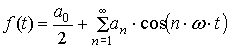
with coefficient

where n – harmonic number; f0 – amplitude; π = 3,14
.
Not considering those areas where the modulation
function is zero, ie f(t)=0 and summing on areas with impulses,
we get –
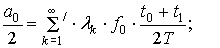
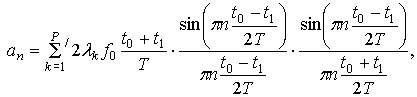
where p – number of single pulses during the period T, so 1< р ≤m; sum  means that the values
of parameter k are not consecutive,
but only for areas with impulses, ie, f(t)=λkf0; t1 - time of the impulse front shaping.
means that the values
of parameter k are not consecutive,
but only for areas with impulses, ie, f(t)=λkf0; t1 - time of the impulse front shaping.