УДК 621:681
N.R.YuSUPBEKOV *, Sh.M.GULYaMOV, A.O. ATAULLAYeV, B.M.TEMERBEKOVA (TAShGTU, Republic of Uzbekistan)
CALCULATION OF STABILITY OF PRODUCTION
The method of
calculation of stability of production in difficult chemical and technological
complexes and the installations, considering the block diagram of
communications of accumulative and technological knots is stated.
Let's
address to a problem of calculation of stability of technological process [1,
2] on the example of inorganic group of productions of JSC Navoiazot which
consists of the shops making ammonia, weak nitric acid and ammonium nitrate. In
turn, shops share on turn because of territorial dissociation and technological
distinctions of the same shops. For example, the first and vtokry productions
of ammonia let out a product of one quality therefore their division is caused
by only the territorial and administrative reasons. Shops of weak nitric acid
No. 5 and No. 25 make nitric acid of different concentration. Liquid ammonia исполь¬зуется in shop of nitric
acid No. 25 also goes on shipment
Gaseous
ammonia from the general collector is used in shops No. 5, 3 and 23.
Production
of liquid and gaseous ammonia is connected by a sokotnosheniye:
 (1)
(1)
where т — coefficient,
time-dependent years, conditions of water condensers, temperatures of reverse
water etc.
M size
for planning is established by production department of the enterprise.
The collector of gaseous ammonia can be considered as
a peculiar warehouse, to the top and which bottom level there correspond
maximum and minimum admissible pressure of gaseous ammonia, and to the current
level - pressure at present to time.
For calculation of amount of ammonia in a collector
(that corresponds to the current level of filling of accumulative knots), and
also minimum and maximum admissible amounts of ammonia in a collector we use
formulas
 (2)
(2)
where -
 the specific
weight of ammonia under normal conditions; T - ammonia temperature, °К;
the specific
weight of ammonia under normal conditions; T - ammonia temperature, °К;  - collector
volume;
- collector
volume;  - maximum and minimum admissible pressure in a
collector;
- maximum and minimum admissible pressure in a
collector;  - the current pressure in a collector.
Size  depends on
ammonia temperature in a collector,
depends on
ammonia temperature in a collector,  - is set by
production regulations. The collector is considered in mathematical model of a
warehouse as accumulative knot with parameters
- is set by
production regulations. The collector is considered in mathematical model of a
warehouse as accumulative knot with parameters 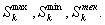
By
consideration of inorganic group of shops of studied object the following
regularities of change of loadings are revealed. Shops of ammonium nitrate and
weak nitric acid change the load of new value for 10÷15 min., that is in
relation to the considered period almost instantly. After change of an entrance
stream in shops of nitric acid and ammonia on an entrance to office of
conversion of ammonia productivity of office of absorption of shop № 5 changes
through 50÷60 min., and shops № 25 — in 70 min. after the beginning of
change of loadings. It is enough this time to bring concentration of acid in
absorbing columns to procedural values. Change of output streams after
establishment of concentration happens within 10 min., that is values of output
streams of shops No. 5 and № 25 change in relation to entrance streams with
temporary shift 55 min. and 70 min. according to.
After
change of loading of shops of saltpeter No. 3 and No. 23 on a consumption of
ammonia on an entrance to devices ITN the consumption of the ammonium nitrate
arriving on granulyatsionny towers, will start changing through 25÷30
min. and lasts 5÷7 min. Change of output streams of these shops про¬исходит at the same time
with change of a consumption of saltpeter on granulyatsionny towers, that is
for 5÷7 min.
Thus,
for shops № 5, 25, 23 and 3 dynamic characteristics are determined by channels
"the entrance-day off по¬токи" by value of
time of pure delay (these temporary shifts are equal respectively 55 min., 1
hour 10 min., 25 min. and 25 min.).
Operational
overloads of ammoniac productions are carried out by change of loadings of gas
compressors. Operating parameter in this case is the converted gas. Speed of
change of loading is defined by the dispatcher depending on a concrete
production situation.
At
creation of model of a technological complex the following assumptions are
accepted:
—
warehouses of liquid ammonia, ammoniac productions of I and II turns are united
in one accumulative knot;
—
ratios of production of gaseous and liquid ammonia on an interval of a usage
time of the decision are constant and don't depend on loading size;
—
weight functions on loading productivity channels and the current account
coefficients calculated on the moment, are considered as constants and are set
in the form of a set of ordinates on each channel;
—
volumes of C3 and C23 stores are rather great, and
possibility of their overflow is absent (these stores in model aren't
considered).
Structural
communications between shops and accumulative knots are presented by the
following matrix from 6 columns and 4 lines:
|
|
shop 1 |
shop 5 |
shop 3 |
shop 26 |
shop 25 |
shop 23 |
|
К |
0,830 |
-0,450 |
-0,220 |
0,830 |
-0,033 |
-0,220 |
|
С5 |
0,000 |
1,000 |
-0,790 |
0,000 |
0,000 |
0,000 |
|
А=СЖА |
0,170 |
0,000 |
0,000 |
0,170 |
-0,110 |
0,000 |
|
С25 |
0,000 |
0,000 |
0,000 |
0,000 |
1,000 |
-0,790 |
It is a
matrix contains information on values of coefficient of recalculation of
production - wow technological knot in a product - wow accumulative knot. The
sign "+" means receipt in accumulative knot, a sign
"-"-production consumption from it.
Weight
functions on channels "loading of gas compressors-production of ammonia on
shops №1 and 25" are set in the form of a set from 11 ordinates. - vector
of tasks for output in technological knot on time interval (it is set by the
dispatcher or production department of the enterprise). Task example: = (240; 720; 330; 300; 240;
140).
Here
tasks for output in technological knots in an order corresponding to an order
of a matrix are presented  . Similar to the dispatcher it is set
  - a vector of
possible speeds (rate) of change of loadings of technological knots. Record
example:
- a vector of
possible speeds (rate) of change of loadings of technological knots. Record
example: 
For
this model vectors maximum ( ) and minimum (
 ) admissible stocks in accumulative knots have the
following values:
) admissible stocks in accumulative knots have the
following values:  = (50; 1; 100; 100);
  = (500; 3; 1500; 1000).
Let's
enter the following designations:  - a vector of the greatest possible productivities
(grows out of the solution of a problem of calculation of the current
capacities of technological knots);
- a vector of the greatest possible productivities
(grows out of the solution of a problem of calculation of the current
capacities of technological knots);  - vector of
minimum admissible values of productivity of technological knots (it is set by
production schedules);
- vector of
minimum admissible values of productivity of technological knots (it is set by
production schedules);  - vector of the current productivities and levels of
filling of accumulative knots (the primary processing of entrance information
(PPEI) grows out of the solution of a task).
- vector of the current productivities and levels of
filling of accumulative knots (the primary processing of entrance information
(PPEI) grows out of the solution of a task).
For
calculation of stability of technological and accumulative knots the following
expressions are used:
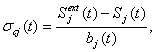 (3)
(3)
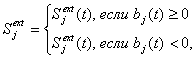
where 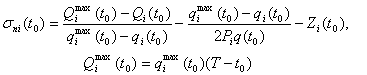
Here:  - measure of stability
  of knot in a
timepoint
of knot in a
timepoint  (time during
which level of filling with production of knot
(time during
which level of filling with production of knot  will reach one
of the borders in the absence of impacts on the related technological knots);
will reach one
of the borders in the absence of impacts on the related technological knots);  and
and  - maximum and
minimum admissible borders of filling of a warehouse
- maximum and
minimum admissible borders of filling of a warehouse  production;
  - the
size of a plan target to technological knot on a planning interval T;
- the
size of a plan target to technological knot on a planning interval T;  - the greatest
possible development of knot at the maximum involvement of all resources
available for it during the whole period
- the greatest
possible development of knot at the maximum involvement of all resources
available for it during the whole period 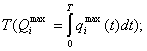
 -
loading at the maximum attraction of all available resources during the T period;
-
loading at the maximum attraction of all available resources during the T period;  - time when it is necessary to begin transition to
maksikmalny loading that process didn't leave stability area (stability of knot
at the moment
- time when it is necessary to begin transition to
maksikmalny loading that process didn't leave stability area (stability of knot
at the moment  at loading
  - for an interval
  - shift of the beginning of change of development in
relation to the beginning of change of loading - for an interval
- shift of the beginning of change of development in
relation to the beginning of change of loading - for an interval  - transition time
  from
development
from
development  before
development for an interval with the moment;
before
development for an interval with the moment;  ;
;  - speed of change of development
  from to
  .
.
If in a timepoint  the knot
  has
filling level
has
filling level  , and difference between entrance and output streams
in accumulative knot (i.e. balance on a warehouse) is equal
, and difference between entrance and output streams
in accumulative knot (i.e. balance on a warehouse) is equal  , depending on a sign of this difference the
accumulative knot
, depending on a sign of this difference the
accumulative knot  will or be
filled (at
will or be
filled (at  > 0), or to be devastated (at
  < 0).
< 0).
At achievement in
accumulative knot  , the upper bound of filling technological knots, developing
production
, the upper bound of filling technological knots, developing
production  , won't be able to continue the work as they will have
no place to give the production.
, won't be able to continue the work as they will have
no place to give the production.
At achievement in
knot of the  lower bound of
filling, the technological knots using this production, won't be able to
continue the work because of absence at them one of types of resources. In both
cases the continuity of technological process is broken that at the continuous
production technology means an emergency situation.
lower bound of
filling, the technological knots using this production, won't be able to
continue the work because of absence at them one of types of resources. In both
cases the continuity of technological process is broken that at the continuous
production technology means an emergency situation.
The first composed
in the last expression corresponds to the stock of time caused by a reserve of
power, and the second and third members - the amendment on the speed of an
increment of development and on development shift in relation to loading.
As the
size estimating a condition of production as a whole, pays off
 (4)
(4)
As a
result of the solution of a task to the dispatcher table listing with a set of
sizes of stability of technological and accumulative knots is given.
Results
of the decision are used as the output data for an optimizing problem of
coordination of loadings. At the same time results of the decision have
independent value. The problem can be solved and is autonomous; so, for
example, the dispatcher uses results of the decision for an assessment of
possibility of performance by separate production divisions of plan targets,
definitions on  production bottlenecks.
Setting
various values of parameter  , the dispatcher loses production situations on model.
For calculation of optimum trajectories of loadings of technological knots as
basic data it is possible to accept the following information: current values
of entrance and output streams
, the dispatcher loses production situations on model.
For calculation of optimum trajectories of loadings of technological knots as
basic data it is possible to accept the following information: current values
of entrance and output streams  :
:  ; the current
values of levels in accumulative knots
; the current
values of levels in accumulative knots  ; the greatest possible productivities of
technological knots on an interval
; the greatest possible productivities of
technological knots on an interval  ; conditional and constant data - weight functions on
channels "entrance - day off streams", plan targets on an interval
; conditional and constant data - weight functions on
channels "entrance - day off streams", plan targets on an interval  ; maximum and minimum possible levels of filling
  ,
,  ; possible speeds of change of loadings of
  technological
knots.
technological
knots.
Almost
all basic data have character of forecasts. Possible speeds of change of
loadings of technological knots are set by the dispatcher before calculation
depending on a technological mode of production divisions.
List of references
1 .
N.R.Yusupbekov, R.A.Aliyev, F.T.Adilov, Sh.M.Gulyamov Analytical information
technologies of automation of productions. // ТашГТУ, Tashkent, 2002-196s.
2 .
Mukharamov F.S. etc. To a question of criteria of management in quick and
dispatching systems. // On Saturday. : Automation of chemical productions. M: NIITEHIM, вып. 2, 1980. – page 14-17.