ROLE
OF THE BRYOPHYTE COVER IN ACCUMULATION OF THE BIOGENIC ELEMENTS IN TECHNOGENIC
SUBSTRATE ON THE TERRITORY OF SULFUR EXTRACTION
N.Ya.
Kyyak, O.L. Baik
Institute of Ecology of the Carpathians, NAS of Ukraine
11, Stefanyk St., Lviv 79000, Ukraine
e-mail: kyyak_n@i.ua
INTRODUCTION
The new approach connected with the maximum utilization of regenerating
possibilities of natural ecosystems for restoring resources and ecological
functions of devastated territories – their “ecological restoration” has been
formed in the world practice of technogenic geosystems rehabilitation. The use
of potential of plants communities, adapted to antropogenically changed
substrates gives a chance to decrease denudation processes intensity of
technical earth to great extent and initiate the soil forming processes in
them. The conception of technogenic geosystems renaturalization is not
ecologically grounded, but economically justifies [9].
As the result of open-cast mine exploitation of native
sulphur extraction on the territory of Novoyavorivsk state mining-chemical
enterprise “Sirka” (L’viv region, Ukraine) a number of various age dumps formed
both from the rocks which take part in zone soil formation and from bedding
rocks which do not form soils (e.g. tertiary clays, sulphur containing
limestones etc.) have been formed. The main problem in cultivating dump rocks
is its alienation for biota and sometimes its toxicity. Population of rock
substrates by microorganisms and pioneer plants promotes structuring of such
substrates qualitative and quantitative changes of properties which identify
the formation of young technogenic soils.
Bryophytes were among the first to settle on the dump
substrates and formed thick, multispecific overgrowth [14]. Gradually dying
off, the pioneer bryophyte species create the substrate for populating other
mosses and vascular plants. The way in which bryophytes change technogenic
substrate has not been investigated enough. It is known from literature that
moss cover essentially influences both the soil formation processes and the
ecological conditions inside ecosystem: hydrometric conditions in rhizosphere,
soil acidity, mineral regime, deposition and carbon cycle [3; 12; 15].
However, the question of the mosses role in renaturalization
of technical earth and on the territories of sulphur extraction remains not
enough investigated. So, the aim of this work was to investigate the influence
of bryophyte cover on accumulation of biogenic elements in the dump No1
substrate of Yazivsky sulphur deposit of state mining-chemical enterprise
“Sirka.
MATERIALS AND METHODS
The object of investigation was bryophytes from the dump No 1 (near the
village of Lis) of Yazivsky sulphur deposit (L’viv region, Yavoriv district),
subordinated to Novoyavorivsk sulphur deposit of state mining-chemical
enterprise „Sirka”. For investigations 3 moss species was chosen: Barbula unguiculata Hedw., Bryum
argenteum L. and Bryum caespiticium Hedw. For investigation of
bryophytes influence on accumulation of biogenic elements in the dump substrate,
the substrate samples under moss cover have been chosen for the experiments and
the surface substrate layer of 2-3 cm wide, where the bryophyte cover is of the
greatest influence, has been analysed [18]. The samples of the base substrate
(without plant cover) have been used as control. The investigations have been
carried out on 3 investigated dump transects (the dump crest and 2 transects on
the north and south slopes) in summer and autumn 2010-2012. The substrate has
been chosen in 3 places within experimental plot; the average sample has been
mixed and formed.
The content of total nitrogen in the substrate was
determined by K’endal’ method [1], the phosphorus content was determined
photocolourimetrically having the coloring intensity of phosphorus-molibdenum
blue color, the potassium content was determined on the photometer PFM-BP-3ОМ3 [2].
All experiments were carried out three times. The obtained
results were processed by the methods of statistical analysis [13].
RESULTS
Most scientists who investigated the processes of young grounds
formation on the territories devastated by extraction of natural deposits point
to the rapid accumulation rates of organic substance in posttechnogenic grounds
[8]. The process is closely connected with the constant over-growth of plant cover
productivity, that is, with the increase of plant fall quantity. On the basis
of substrates analysis, on which moss turfs overgrow, it has been found out,
that under moss cover formed by dense turf species Bryum caespiticium a clear interlayer of dark color – embryonic organic accumulative
horizon made by the products of dying off turf has been formed. This interlayer
is smaller under loose turfs Barbula unguiculata or Bryum
argenteum especially on the slopes as turfs of these species are
destroyed easily as the result of displacement of unstable substrate and hold
the occupied area uneffectively compared to Bryum caespiticium. It has been noted that the thickness of bedding under moss turfs
depends to great extent both on the specific properties and on the growth
locality of plants on the dump slopes with rather complex climatic conditions.
For example, in summer months substrate humidity amounted to 26.3-27.5 %, the
light intensity was 6.5-8.5 thousand lux, the temperature on the substrate
surface was +18.4 - +25.20 C on the crest and the north dump slope.
The top and the south dump slope are characterized by the least favorable
conditions (substrate humidity 4.5-14.8%, light intensity was 10.0-11.0
thousand lux, the temperature on the substrate surface has increased to +32.2 -
+37.50C).
It has been found out that the highest percentage of the
dead part (69.2-74.5% in a moss turf) was in the moss samples Bryum
caespiticium from the north slope and on the dump crest and in Bryum
argenteum from the crest and the south dump slope (66.3-68.9%), where
these species have rather high indices of projective covering (fig. 1).
For Barbula unguiculata the
thickness of the dead layer amounted to 52.2-58.4% in moss turfs and was also
the highest on the north dump slope. It is necessary to note that species Bryum argenteum and Barbula
unguiculata, which form short loose turfs, are typical of dry, open
plots on the dump territory while dense turf species Bryum caespiticium has the maximum productivity in more humid localities.
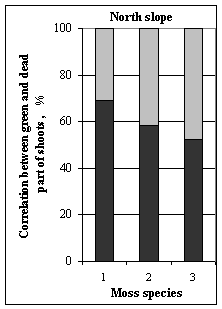
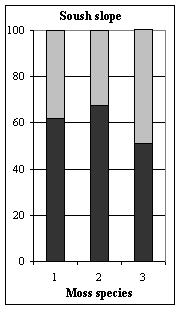
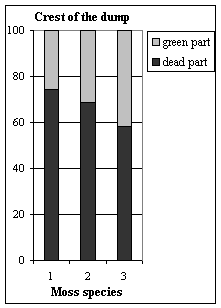
Fig. 1.
Correlation between photosynthetic (green) and dead part of moss shoots. Moss
species: 1 – Bryum
caespiticium, 2 – Bryum argenteum, 3 – Barbula
unguiculata.
One of the main grounds characteristics determining their
fertility and ability for plants population is their supply with nutritious
elements. Technogenic dump substrate of sulphur extraction is not almost
structuralized, it is characterized by insufficient absorbing and water keeping
properties being poorly supplied with the main nutrition elements (nitrogen,
phosphorus, potassium), that in complex defines its low potential fertility and
adaptability to plants life activity. It is known, that bryophytes play an
important part in the circulation of nutritious substances in ecosystem, in
spite of relatively small part of their biomass compared to vascular plants [5;
6; 16]. Mosses can absorb nutritious substances from atmospheric air,
precipitation, dust and keep them during long period of time in undecomposed
part of dead shoots [17]. The main reasons of it are the conditions of bryophyte
existence (low temperature, humidity, heightened acidity) as well as some of
their physical and chemical properties (high cation exchange capacity,
availability of essential content of lignin-like compounds and lipids [7].
Bryophyte role in accumulation of nitrogen in soil is
estimated in numerous publications [3; 4; 5; 11]. It has been established, that
the dead part of moss cover has rather high hydrolytic acidity, thanks to this
factor the moss bedding is characterized by essential absorption ability and
can contain not only hydrogen ions in great quantities, but also other
elements, necessary for plants [18]. In the primary succession on the sands the
rate of nitrogen accumulation in moss cover, formed by Polytrichum juniperium and Polytrichum
piliferum amounted to 10.1 kg/hectare/year, 58% of accumulative
nitrogen has been accumulated in moss bedding. This fact shows, that bryophyte
component positively influences the edaphic conditions. To confirm such
assumption, the moss cover was fully removed on the essential area of the
investigated territory, and it has been found out that nitrogen losses in
ecosystem essentially exceeded its entrance [5]. It has been established in
arctic ecosystems that some species of Sphagnum genus as well as Hylocomnium
splendens and Pleurozium shreberi accumulate
three times as much nitrogen and phosphorus, than Picea marina [12].
We have established that mosses also influence accumulation
of nitrogen and phosphorus in the substrate on the dump territory of sulphur
extraction. The highest indices of their content have been determined in the
substrate under mosses Bryum caespiticium and Bryum
argenteum. In the substrate under moss cover formed by dense turf
species Bryum
caespiticium the gross nitrogen content has increased 2.0-3.5 times,
phosphorus content has increased 1.2-1.4 times compared to their quantity in
bare substrate (table 1). Under moss turfs Bryum argenteum the nitrogen quantity has increased 1.4-2.4 times, phosphorus – 1.2
times (on south slope). Nitrogen content in the substrate has increased 1.2-1.3
times, but the control difference in phosphorus was not authentic.
Microclimatic conditions on the dump territory also
influence accumulation of nitrogen and phosphorus in the substrate, as the
highest content of these elements was determined in the substrate on the dump
crest, but the lowest content was on the south dump slope, that is, the
dependence on the conditions of plant localities is observed. Perhaps, the high
insolation level on the south dump slope influences these indices as for many
moss species negative correlation between nitrogen and phosphorus accumulation
and light intensity has been established [17].
Table 1.
Gross
nitrogen, phosphorus and potassium content under moss cover
on the
dump No 1 territory
|
Locality of substrate samples collection under moss turfs |
Content of nitrogen,
% |
Content of
phosphorus, % |
Content of potassium,
% |
|
Uncovered substrate (control) |
|||
|
Crest of the dump |
0,10±0,01 |
0,09±0,01 |
1,76±0,01 |
|
North slope |
0,09±0,01 |
0,09±0,01 |
1,76±0,02 |
|
South slope |
0,09±0,01 |
0,08±0,01 |
1,74±0,03 |
|
Bryum caespiticium |
|||
|
Crest of the dump |
0,35±0,02* |
0,13±0,01* |
1,85±0,02* |
|
North slope |
0,22±0,01* |
0,12±0,01* |
1,81±0,01* |
|
South slope |
0,16±0,02* |
0,10±0,01 |
1,74±0,02 |
|
Bryum argenteum |
|||
|
Crest of the dump |
0,20±0,02* |
0,11±0,01 |
1,78±0,01 |
|
North slope |
0,13±0,01* |
0,10±0,01 |
1,78±0,01 |
|
South slope |
0,22±0,03* |
0,11±0,01* |
1,74±0,01 |
|
Barbula unguiculata |
|||
|
Crest of the dump |
0,12±0,01* |
0,11±0,01 |
1,85±0,02* |
|
North slope |
0,12±0,01* |
0,11±0,01 |
1,81±0,01* |
|
South slope |
0,10±0,01 |
0,08±0,01 |
1,74±0,02 |
Footnote – * the difference compared to control (base
substrate) is statistically reliable at p<0,05.
The mosses role in potassium accumulation in upper mineral
ground horizon has been shown in a number of publications [10; 18]. These
investigations deal mainly with mosses which get used to the life in the forest
cenoses (species of the genus Sphagnum, Pleurozium shreberi, Dicranum
polysetum). The analysis of potassium content in the dump substrate
has not shown the essential differences between its quantity in bare substrate
and in the substrate under bryophyte cover.
Perhaps, the reason of this is in specific properties or
specific character of ions in moss shoots, as it has been established that
univalent cations (for all K+) are most of all concentrated in the
shoot apex, but divalent cations are located in the basal old part [6]. In our
experiments reliable increase of potassium content in the substrate has been
fixed on the crest and the north dump slope only under moss turfs Bryum
caespiticium and Barbula unguiculata.
Thus,
it has been established that bryophytes promote enrichment of the dump
substrate with biogenic elements. Interrelation
exists between degree of moss turfs decomposition and accumulation of biogenic
elements in substrate under moss cover. The life form of mosses has essential
influence on the process since the highest indexes of nitrogen and phosphorus
content were fixed in substrate under the moss B. сaespiticium with dense turfs. The important role is also played by concrete
ecological conditions on slopes of the dump.
LITERATURE
CITED
1. Agrochemical
methods of the soil investigations / Ed. А. V. Cokolov. М.: Nauka,
1975. 656 p. (In Russ.)
2. Arinushkina Е.V. Guide for chemical analysis of soils. М.: Nauka,
1970. 488 p.
(In Russ.)
3. Brisbee K.E., Gower S.T., Norman J.M., Nordheim E.V. Environmental control on ground cover species composition and
productivity in a boreal black spruce forest // Oecologia. 2001. Vol. 129. P.
261–270.
4. Bowden R.D. Input,
outputs and accumulation of nitrogen in an early successional moss (Polytrichum)
ecosystem // Ecological Monographs. 1991. Vol. 61. 207 p.
5.
Bowden W. B., Arscott D., Pappathanasi D. et al. Roles of bryophytes in stream
ecosystems // J. N. Amer. Benthol. Soc. 1999. Vol. 18. P. 151–184.
6. Brown D.H. Mineral
nutrition. In Bryophyte Ecology / Ed. A. J. E. Smith. London: Chapman &
Hall, 1982. P. 383–444.
7. Brown D.H., Bates
J.W. Bryophytes and nutrient cycling // Botanical Journal of the Linnean Society. 1990. Vol.
104. P. 129–47.
8. Humus formation in technogenic
ecosystems //Ed. R.V.
Kovalev. – Novosibirsk: Nauka,
1986. – 164 p. (In Russ.)
9. Lisetskiy F.N., Goleusov P.V., Kuharuk N.S.,
Chepelev O.A. Ecological aspects of reproduction of the soil-vegetative cover
in the landscapes broken by the mining industry // On-line scientific journal “Investigated
in Russia”. http://zhurnal.ape.relarn.ru/articles/2005/217.pdf.
10. Longton R. E. The
role of bryophytes and lichens in terrestrial ecosystems. In: Bryophytes and
Lichens in a Changing Environment / Eds. J. W. Bates and A. M. Farmer.
Clarendon Press, Oxford. 1992. P. 32–76.
11.
Oechel W. C., Van Cleve K. The role of bryophytes in nutrient cycling in the taiga. New York: Springer-Verlag,
1986. P. 121–137.
12. O’Neill K. P. Bryophytes in the global
carbon budget. In: Bryophyte biology / Еds A.J. Shaw, B. Goffinet. Oxford,
2000. P. 344–368.
13. Plochinsky N. А. Biometry. М.: Moscow
Univ. Publ., 1970. 367
p. (In
Russ.).
14. Rabyk I., Danylkiv I., Shcherbachenko O. The structure end dynamics of bryophytes communities on
devastated territories of Lviv region lands (for example mining-chemical
enterprise "Sulfur") // Bulletin of Lviv University. Biol. Series. 2010. № 53. С. 58–66. (In Ukr.)
15. Ringen D. The role
of moss in facilitating natural revegetation of metal-contaminating sites
during primary succession. www.bioed.org/ibscore/.
16. Skré, O. and
Oechel, W. C. Moss functioning in different taiga ecosystems in interior
Alaska. I. Seasonal, phenotypic, and drought effects on photosynthesis and
response patterns // Oecologia. 1981. Vol. 48. P. 50–59.
17. Thomas R. J.,
Schiele E. M., Scheirer D. C. Translocation in Polytrichum commune (Bryophyta)
I. Conduction and allocation of photoassimilates // Amer. J. Bot. 1988. Vol.
75. P. 275–281.
18. Trofimets V.I., Ipatov V.S. The role of lichens and moss cover in the dry pine forest // Bot. Journ. 1990. Vol. 75, №8. P. 1102–1109.