Экономические науки/15.Государственное регулирование
экономики
К.э.н. Соловьёва Ю.В.
Российский университет
дружбы народов, Россия
Features of formation of the Russian technopark structures
Due
to the dynamic development of high-tech industries of science and business the
increasing value is gained by innovative and technological structures. Today
for them there is no uniform definition or model, and in the different
countries (in the presence of the minimum set of requirements and standards)
there are equivalent concepts, such as "technological park",
"technopol", "a technological area", "research
park", "science park". So, in the USA the term "research
park", in Europe – "science park" is mainly used. In Russia the
concept "science and technology park" or ''technopark'' is more often
applied.
Formation
of the first technopark structures in Russia began at the end the
1980-h-beginning of the 1990th years. Their most part was organized at the higher
school. These science and technology parks had no developed infrastructure, the
real estate, the prepared teams of managers. They were, as a rule, created as
structural division of higher education institution (faculty) and weren't
really operating organizations creating and supporting the small innovative
enterprises. In some cases science and technology parks were formed in the form
of joint stock company which gave the chance to exercise flexible control at
relative independence of the basic organization
The first
Russian science and technology park (Tomsk scientific and technological park)
was created in 1990 as association from 100%-y by state ownership. His founders
were the State Committee on Education of the USSR, Ministry of the higher and
secondary vocational education, power structures of the Tomsk region, leading
higher education institutions of the city, Tomsk Scientific Centre SB AS USSR
and large industrial enterprises.
In the same 1990 on passing in Tomsk the first for
Russia the international seminar on science and technology parks made the
decision on establishment of association of the scientific and technological
parks created on the basis of higher educational institutions – Technopark
associations. The created Association united 27 science and technology parks
and 65 incubators of innovative business. Since 1993. The Technopark
association together with scientific park of University of Warwick (Great
Britain) carried out the international project on preparation of teams of
managers and consultants for science and technology parks. At the end of 1995
the same organization together with Association of university scientific parks
of the USA and Canada realized the project of training of experts for science
and technology parks of Russia and the CIS financed by the American fund
"Eurasia".
Today in Russia 56 science and technology
parks function. Some already passed the period of formation and successfully
work, are recognized as the international experts (for example, a technopolis
Zelenograd in Sverdlovsk region, science and technology parks in Ufa and Tomsk, International center of development
of science and technologies ''Dubna).
In these structures 900 innovative firms and 150 small serving firms
function, over 7 thousand new workplaces are created. The mechanism of the
state support of science and technology parks is presented in Figure 1.
In the late nineties - the beginning of the 2000th years with
participation of the Ministry of Industry and Science of Russia the network of
the innovative and technological centers (ITC) which on solved tasks in many
respects are crossed with science and technology parks started being created.
The main feature of ITCs consists that it inherently is structure of support of
the created small innovative enterprises which have already passed the most
difficult stage of creation, formation and a survival in an initial stage of
the activity when perishes to 90% of the small innovative enterprises. For this
reason science and technology parks were created mainly at higher education
institutions and carried out a problem of incubation of small firms, and ITCs
were urged to provide more stable relations of small business with the
industry, had to be created at the enterprises or scientific-industrial complexes.
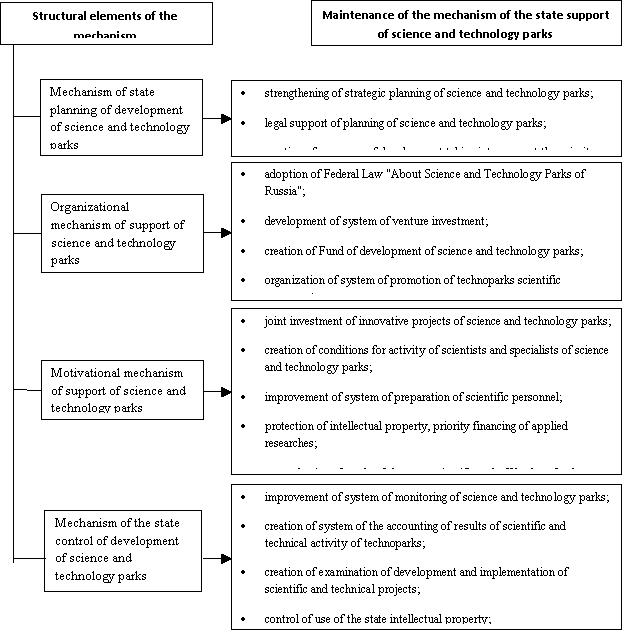
Fig. 1. Mechanism of the state support of science and
technology parks
In practice about 45% of ITCs were created at higher
education institutions, is frequent - on the basis of already operating science
and technology parks so two of this types of infrastructure substantially
intertwined and were to some extent duplicating. The conglomerates uniting at
once some types of infrastructure (for example, National
Research University of Electronic Technology ''MIET'') were in certain cases created. Today in Russia
works 52 ITCs in which more than 1000 small firms work. However it isn't enough
of it for the Russian scales (for example, in Germany works over 300 structures
similar on the functions to domestic ITCs).
Now
the number of the small enterprises being in ITTs and science and technology
parks, significantly doesn't change. Demand for hi-tech products remains within
the country low. The industrial enterprises interested in implementation of
innovative activity, prefer to buy new technologies abroad where is on sale not
only a new product, but also its aftersales service is provided. The majority
of domestic-owned small firms isn't able to offer similar services yet.