Vlasenko I.B.1,
Shevtsov S.N.2, Huang Jyun-Ping3
1Don State Technical
University, 2South Center of Russian Academy,
Rostov on Don, Russia
3National Kaohsiung
Marine University, Kaohsiung, Taiwan R.O.C.
On
the Contact Stiffness of Anti-Friction Polymeric Composite Covering Operated in
the Fluid Media
The polymeric composite antifriction coverings
are widely used in the modern bearing assemblies, which operated in the
chemically active aqueous solutions. These coverings have the good wearing
resistance at the high contact stresses and slipping velocities [1]. Such coverings
produced from the fabrics with different weavings impregnated by the polymeric resin
that ensure the required contact stiffness. At the same time the fabric
structure creates the regular micro-relief on the friction surface, and the
micro cavities on this surface contain small volumes of fluid which gives to these
coverings the ability of self-lubrication. The most important features of antifriction
coverings are the wear intensity, the creep under the normal contact stress,
activated by the thermal effect due to friction, and also the elastic contact
stiffness needed to maintain the pre-assigned gap at the action of the high
radial loading. Some works, e.g. [2] communicate about experimentally established
increasing on 20…30% of the contact stiffness of polymeric composite coverings
at operation in the fluid media. This paper presents an approach to the
modeling of this phenomenon and some results obtained by the finite element
implementation of contact problem for the stiff shaft and polymeric composite
covering with the presence of fluid.
It has been
established [1, 2] that weight of the polymeric composite covering is gained on
5…7% due to water absorption. We assumed the increasing of the contact stiffness
of moistened polymeric composite is caused by the presence of small amounts of
fluid in the closed pores of the composite structure. In order to build our
model some assumptions have been adopted.
Assuming
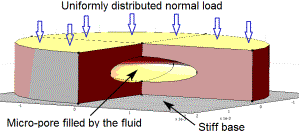
regular structure of composite based on the fabric the micro-domains of fluid
have been adopted as the ellipsoid of revolution with the similar dimensions
and lesser axis is normal to the friction surface (see Fig.1, a). All pores
filled by the fluid are closed and not connected one with other. Tangent
stresses due to friction are negligible, so, they are not taken into account.
All stress and strains are adopted as quasi-static. Material of covering is
adopted as elastic transversally isotropic with the elastic properties early
determined according to [3]. The fluid is compressible with a compressibility
corresponding to the water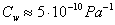 . These assumptions allowed to consider the studied system as
axially symmetric circular disk which is clipped from the anti-friction covering
with the small elliptic fluid inclusion (see Fig. 1, a).
. These assumptions allowed to consider the studied system as
axially symmetric circular disk which is clipped from the anti-friction covering
with the small elliptic fluid inclusion (see Fig. 1, a).
|
|
|
|
Figure 1. Schematic view of
the studied model: Geometry of
subdomains (left) and designations of boundaries (right) |
|
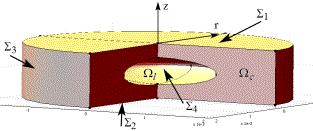
The constructed model take into account
the change of the fluid volume at the external loading, and due to change of
the fluid volume the hydrostatic pressure is applied to the interface boundary  between fluid and
elastic material. A correct description of these phenomena is ensured by the joint
consideration of global coordinate frame
between fluid and
elastic material. A correct description of these phenomena is ensured by the joint
consideration of global coordinate frame  together with local frame
  which moves according to
deformations of elastic body. To do this the equations of the moving finite
element mesh have been introduced, and these equations allow to calculate the
fluid volume on each iteration step. The appropriate numerical technique named
as the Arbitrary Lagrangian-Eulerian – ALE method [4] imply a determination of
the finite element mesh coordinates from the solution of mechanical sub-problem
which moves according to
deformations of elastic body. To do this the equations of the moving finite
element mesh have been introduced, and these equations allow to calculate the
fluid volume on each iteration step. The appropriate numerical technique named
as the Arbitrary Lagrangian-Eulerian – ALE method [4] imply a determination of
the finite element mesh coordinates from the solution of mechanical sub-problem
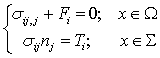 ,
,
where  is the stress tensor;
 are the densities of
volumetric forces and surface traction respectively,
are the densities of
volumetric forces and surface traction respectively,  is normal to the
surfaces,
is normal to the
surfaces,  is coordinate of
arbitrary point in the elastic body.
is coordinate of
arbitrary point in the elastic body.
So, the
solved joint problem includes equations of elasticity, hydrostatic equation of the
compressible fluid in the varied volume, which is determined by the moving mesh
equations. The problem has been implemented in the commercial finite element
soft package Comsol Multiphysics 3.5. The problem is stated as static with
linearly increasing normal force on the surface  .
.
The finite element model has been
simulated at the different volumetric content of fluid. The changed geometry of
elastic and fluid subdomains, contour lines of von Mises stress, and strain
(arrows) in the covering are presented on the plot (see Fig. 2).
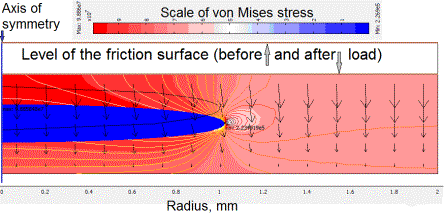
Figure 2. The
fields of displacements and von Mises stress in the layer of anti-friction
polymeric composite covering which contains 5.6% (volumetric) of absorbed water
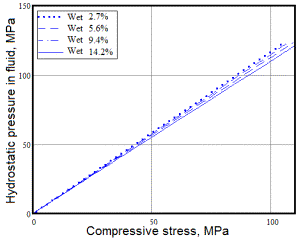
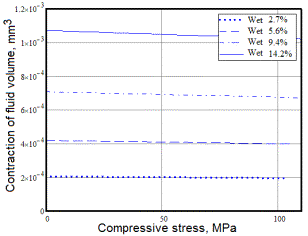
Calculation results show the considerable increase of internal pressure
in the pore filled by water and some decrease of the fluid volume that caused
by deformation of initially ellipsoidal shape of pore (see Fig. 3).
|
|
|
|
Figure 3. The dependencies
of hydrostatic pressure in the liquid inclusion and reduction of its volume
on the applied compressive stress at the different volumetric content of
water |
|
Such pressure can lead to the
delamination and destruction of the covering structure, all the more so, von
Mises stress is concentrated near pore surface with high curvature (see Fig.
2). The dependence of the effective compressive elastic modulus on the water
content can be good described by the polynomial model presented on the Fig.3.
As on can see graph of this dependence is growing with diminished rate. Thus,
experimentally established increasing of the contact stiffness of anti-friction
polymeric composite coverings in the fluid media can be satisfactorily
explained by the proposed model, which further identify a riskiness of extreme
contact forces for the integrity of anti-friction covering.
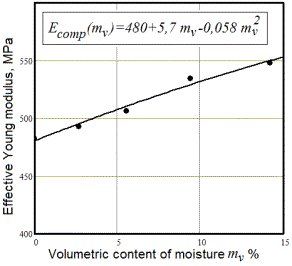
Figure 4. The dependence
of effective compressive module of covering on the volumetric content of water:
points – finite element calculation results; solid line – empiric polynomial
model of dependence shown on the inset
References
1. Gardos M.N.
Self-lubricating composites for extreme environmental conditions // In Friction
and Wear of Polymer Composites, Ed. K.Friedrich, Elsevier Science Publ.,
Amsterdam, 1986, p.397-448
2.
Власенко И.Б. Вязкоупругие свойства антифрикционных покрытий в
водных средах // Трение и смазка в машинах и механизмах, 2012, №12, с. 34-38
3. Shevtsov S. et al. Polymeric
Composite Shear Elastic Constants Determination on the Basis of Modified
Technique // Proc. of the 2nd Int. Conf. “From Scientific Computing
to Computational Engineering” 2nd IC-SCCE, Athens, Greece, 5-8 July, 2006, 8 p.
4. Donea J., Huerta
A., Ponthot J.-Ph. and Rodrıguez-Ferran A. Arbitrary Lagrangian–Eulerian
Methods // In Encyclopedia of Computational Mechanics, Ed. Erwin Stein,
Rene de Borst and Thomas J.R. Hughes. Vol. 1: Fundamentals. 2004, John
Wiley & Sons, Ltd., p.125-149