Technical science /6. Electrical equipment and radio
electronics
Doctor of Technical Science, professor. Basan S. N.
Russian state hydrometeorological university, branch in Tuapse, Russia
Master of Science Pivnev V. V.
Southern federal university, Russia
Conditions of reversibility of
processes in linear electric chains
Now
it is possible to meet various interpretation of property of reversibility. So,
for example, in the theory of linear electric chains property of reversibility
is formulated in the form of the theorem of reversibility (reciprocity) [1].
Its essence consists in the following. If the source of tension  is in a branch with
number
is in a branch with
number  and causes in a
branch with number
and causes in a
branch with number  current
  , after source transfer in a branch
  it will cause in a
branch
it will cause in a
branch  current
  , such that equality will be carried out
 . (1)
. (1)
Other interpretation of property of reversibility is that process is
considered reversible if, since some timepoint  , processes in studied system take place in the return
sequence [2]. In this work the vtory understanding of property of reversibility
of processes is used.
, processes in studied system take place in the return
sequence [2]. In this work the vtory understanding of property of reversibility
of processes is used.
Definition. Process of change of current  (or tension
  ) in one of branches of an electric chain we will call
reversible in that case when, since some timepoint
) in one of branches of an electric chain we will call
reversible in that case when, since some timepoint  , as a result of change of parameters of an equivalent
circuit of an electric chain (switching), the condition is satisfied:
, as a result of change of parameters of an equivalent
circuit of an electric chain (switching), the condition is satisfied:
 . (2)
. (2)
Or
 . (3)
. (3)
At the heart of many
forms of movement of a matter lie electromagnetic interactions. Therefore
conditions of course of the reversible process, received bu studying of
reversibility electric chains, can be extended to other forms of movement of a matter, mechanical, thermal, etc.
These results can be in the long term applied to the solution of problems in
various areas of practical activities (ecology, medicine, a hydromechanics,
etc.). In this regard the subject of this work is greatly actual. Let's consider an equivalent circuit of
any linear electric chain. Let it is required to make in this electric chain in
the set timepoint  switching so that
current (or tension) in a branch
switching so that
current (or tension) in a branch  began to change in the return sequence Generally for the set
class of electric chains current changes according the law:
began to change in the return sequence Generally for the set
class of electric chains current changes according the law:
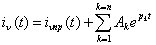 . (4)
. (4)
Here:
 - the forced
component of current,
- the forced
component of current,
 - integration constants,
 - roots of
the characteristic equation,
- roots of
the characteristic equation,
 - order of
an electric chain.
- order of
an electric chain.
Applying
to (3) condition (1) to the scheme after switching, we will receive:
 . (5)
. (5)
By
simple transformations the equation (4) can be given to a look:
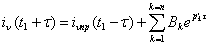 . (6)
. (6)
In this expression:  . (7)
. (7)
 . (8)
. (8)
The demanded law of change of the forced component can achieve, having
changed as appropriate parameters of independent sources of electric energy in
a chain. Reversibility of process for a free component can be provided, having
changed signs of the corresponding elements so that signs of roots of the
characteristic equation changed on the opposite. As an example we will consider an equivalent circuit of a
linear electric chain of the first order (Fig.1).
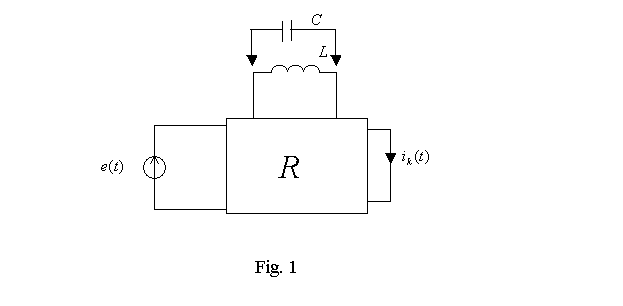

Here:  - tension
source,
- tension
source,
R
– linear resistive passive multiterminal network,
L
– inductance,
С- capacity,
 - current in k- й branches.
It
is known [3] that current in randomly chosen k- й branches will change generally under the law:
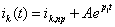 . (9)
. (9)
In
this expression:
 - the forced
component of current,
- the forced
component of current,
A
– integration constant,
 - integration
constant,
- integration
constant,
In
order that in this equivalent circuit, since some timepoint  current
  - started changing in the return sequence eventually,
performance of the following condition is necessary:
- started changing in the return sequence eventually,
performance of the following condition is necessary:
 . (10) Thus,
since some timepoint current will start changing in the return sequence if in
the return sequence both the forced component of current and a free component
at the same time starts changing. The first condition can be satisfied by
change of parameters of a source of tension, and in this work its realization
isn't considered. For a free component it is possible to write down:
. (10) Thus,
since some timepoint current will start changing in the return sequence if in
the return sequence both the forced component of current and a free component
at the same time starts changing. The first condition can be satisfied by
change of parameters of a source of tension, and in this work its realization
isn't considered. For a free component it is possible to write down:
 . (11)
The received expression differs from
initial an opposite sign of a root of the characteristic equation.
 (12)
(12)
Here
 - the entrance resistance of the resistive two-pole network
from inductance provided that all sources of electric energy are excluded (are
replaced with the internal resistance). The similar result turns out for an
equivalent circuit of the first order with a capacity.
- the entrance resistance of the resistive two-pole network
from inductance provided that all sources of electric energy are excluded (are
replaced with the internal resistance). The similar result turns out for an
equivalent circuit of the first order with a capacity.
 . (13)
Generalizing the aforesaid it is possible to draw the following
conclusion:
-
if in an equivalent circuit of the first order in a timepoint  to change a sign of parameter of one of elements on opposite,
that, from this time time, free components of currents of all elements will
start changing in the return sequence.
to change a sign of parameter of one of elements on opposite,
that, from this time time, free components of currents of all elements will
start changing in the return sequence.
One
of arisen when performing the considered transformation of problems is
realization of demanded switching. It can be rather simply solved if the
switched element is an analogo-digital-to-analog element.
Literature.
1
. S. Sesha, N. Balabanyan, Analysis of linear chains, Gosenergoizdat, M, L.
1963, 551с.
2. I.V.Savelyev Kurs of physics, т.1, M, "Science", 1989, 350 pages.Л. Р.
3. Neumann, K.S.Demirchyan, Theoretical
bases of electrical equipment, том1, Lenizdat, Energoizdat, 1981 of 530 pages.
4.
Basan S. N., Izotov M. V. Use of microprocessor
devices in problems of synthesis of nonlinear electric chains with the set
properties.// Materiały VII Międzynarodowej naukowi-praktycznej
konferencji «Perspektywiczne opracowania są nauką i technikami -
2011». Volume 56. Techniczne
nauki.: Przemyśl. Nauka i studia, 2011. – P.17-24.
5 . Basan S. N., Izotov M. V. To a problem of a choice of analog-digital element basis at realization of nonlinear resistive two-pole networks with the set voltamperny characteristics//Izv. higher education institutions. Electromecanics. 2010 . No. 6. Page 80-83