A MATHEMATICAL INTERPRETATION OF INFORMATION ANALYSIS OF
TECHNOLOGICAL PROCESSES
S.Sh.Kazhikenova, M.Kalikbergenova
Quantitative
estimations of sense and value of the information can be made for the
information analysis of quality of technological products and processes of
their reception only after the preliminary agreement about what precisely in
each concrete case has value and sense for the considered phenomena. Methods of
calculation the information suggested by Shannon allow to reveal a ratio of quantity
of the predicted information and quantities of the unexpected information which
cannot be predicted beforehand, and thus to enable to define a qualitative and
quantitative estimation of the certain technological circuit. As a probability
of detection of the main element of technological system it is possible to
accept its maintenance in a product, expressed in shares of unit. For example,
let’s examine the maintenance of a considered chemical element, in our case -
copper, in products of technological repartition. Also for probability of
detection it is possible to take the maintenance of suitable fraction
(remnants, briquettes) in a corresponding product. The same concerns the
process of extraction of an element in this or that product, as in this case a
parameter of extraction is equal to a probability of
transition of the given element from one condition of system into another.
These both parameters - the maintenance and extraction - can be equally used
for an estimation of quality of a product or technological repartitions.
Let's show how quality of
technological products and the technological processes resulting in reception
of these products is estimated by results of technological repartitions
copper-liquating manufactures on Zhezkazgan and Balkhash copper-smelting
plants (CSP) (table
1). So, the maintenance of copper in ore makes 0,5-1,2% (on the average 0,85%),
and in concentrates 5,5-40% (on the
average 22,75%). Stein of melting in a liquid
bath contains 40-55% copper (on the average 47,5%) . The basic result of the
work carried out on a scientific, technological and technical substantiation of
process of converting finally is reduced to an opportunity to increase the
maintenance of copper in draft metal.
Table 1 - The maintenance
of copper in products on Zhezkazgan and Balkhash CSP
|
Repartition |
The name |
Maintenance |
Average value |
|
Extraction |
Ore |
0,5-1,2% |
0,85% |
|
Enrichment |
A concentrate |
5,5-40% |
22,75% |
|
Melting |
Stein |
40-55% |
47,5% |
|
Converting |
Draft copper |
98,6-98,9% |
98,75% |
|
Fire refinement |
Anodic copper |
99,2-99,5% |
99,35% |
|
Electrolyte refinement |
Cathode copper |
99,9-99,99% |
99,95% |
This parameter
varies within the limits of 98,6-98,9% (on the average 98,75%). As a result of
technological process of anodic melting the parameters of the maintenance of copper
in anodes are the following 99,2-99,5% (on the average 99,35%). In process of
electrolyte refinements parameters of the maintenance of copper in
cathodes make 99,9-99,99% (on the average 99,95%).
For accounting of a various degree
of unexpectedness (probability) of events K. Shannon has suggested to use probabilities' function of
entropy borrowed from statistical physics, resulted as follows:
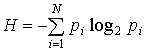 ,
,
where  – is a probability of detection of any homogeneous
element of system in their set
– is a probability of detection of any homogeneous
element of system in their set  ,
,  ,
, 
 .
.
If  is a
probability of detection of a controllable element then unexpectedness or
uncertainty of this
is a
probability of detection of a controllable element then unexpectedness or
uncertainty of this  detection is equal to
  . In our variant of estimation this uncertainty will be
expressed as:
. In our variant of estimation this uncertainty will be
expressed as:
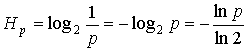 . (1)
. (1)
Before the publication of K.
Shannon's theory R.Hartly has suggested to define quantity of the information
under the formula:
 , (2)
, (2)
where  ,
,  - number of
levels,
- number of
levels,  - length of a code of elements at each level of hierarchical system.
The theorem 1 Let  - number of
elements of
- number of
elements of  - level.
  - capacity of
the information of a zero level of technological system. Then the capacity of
the information of
- capacity of
the information of a zero level of technological system. Then the capacity of
the information of  -level counting
upon one element is expressed by the formula:
-level counting
upon one element is expressed by the formula:
 .
.
In the technological circuit
considered by us  there is a
sample of set of elements - an element and not an element (in our case copper
and all other elements in aggregate) then the equation (2) will become:
there is a
sample of set of elements - an element and not an element (in our case copper
and all other elements in aggregate) then the equation (2) will become:
 .
.


 On the basis of
the theorem 1 we shall calculate the maximal information of the technological
circuit on initial 10 levels at
On the basis of
the theorem 1 we shall calculate the maximal information of the technological
circuit on initial 10 levels at  :
:

 0 1
2 3 4 5 6 7 8 9 10
0 1
2 3 4 5 6 7 8 9 10
 , 1 2 4 8
16 32 64
128 256 512 1024
, 1 2 4 8
16 32 64
128 256 512 1024
bit/el.
Essentially important advantage of
an information estimation of quality of products or technological operations is
that a suggested parameter  , as well as any entropy-information sizes, can be added.
The given property of additive is immanently inherent to entropy and
information and is a basis for expression of the law of preservation of their
sum. Hence, technological uncertainty of various operations within the limits
of the unified circuit can be expressed by a system parameter of uncertainty:
, as well as any entropy-information sizes, can be added.
The given property of additive is immanently inherent to entropy and
information and is a basis for expression of the law of preservation of their
sum. Hence, technological uncertainty of various operations within the limits
of the unified circuit can be expressed by a system parameter of uncertainty:
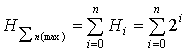 , bit/el.
Or for initial 10 levels:


 0 1 2 3 4 5 6 7 8 9
10
0 1 2 3 4 5 6 7 8 9
10

 , 1 3 7 15 31
63 127 255
511 1023 2047
, 1 3 7 15 31
63 127 255
511 1023 2047
bit/el.
The theorem 2 Information
capacity of hierarchical system and n-level are defined by equality:


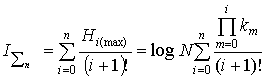 ,
, 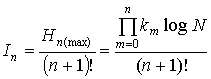 , (3)
, (3)
where  - greatest
possible entropy of a system.
- greatest
possible entropy of a system.
The determined component of the
information  on the basis of
the theorem 2 is defined by equality:
on the basis of
the theorem 2 is defined by equality:
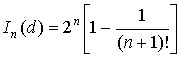 bit/el.


 0 1
2 3 4 5 6 7 8 9 10
0 1
2 3 4 5 6 7 8 9 10

 , 0 1 3,33 7,67
15,9 32,0 64,0
128 256 512
1024
, 0 1 3,33 7,67
15,9 32,0 64,0
128 256 512
1024
bit/el.


 As the
information capacity of technological system is defined by its stochastic part
on the basis (3) we shall receive:
As the
information capacity of technological system is defined by its stochastic part
on the basis (3) we shall receive:

 0 1
2 3 4 5 6 7 8 9 10
0 1
2 3 4 5 6 7 8 9 10
 , 1 1 0,6667
0,3333 0,1333 0,0444
0,0127 0,0032 0,0007 0,0001 0,0000
, 1 1 0,6667
0,3333 0,1333 0,0444
0,0127 0,0032 0,0007 0,0001 0,0000
bit/el.
The system determined component  is equal:
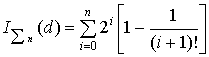 bit/el.,



 0 1
2 3 4 5 6 7 8 9 10
0 1
2 3 4 5 6 7 8 9 10
 , 0 1 4,33
12 27,9 59,8
124 252 508
1020 2044
, 0 1 4,33
12 27,9 59,8
124 252 508
1020 2044
bit/el.
Having defined degrees of
determination and ineradicable stochasticity at each level of technological
system under formulas:
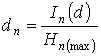 ,
, 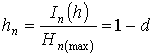 ,
,
let's analyze the received results
of the carried out calculations which are submitted in table 2.
Table 2 -
Settlement information-entropy characteristics of technological repartitions in
hierarchical system for  ,
, 
|
|
|
|
|
|
|
|
|
0 |
0 |
1,0 |
0 |
0 |
1,0 |
0 |
|
1 |
1,00 |
2,0 |
0,50 |
1,00 |
3,0 |
0,33 |
|
2 |
3,33 |
4,0 |
0,83 |
4,33 |
7,0 |
0,62 |
|
3 |
7,67 |
8,0 |
0,96 |
12,0 |
15,0 |
0,80 |
|
4 |
15,9 |
16,0 |
0,99 |
27,9 |
31,0 |
0,90 |
|
5 |
32,0 |
32,0 |
1,0 |
59,8 |
63,0 |
0,95 |
|
6 |
64,0 |
64,0 |
1,0 |
124,0 |
127,0 |
0,98 |
|
7 |
128,0 |
128,0 |
1,0 |
252,0 |
255,0 |
0,99 |
|
8 |
256,0 |
256,0 |
1,0 |
508,0 |
511,0 |
0,99 |
|
9 |
512,0 |
512,0 |
1,0 |
1020,0 |
1023,0 |
0,998 |
|
10 |
1024,0 |
1024,0 |
1,0 |
2044,0 |
2047,0 |
0,999 |


We shall illustrate the comparison
of these data with practical "know-how" of copper (tab. 1)
graphically in coordinates  . The factor of their correlation has made 0, 8614 at the importance 6,
6744 that testifies the adequacy of suggested model of an information
estimation of quality of products in consecutive operations of the
technological circuit.
. The factor of their correlation has made 0, 8614 at the importance 6,
6744 that testifies the adequacy of suggested model of an information
estimation of quality of products in consecutive operations of the
technological circuit.
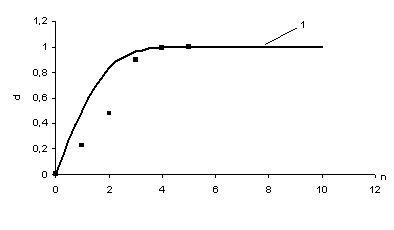
1 - dependence on new model, points - experimental
data
Figure 1 - Dependence of a degree of determination on
a level
The size  in this case
does not influence the solution of a problem as it is reduced at calculation of
level
in this case
does not influence the solution of a problem as it is reduced at calculation of
level 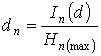 and system
 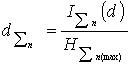 determinations
Thus, the theorems proved in the given section show
indissoluble connection of the determined and stochastic components from which
the first is dominating and providing stability, and the second defines the
most thin changes and optimum information capacity of technological systems. In
this connection we conclude, that the entropy-information approach to research of
technological systems is objectively necessary.