Математика/5. Математическое моделирование
N. Rvachova, O. Symonenko
Poltava National Technical Yuri Kondratyuk University, Ukraine
Technique
of modeling the intensity of the real time traffic in a telecommunication
network channel with switching packages
In this paper, offers
a technique of modelling the intensity of the real
time traffic in channel telecommunication networks with switching packets which
is based on exponential distribution of the
moments of the beginning of transfer and duration of transfer of real time
streams. The implementation of the specified technique allows creating the
adequate models simulating a process of dynamic change of intensity of the real
time traffic in channel telecommunication networks with switching packets.
Key
words: traffic, real time stream, exponential distribution, technique
of modelling, telecommunication
networks with switching packets.
I. Introduction
In modern telecommunication
networks with switching packets (TNSP) at transferring of speech messages and
streams of video information the multimedia traffic is formed. The intensity of
the information transfer initiated by real time operation of any multimedia
application is high enough and close to constant value, therefore such kind of
the traffic is frequently called streaming traffic or real time traffic [1 -
3]. For qualitative transfer of streaming traffic it is necessary to minimize a
delay of packages and its dispersion (jitter) that is possible at realization
of efficient real time streams control in the conditions of presence of the
limited network resources [4]. During development the methods of management of
real time streams in TNSP it is expedient to use the mathematical models
simulating the process of dynamic change of the intensity of the real time
traffic in a TNSP channel.
Therefore
the scientific problem consisting in development of a technique of creation of
adequate models, simulating change in time the size of intensity of the real
time traffic in the channel of a telecommunication network with switching
packages is actual.
II. The purpose of the article
The purpose of the article is
to receive by means of mathematical modeling the correct current values which
the size of intensity of the real time traffic takes in a TNSP channel.
III. A substantiation of characteristics of the real
time streams transmitted by a channel TNSP
For modeling the real time
streams transmitted by the channel it is necessary to prove the laws of
distribution and the characteristics of random variables S (an interval
of time between the moments of the beginning of transfer in this channel of the
real time streams) and T (duration of transfer in this channel the real
time streams). Within the framework of the theory of mass service we offer the
models that adequately describe the functioning of telephone channels switching
unit on which the stream of inquiries for establishing connection comes [5].
The most widespread models of receiving calls in such system and their service
assume that the density of distribution of a time interval between receiving
calls, and also the density of distribution of duration of their service submit
the exponential law. Practical importance of these models is caused by the fact
that the values of the basic characteristics of the mass service system
calculated on the basis of the above mentioned models will well be coordinated
to the results of corresponding measurements in really functioning networks
with switching channels.
There is an obvious analogy
between the two processes - the service of a call in a traditional telephone
system of communication and a transfer of a real time stream in a
telecommunication network with switching packages. The doubtless similarity of
these processes is that the moments of their beginning and termination are
initiated exclusively by the users and are only connected to their subjective
needs, instead of technological features of information transfer in one or
another network. Therefore the assumption seems to be proved that the density
of the distribution of a time interval between the moments of the beginning of
real time streams transfer, and also the density of distribution of duration of
their transfer satisfies the requirements of the exponential law.
We have set:
1) The size - throughput of
the channel on which it is required to transfer the real time streams;
2) The set of real time
streams  , where
  is the number of a stream which
is required to be transferred on the channel;
is the number of a stream which
is required to be transferred on the channel;
3) The set  , where
  is the required value of intensity of transfer of a stream
  ;
;
4) The set  , where
  is the value of the moment of time corresponding to the beginning of a
transfer of a stream
is the value of the moment of time corresponding to the beginning of a
transfer of a stream  ;
;
5) An interval of time of
modeling  .
.
It is necessary: to determine the
values of intensity of the real time traffic in a TNSP channel in each present
situation of time.
Assumptions:
1) The interval of time
between the next moments of the beginning of transfer of real time streams on
the channel is a random variable S which is distributed on the exponential
law and is characterized by an average of distribution  ;
;
2)
Duration of transfer of a real time stream on the channel is a random variable T
described by the exponential law of distribution and an average of distribution
 .
.
IV. Development of a
technique
The task of receiving the
values which are possessed in a present situation of time by the size of intensity
of the real time traffic in a TNSP channel is reduced to the definition of size
 , i.e. the total intensity of the real time streams transmitted on the
examined channel at a present situation of time.
, i.e. the total intensity of the real time streams transmitted on the
examined channel at a present situation of time.
At defining the size  it is necessary to take into
account, that total intensity of streams simultaneously transmitted on the same
channel cannot exceed throughput of this channel. The transfer of a stream at the
moment of time is only possible at meeting a condition:
it is necessary to take into
account, that total intensity of streams simultaneously transmitted on the same
channel cannot exceed throughput of this channel. The transfer of a stream at the
moment of time is only possible at meeting a condition:
 , (1)
, (1)
where  is a value of total intensity of
real time streams, which are required to be transferred on a TNSP channel at the moment of time.
is a value of total intensity of
real time streams, which are required to be transferred on a TNSP channel at the moment of time.
The value of  is defined from the expression:
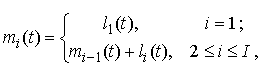 (2)
(2)
where  is a required value of intensity
of transfer of a stream
is a required value of intensity
of transfer of a stream  at the moment of time t.
Having defined on the formula
(2) the set  , it is possible to find the required value
  as meeting a condition (1) the
greatest value of total intensity of real time streams which are required to be
transferred on a TNSP channel at the moment of time t:
as meeting a condition (1) the
greatest value of total intensity of real time streams which are required to be
transferred on a TNSP channel at the moment of time t:
 .
.
In the formula (2) the values  are unknown. If at the moment of
time t it is required to transfer a stream
are unknown. If at the moment of
time t it is required to transfer a stream  , the required value of intensity of its transfer to this moment of time
will correspond to a predetermined value
, the required value of intensity of its transfer to this moment of time
will correspond to a predetermined value  , otherwise it will be zero:
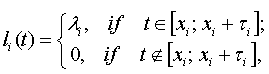 (3)
(3)
where  is the value of the moment
of time when it is required to begin transfer of a stream
is the value of the moment
of time when it is required to begin transfer of a stream  ;
;  is the required value of
duration of transfer of a stream
is the required value of
duration of transfer of a stream  .
.
According to the assumptions,
it is known, that the random variable  is distributed on the exponential
law. Therefore the density of distribution of required duration of transfer of
a stream from the set
is distributed on the exponential
law. Therefore the density of distribution of required duration of transfer of
a stream from the set  can be submitted as a function:
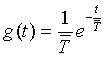 .
.
To receive the values of any
random variable during modeling special gauges are used, which, as a rule,
generate values of the random variable having an even distribution in an
interval (0, 1). In a reality such gauges generate not casual but pseudorandom
numbers close enough to them. Having a sequence of evenly distributed random numbers
 where
where  , it is possible to calculate the values of random numbers
  with exponential distribution and average value
  on the formula [8]:
 .
.
Therefore, using the gauge
generating evenly distributed values of random numbers  , it is possible to receive values
  of a random variable
  :
:
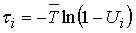 . (4)
. (4)
In the formula (3) the unknown
is the set of values  . The elements of this set can be found consistently, using the
expression:
. The elements of this set can be found consistently, using the
expression:
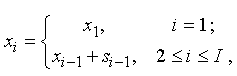 (5)
(5)
where  is the size of an interval
between the moments of time
is the size of an interval
between the moments of time  and
and  .
.
As an example the moments of
the beginning of transfer of real time streams, the intervals between them and
the values of duration of transfer of these streams in the TNSP channel are
illustrated in fig. 1.
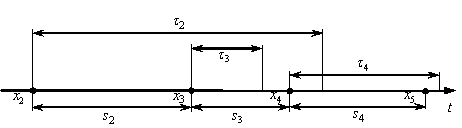
Fig.
1. The moments of the beginning of transfer of real time streams, the intervals
between them and the values of duration of transfer of these streams in the
channel of a network
For the solution of a problem
put by it is necessary to receive the set of values  . It is known, that the density of distribution of the random variable
  , corresponding to the exponential law, looks like:
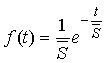 .
.
Therefore for definition of
values  of a random variable
  it is possible to take advantage
of the expression:
it is possible to take advantage
of the expression:
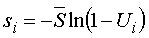 . (6)
. (6)
The technique of modeling of
intensity of the real time traffic in a TNSP channel, and the block diagram of
a realization algorithm is submitted on fig. 2, it includes the following
stages.
1.
Input of the initial data (block 1). There
have been entered the value of the size  , the predetermined sets of values
  ,
,  , the value
  .
.
2. Applications setup for the
transfer of real time streams on the channel of a network. At this stage the
generating numbers  (block 5) and consecutive calculation
of values
(block 5) and consecutive calculation
of values  on the formula (6),
  on the formula (5) and
  on the formula (4) (block 6) is
carried out. As a result for each application for transfer of a stream
on the formula (4) (block 6) is
carried out. As a result for each application for transfer of a stream  the values are defined for the
moments of time
the values are defined for the
moments of time  when it is required to begin
the transfer, and the required duration
when it is required to begin
the transfer, and the required duration  of the transfer.
3. Receiving of the required
values of intensity of transfer of real time streams in the channel of a network in a present situation of time  . At the given stage with the use of expression (3)
the values
. At the given stage with the use of expression (3)
the values  are calculated (blocks 7 - 9).
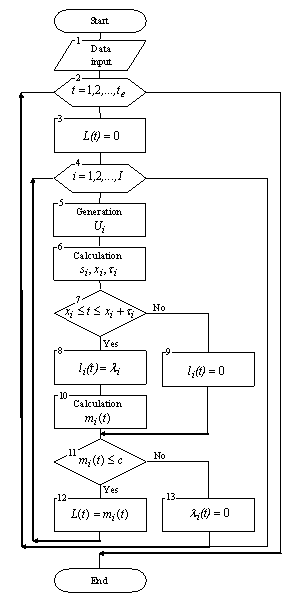
Fig. 2. The block diagram of the algorithm
realizing a technique of modeling of intensity of the real time traffic in a TNSP channel
4. Calculation of values of
total intensity of real time streams which are required to be transferred in
the channel of a network at the moment of time  . The essence of this stage is in the receiving by the
means of expression (2) the values
. The essence of this stage is in the receiving by the
means of expression (2) the values  (block 10).
5. Definition of total
intensity of transmitted streams of real time in the channel of a network in a present situation of time  . In the block 11 the fulfillment of a condition (1)
is checked. If the given condition is fulfilled, the value of the size
. In the block 11 the fulfillment of a condition (1)
is checked. If the given condition is fulfilled, the value of the size  (block 12) which has been
originally equal to zero (block 3) is updated. The default of a condition (1)
corresponds to a situation when in consequence of limiting congestion of the
channel the application for transfer of the stream
(block 12) which has been
originally equal to zero (block 3) is updated. The default of a condition (1)
corresponds to a situation when in consequence of limiting congestion of the
channel the application for transfer of the stream  , arrived at the moment of time
  , receives refusal. Thus the required value of
intensity of transfer of a stream
, receives refusal. Thus the required value of
intensity of transfer of a stream  is nulled (block 13).
Stages
3 - 5 of the technique are cyclically repeated with the purpose of receiving
the resulting values  for each moment of time
  .
.
V. Conclusions
Thus, the article offers a
technique of modelling the intensity of the real time traffic in a TNSP channel which is based
on exponential distribution of the moments of the beginning of
transfer and duration of transfer of real time streams.
The
implementation of the specified technique allows creating the adequate models
simulating a process of dynamic change of intensity of the real time traffic in
a TNSP channel.
References
1. Кучерявый Е.А. Управление трафиком и качество
обслуживания в сети Интернет. – СПб.: Наука и техника, 2004. – 336 с.
2. Куроуз Дж., Росс К. Компьютерные сети. 2-е
изд. – СПб.: Питер, 2004. – 765 с.
3. Столлингс В. Современные компьютерные сети. 2-е
изд. – СПб.: Питер, 2003. – 783 с.
4. Вегенша Ш. Качество обслуживания в сетях IP: Пер. с
англ. – М.: Издательский дом «Вильямс», 2003. – 386 с.
5.
Вишневский В.М. Теоретические основы проектирования компьютерных систем. –
М.: Техносфера, 2003. – 512 с.