Investigation of
privatization and re-privatization processes in the
transition economy of Ukraine
Privatization of State Property has become one of the
cornerstones of social and economic reforms in Ukraine. Her role in shaping the
foundations of a market economy, the creation of a critical mass of effective
private owners is undeniable. However, the task of privatization often narrowed
to purely fiscal and inconsistency and lack of transparency of privatization
processes, their significant politicization provide the basis for a mixed
assessment by experts, politicians, civil society, creating conditions for
political confrontation, which ultimately prevents the formation of correct
privatization strategy.
Especially at this point is to find effective
approaches to solving the problem of improving the efficiency of the
privatization process and the search for effective social contract, which will
allow taking into account the interests of all parties.
A prolonged period of privatization in transition
economies Ukraine connected with the problem that initially is chosen economic
policy of the state, not by a clear position of the state is not defined rules
for other facilities management and there was no synchronization privatization
and defining strategic objects determine the time and conditions of
privatization. [1]
From the perspective of system analysis and informed
decision making for the implementation of the privatization process to apply
modeling approach. This means that a decision on the formation and
implementation of privatization policies need to visit the appropriate
mathematical model on which the decision will be made.
This paper demonstrated a model of privatization in
the form of a system of ordinary differential equations of order 1. For
calculation based on ratings trajectory forecasts and key variables of the
process. In addition, the software used for the forecast for the next three
steps.
Thus, in the transition from one species to another
property the following problems occur: a significant decline in production
resulting in a stop or full stop operation of manufacturing plants, accompanying
this recession inflation (which can go into hyperinflation), a significant
increase in unemployment, the general decline of social security population and
living standards in general, and the deterioration of almost all other
macroeconomic indicators. Solution of these problems should find its place in
the decisions and plans of the government that decides to implement the
privatization process.
It is clear that privatization should be done at a
certain finite time interval synchronized with the solutions of other problems
of the transition process. It is important to prevent production decline below
a certain critical level, which provides an acceptable level of welfare and
curb unemployment at a level acceptable to the socio-political point of view.
Another objective of privatization may be due to the accumulation of capital
privatization with a view to future use for the development of production in
the new environment and reduce the budget deficit.
Thus, analysis of the privatization process as a
process control shows that the output of this process are the following
variables:
- The total volume of production (for a separate
branch for several industries or the national economy as a whole);
- Appropriate to the socio-political point of view,
the unemployment rate;
- The amount of capital accumulated from the sale of
state-owned enterprises to new owners.
As a control input variables can select the number of
enterprises subject to privatization per unit time (eg quarterly, half-year or
year) and the number of enterprises that are brought to market privatization.
The first variable we call the speed of performance or speed of privatization.
The third group of variables that affect the process
of privatization, are so-called perturbation, i.e. the input values
that are most often affecting the process (which we are going to
manage) and is usually difficult or unmanageable manageable. This group
comprises the following factors:
- General macroeconomic instability that affects all
socio-economic processes in the country and is virtually uncontrollable factor;
- The impact of foreign creditor relies on a decision
taken by the government and parliament; this factor has its advantages, but
overall the state will have to ultimately accept credit, loans, and interest
and not always favorable to the decision of the national economy, which is
especially painful for the country as unstable transitional period;
- A rapid change in the legal framework of
privatization that leads to chaos and illegal actions on the part of those who
sell, and by those who buy the company;
Obviously, the list of negative factors could
continue, but just how difficult it can be seen in the model to take into
account their impact. Therefore, further analysis will limit ourselves to some
generalized integrable perturbation as a Gaussian random process.
Privatization plans as a whole can be seen as a
function of time at a certain time interval, which depends on the speed of
privatization and variable number of enterprises that are brought to market
privatization in the current time. In this case it is important to find a speed
of privatization and the current number of enterprises in the privatization
market that will ensure compliance with other parameters within specified boundaries.
In the process of transformation from state to private
ownership in any industry can be divided into the following three groups of
enterprises that affect the progress of the privatization plan:
- Enterprises remaining in state ownership;
- Companies that are transformed into private
ownership at the beginning of the time period in question;
- Entities that pass into private ownership during the
time period in question.
It is obvious that the second and third group of
enterprises play a decisive role in the formation of key macroeconomic
indicators of the sector and the whole economy in transition.
In developing the model also relies that the volume of
production at enterprises that were privatized at the beginning of the period
remaining for simplicity the same as in state enterprises, but with fewer
employees. And the volume of production at enterprises of the third group may
be different from the first two groups.
As a result of the privatization of state-owned
enterprises of the workers released from work and, as the experience, the
percentage of released can reach almost 100%. Despite the fact that the workers
of state enterprises find work in the second and third groups, this leads to a
significant growth rate, which may be open or hidden. Thus, one of the key
variables of the mathematical model must be current employment in the
privatization process.
Since privatization inevitably accompanied by a
decline in production due to quantitative and restructuring of the industry,
the second variable that must be considered is the current volume of products
within this industry. Third base, you need to enter in the model is the amount
of capital that is accumulated from the sale of businesses.
To construct the model is necessary to consider a
number of variables that characterize the flow of this process at the industry
level. In the process of constructing mathematical models will comply with the
methodology proposed in [13]. In order to describe the dynamics of PE, we
introduce the following variables:
 number of enterprises
that are brought to market at the beginning of the privatization implementation
of the transition from state to private ownership;
number of enterprises
that are brought to market at the beginning of the privatization implementation
of the transition from state to private ownership;  current number of enterprises that are
brought to market further privatization at time
current number of enterprises that are
brought to market further privatization at time  ; introduction of this variable due to both
economic and socio-political reasons;
; introduction of this variable due to both
economic and socio-political reasons;  period of time during which must be made
privatization of the industry;
period of time during which must be made
privatization of the industry;  number of enterprises privatized unit time
(month, quarter); it is obvious that
number of enterprises privatized unit time
(month, quarter); it is obvious that  number of firms privatized in the time
interval
number of firms privatized in the time
interval  ;
;
 current volume of products produced by
private enterprise;
current volume of products produced by
private enterprise;  number of workers employed at a private
company, the company is the second group (for simplicity, it is assumed that
the number of workers in all private enterprises the same, that does not affect
the generalization of the results);
number of workers employed at a private
company, the company is the second group (for simplicity, it is assumed that
the number of workers in all private enterprises the same, that does not affect
the generalization of the results);  number of workers employed at a state
enterprise;
number of workers employed at a state
enterprise;  performance of the
state enterprise privatization at the beginning of the period (assumed constant
throughout the period);
performance of the
state enterprise privatization at the beginning of the period (assumed constant
throughout the period);  productivity per worker of state enterprises;
 productivity per worker private enterprise;
  current number of enterprises that are
created in the private sector at a time
current number of enterprises that are
created in the private sector at a time  ;
;
 number of workers at a private company, which
is created in the process of privatization;
number of workers at a private company, which
is created in the process of privatization;  performance of a single private company,
which is created in the privatization process;
performance of a single private company,
which is created in the privatization process; total number of employees in state enterprises at the beginning of the period
of privatization;
total number of employees in state enterprises at the beginning of the period
of privatization;  Total current employment in the field at time
 ;
;
 rate of change of total current employment in
the field at time
rate of change of total current employment in
the field at time  ;
;
 number of workers who have become unemployed
as a result of privatization;
number of workers who have become unemployed
as a result of privatization; 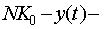 number of workers who have become unemployed
as a result of privatization without public enterprises that are brought to
market further privatization during
number of workers who have become unemployed
as a result of privatization without public enterprises that are brought to
market further privatization during  ;
;
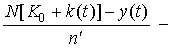 number of private enterprises that are
created by the labor of state-owned enterprises to be privatized;
number of private enterprises that are
created by the labor of state-owned enterprises to be privatized; 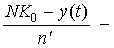 number of private enterprises that are
created by the labor of state-owned enterprises to be privatized without those
state enterprises that additionally submitted for privatization during
number of private enterprises that are
created by the labor of state-owned enterprises to be privatized without those
state enterprises that additionally submitted for privatization during  ;
;
 function of the current volume of production
for enterprises of all types of property;
function of the current volume of production
for enterprises of all types of property;  the rate of change of the current volume of
production for enterprises of all types of property;
the rate of change of the current volume of
production for enterprises of all types of property;  current unemployment caused by the transition
to a new form of ownership;
current unemployment caused by the transition
to a new form of ownership;  initial cost of a state enterprise
privatized;
initial cost of a state enterprise
privatized;  current gains of one state enterprise; while
gains on a range of public
current gains of one state enterprise; while
gains on a range of public  is
is  ;
assigned as the function
;
assigned as the function  can be predicted based on previous experience
of privatization;
can be predicted based on previous experience
of privatization;
 current amount of revenue from
the sale of state-owned enterprises; Thus, the total amount of proceeds from
the sale of state-owned enterprises in the interval
current amount of revenue from
the sale of state-owned enterprises; Thus, the total amount of proceeds from
the sale of state-owned enterprises in the interval  is
is 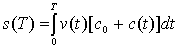 , and taking into account the state-owned enterprises,
further submitted to the market, total revenue will
, and taking into account the state-owned enterprises,
further submitted to the market, total revenue will
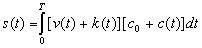 . (1.1)
Be it  variable that describes the part of the
workers who left the privatized state enterprises and found employment in
private enterprises established in the privatization process. The absolute
value of the number of workers who find work in the new private enterprises
with growth time
variable that describes the part of the
workers who left the privatized state enterprises and found employment in
private enterprises established in the privatization process. The absolute
value of the number of workers who find work in the new private enterprises
with growth time  ,
calculated by the product
,
calculated by the product  .
Note that this value increases the total current employment
.
Note that this value increases the total current employment  .
difference
.
difference  describes the number of workers who are
exempt from state enterprises. If
describes the number of workers who are
exempt from state enterprises. If 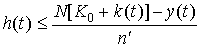 ,
,
then the manpower requirements for new private enterprises (third group)
will be fully met by workers who lose their jobs in state enterprises due to
their privatization. On the other hand, if there is a less likely situation, ie
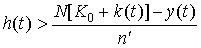 ,
,
then the needs of the third group in the labor force will be met by the
unemployed in the first two groups. Thus, we can write the following
relationship:  that a coefficient
  is
is
 ,
(1.2)
,
(1.2)
where .
.
Write an expression that
describes the amount of workers who lose their jobs as a result of
privatization of state enterprises in some elemental spell  :
: 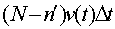 .
This value reduces the total current employment
.
This value reduces the total current employment  .
Thus we can write the following equation for the rate of change of current
employment:
.
Thus we can write the following equation for the rate of change of current
employment:  or
or  ,
and taking into account (1.2) we obtain
,
and taking into account (1.2) we obtain  . (1.3)
Consider the structure of the differential equation to
describe the rate of change of the current production volume in the industry.
Increase in volume production in the second group of enterprises is
characterized by the product  ,
and a decline in production at enterprises of the first group can be written
expression
,
and a decline in production at enterprises of the first group can be written
expression  .
Increase in volume production at enterprises of the third group by time period
.
Increase in volume production at enterprises of the third group by time period  can be described by the following equation:
 .
(1.4)
.
(1.4)
Thus, the rate of change of the volume of production in the industry as
a whole is described by the following differential equation:
 . (1.5)
Combining equation (1.1) (in differential form), (1.3) and (1.5), we
obtain a system of equations describing the process of privatization of the
industry on condition that they produce the same products before and after
privatization:  , (1.6)
 ,
(1.7)
,
(1.7)
 .
(1.8)
.
(1.8)
Note that the current unemployment
rate can be calculated by the expression
 . (1.9)
A number of potential businesses you can create by attracting
unemployed, calculated by the expression  . (1.10) The
resulting system of equations can be used to find the optimal (with respect to
some chosen criterion) values of variables
. (1.10) The
resulting system of equations can be used to find the optimal (with respect to
some chosen criterion) values of variables 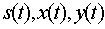 for the period of
time designated for privatization. Obviously, for the formulation of the
optimization problem it is necessary to impose restrictions on some variables.
for the period of
time designated for privatization. Obviously, for the formulation of the
optimization problem it is necessary to impose restrictions on some variables.
Note that the function  (speed of the privatization process) must be
piecewise continuous. One of the possible strategies of the privatization
process is the simultaneous privatization of the entire set of the industry
that are brought to market privatization. However, this strategy is
unacceptable to the socio-political and economic point of view because it has
the following disadvantages: the rapid and uncontrolled growth of unemployment,
a significant decline in production, the low probability of finding the
necessary investments for a rapid transition to private ownership and further
expansion of production volumes. It is therefore necessary to find a speed of
privatization, which would optimize the values of the key
variables. Limit the speed of privatization have the form
(speed of the privatization process) must be
piecewise continuous. One of the possible strategies of the privatization
process is the simultaneous privatization of the entire set of the industry
that are brought to market privatization. However, this strategy is
unacceptable to the socio-political and economic point of view because it has
the following disadvantages: the rapid and uncontrolled growth of unemployment,
a significant decline in production, the low probability of finding the
necessary investments for a rapid transition to private ownership and further
expansion of production volumes. It is therefore necessary to find a speed of
privatization, which would optimize the values of the key
variables. Limit the speed of privatization have the form
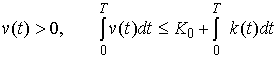 ,
(1.11)
,
(1.11)
and a fixed number of enterprises to be privatized 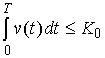 .
If you set the level of unemployment through
.
If you set the level of unemployment through  ,
then the final time
,
then the final time  share of employment in the area should not be
less than
share of employment in the area should not be
less than  on the amount of labor that is released. On
this basis, we can write the expression for employment at the end of the term
privatization
on the amount of labor that is released. On
this basis, we can write the expression for employment at the end of the term
privatization  ,
(1.12)
,
(1.12)
and a simplified version with a fixed number of enterprises  ,
that are brought to market privatization
,
that are brought to market privatization
 . (1.13)
Thus the launch of the privatization process must be defined with the
following values:  .
For more complicated version when the number of enterprises to be privatized,
is variable, it is necessary function
.
For more complicated version when the number of enterprises to be privatized,
is variable, it is necessary function .
Restrictions on the proceeds from the sale of businesses
.
Restrictions on the proceeds from the sale of businesses  .
(1.14)
.
(1.14)
The initial conditions for the basic variables are:
 .
(1.15)
.
(1.15)
A mathematical model of the process of privatization, restrictions on
the variables and initial conditions can make the formulation of the
optimization problem.
Find an (optimal) speed  implementation of the privatization process,
which is described by a mathematical model
implementation of the privatization process,
which is described by a mathematical model  , (1.16)
 ,
(1.17)
,
(1.17)
 ,
(1.18)
,
(1.18)
 (1.19)
that maximizing the
total production ,
,
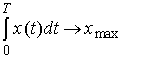

Where  class of piecewise continuous functions over
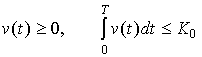
the planned privatization period with restrictions
class of piecewise continuous functions over
the planned privatization period with restrictions
 ,
,  .
.
В formulation of this
optimization problem is assumed that the market is made privatization a fixed
number of enterprises  ,
which does not change throughout the period of implementation of the process,
ie
,
which does not change throughout the period of implementation of the process,
ie  ,
,  . An alternative formulation of the
optimization problem is an option, complicated by the fact that the market for
enterprises, which are made for sale, can be expanded during the period
. An alternative formulation of the
optimization problem is an option, complicated by the fact that the market for
enterprises, which are made for sale, can be expanded during the period  .
.
Consider possible alternative solution to the problem for model (1.17) -
(1.19) using Lagrange multipliers. Instead of restricting 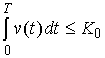 Add additional variable
  with boundary conditions
  and
and  .
.
 is the current number of privatized
enterprises. By writing the Hamiltonian for this problem
is the current number of privatized
enterprises. By writing the Hamiltonian for this problem  (1.28)
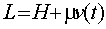 ,
,
where  ;
;
 introduced as a measure that is maximized;
  can be interpreted as the shadow price of
production area;
can be interpreted as the shadow price of
production area;  describes the dynamics of employment and
  dynamics of privatization market. Conjugated
variables
dynamics of privatization market. Conjugated
variables ,
determined by the following differential equations:
,
determined by the following differential equations:
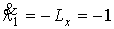 Where
Where  ; (1.29)
 (1.30)
The terms transversality
 ;
;
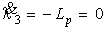 (1.31)
The terms transversality  .
Thus, we can write that
.
Thus, we can write that ;
;
 ;
;
 .
.
 And
And  terms transversality
  ,
,
 ,
,  ,
, 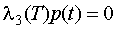 .
If
.
If  і
і
 , so
, so  we can get
 ,
(1.32)
,
(1.32)
Where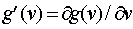 .
.
If  - growing bent function, then there exists a
unique solution of (1.32) defined for each point in time
- growing bent function, then there exists a
unique solution of (1.32) defined for each point in time  thus a necessary condition is also sufficient
for optimality.
thus a necessary condition is also sufficient
for optimality.
In order to get inputs for the model developed software that uses data
from past years and forecasts the number of public companies that can be of
privatization in these periods. To analyze the operation and was elected a
number of times based on 15 values, ie, during the years of the
privatization process in Ukraine.
Table 5.1 summarized the characteristics of mathematical models built
for the privatization of group A, and features the same stepper projections
calculated in these models.
Table 5.1
|
Type of model |
characteristics of the model |
Specifications forecast |
||||
|
|
|
DW |
RMSE |
MAPE |
Theil Coefficient |
|
|
AR(1) |
0,875844 |
157593,1 |
0,859390 |
192,7309 |
36,96071 |
0,202947 |
|
AR(3) |
0,920181 |
68897,81 |
1,827690 |
68,82119 |
19,98405 |
0,077099 |
|
AR(6) |
0,984161 |
1481,658 |
2,024068 |
12,12040 |
6,491308 |
0,024747 |
|
ARMA(1,1) |
0,932531 |
85639,42 |
2,304531 |
61,66583 |
16,12263 |
0,050405 |
|
ARMA(2,1) |
0,965990 |
38180,54 |
1,970234 |
81,16433 |
12,84269 |
0,074889 |
|
multiple autoregressive |
0,758138 |
319088,5 |
0,920338 |
150,9703 |
33,96408 |
0,128580 |


Simulation results are presented in Table 5.1 indicate
that all models except the first and last are suitable for modeling as Theil
coefficient is measured in hundredths fate. The best model can be considered AR
(6) and the set of regression of logarithms of data.
Predict the data for the next 3 years and will
demonstrate in Table 5.2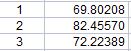
5.1's represent the graph, what is the difference
between the known and predicted data.
 0
0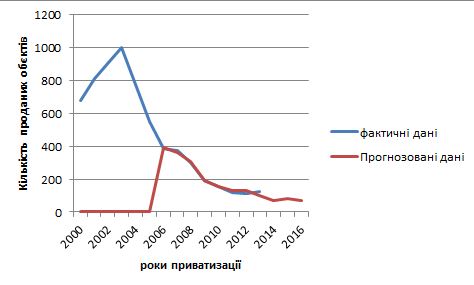
Figure 5.1 - Prediction 3 years AR (6)
Consequently, the graph shows that the AR (6) predicts
fairly close privatization in transition economies Ukraine and we can get
input.
The paper analyzes current privatization processes,
methods and models to describe the process of privatization. And the algorithm
of solving the problem of privatization. We consider the optimal model for our
country to nearest privatization process proceeded normally and performed two
functions; the state budget was increased and filled with employment. A
mathematical model of the process of privatization in the form of differential
equations of the first order. The model is used to solve the optimization
problem of transformation of ownership at branch level.
Literatura:
1) Government Privatization History, Examples, and
Issues. Commission on Government Forecasting and Accountability [electronic
resource]. - Mode of access:
http://cgfa.ilga.gov/Upload/2006Gov_Privatization_Rprt.pdf
2) Oxford Development Studies. Vol.32, №4, December
2004 [electronic resource]. - Access http://www.tandfonline.com/doi/pdf/10.1080/1360081042000293353#.U3qax_l_vu4
3) FederalAid Facility Privatization Act [electronic
resource]. - Mode of access:
http://beta.congress.gov/bill/104th/housebill/1907/text
4) Economics of Transition [electronic resource]. -
Mode of access:
http://lnu.edu.ua/faculty/ekonom/Economics/publish/Ek_Ukr_10/R_1.pdf
5) Chepinoha VG Economics: a textbook / VG. Chepinoha
// - K .: Yurinkom Inter, 2011.-656s.
6) L. Geiger Makroэkonomycheskaya Theory and
perehodnaya Economy; [Trans. from English. L.zorina] - M .: INFRA-M, 1996.
7) The essence of the cause and tenedentsiyi
privatization in the context of global economic growth: the institutional
aspect / GA Kramarenko, AE Black // Academic Review. - 2013. - №2 (39). -
S.13-20.
8) Privatization in a market economy / N.H.Panchenko
// Actual problems of economy. - 2006. - №5 (59). - S.18-20.
9) The experience of privatization in the UK to
Ukraine / P.H.Perova, A. Chubukov // Actual problems of economy. - 2006. - №4
(58). - S.14-16.
10) Pashaver O. Privatization and re-privatization in
Ukraine after the "Orange" revolution / Pashaver OI, Verkhovodova LT,
AheyevaK.M. - K.: Millennium 2006 - 106s.
11) Bidyuk PI Analysis chasovyz series / Bidyuk PI, VD
Romanenko, Tymoshchuk AL - By: Polytechnic University, 2010 - 317 p.
12) Grover R. Management nedvyzhymostyu
Mezhdunarodny'j uchebnыykurs - M.: VSHPP, 2007 - 375s.
13) Bidyuk PI Analysis and mathematical modeling of
economic processes of transition / Bidyuk PI, Polovtsev O. -K: PLAB-75, 1999 -
209s.
14) on transition process [electronic resource]. -
Mode of access:
http://library.nulau.edu.ua/POLN_TEXT/KOMPLEKS/ET/KURS/OSNOVA_ET/TEST/LEKC_5.htm
15) Bydyuk PI Analysis and modeling processes
ekonomycheskyh perehodnoho period / Bydyuk PI, Polovtsev AV // Problems of
Control and Informatics. -1998. - №5. - s.138-146
16) Kovalev VV Management fynansamy: Textbook.
Textbook. - M.: FCO Press, 1998 - 356 p.
17). McGowan Kenneth L. Value Based [electronic
resource]. - Mode of access: http://www.privatizationbarometer.net/PUB/
Delivery for Public Owners. Paper presented NL / 4/9 / PB_Report_2011.pdf to
the National Society of Professional
18) Privatization Barometer, Policy paper by the
Reason Foundation [Electro, nnyy resource]. - Mode of access: http: //
September 2000. - P. 38.