Педагогика /
4. Стратегические направления
реформирования
системы образования
Shastova I.V.
Educational centre
“Greenly”
Research in the Model of
Interpersonal Teacher Behaviour: Greek Elementary educational context
In The Model of Interpersonal Teacher Behaviour:
a Quantitative Cross-Cultural Validation Within Greek elementary education
context Kyriakos Charalampous and Constantinos M. Kokkinos provide a
framework for studying the student-teacher interaction and enrich it with cross-cultural
validity within Greek context. The authors provide a solid and reliable review
of the researches done in this field and reason the necessity of the
cross-cultural validity of the Model of Interpersonal Teacher Behaviour (MITB).
There have been many
efforts to investigate student-teacher interactions and since the inceptions of
Wubbles’ MITB the model received international recognition. The authors explain
that the tool of measuring students’ perceptions of teacher interpersonal behaviour
is the Questionnaire on Teacher-Interaction (QTI) and it has been widely
recognized and been published into more than 15 languages. However, they mention
about questions being just merely translated and not adapted to possible
cultural peculiarities. As researchers point at some failures to depict
teacher-student relations and some successful adaptations (for example in
Turkey) they conclude that MITB should correspond to the teachers’ behaviour in
specific context. Thus, there is a necessity to examine the cross-cultural validity
of the MITB.
In
the section of Theoretical framework
Charalampous and Kokkinos represent the model as a circle with two intersecting
dimensions. The dimensions are called Influence (with Dominance and Submission
as the opposite poles) and Proximity (with Hostility and Affection
accordingly). Taking into the account these four poles, the model consists of
eight sections: Leadership, Friendly/Helping, Understanding, Student Responsibility/Freedom,
Uncertain, Dissatisfied, Admonishing and Strict.
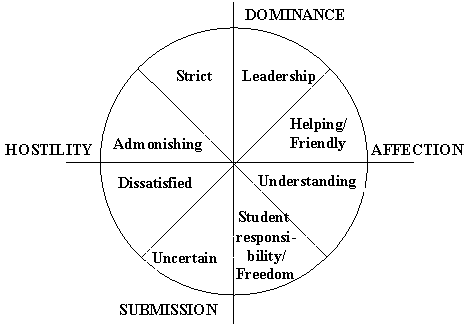
Figure 1. The model of
interpersonal teacher behaviour
In
the Results section the tables
display original descriptions of the eight types of behaviour along with those,
which were received during the interviews with 24 students and 6 teachers and
give some additional comments. There was also mentioned about initial codes,
code frequencies in the interview transcripts and their percentages. In general
it was discovered a close match between the desсriptions of MITB provided by interviewed people (students and teachers)
with the original one.
In Discussions the authors conclude that descriptions
received from students and teachers captured the main points of the
descriptions, however there were some points which were different. In terms of
teachers’ input, the results showed the strong influence of modern educational
practices. For example, the descriptions of
Leadership behaviour was morer positioning towards Hostility pole, while Student
Responsibility/Freedom was closer to Affection pole. In general it represents
positive attitudes towards student centred learning and associations of
teachers’ dominance as a sign of hostility.
For students,
such behaviour as Leadership, Student Responsibility/Freedom, Uncertain
and Strict were characterised close
to original descriptions of MITB. However, other descriptions were
distinguished with much difference. As they are situated along Influence axis, the authors conclude
that students might experience difficulties in observing minor changes.
Another objective
was to provide difference among subgroups based on their gender features and
demographical characteristics. For gender differences, the description of Student Responsibility/ Freedom was better conceptualized by female
teachers. The researchers suppose that female teachers can better distinguish
and conceptualise more responsible and active role in teacher behavior.
On the other
side, students’ MITB descriptions were rather different in terms of
demographical characteristics. Those who attended urban schools with the
majority of immigrants can describe Leadership
behavior as more dominant and friendly.
In Conclusions, Charalampous and Kokkinos
state that the study prove the validity of the MITB model within Greek context
and suggest further re-adapting the MITB. However, the researchers recommend
involvement of experts in languages during the translation as it can supply
better definitions in mother tongue.
Finding this
paper of interest and insight, it is important to mention about some uncertain issues.
In the methods section the authors explain the approaches they used but also
all the circumstances of getting sample and the procedure of the interview. The
research seems to be reliable and fair. However, there are a very small number
of samples: 6 teachers and 24 children. Additionally, 8 children and 2 teachers
represent each type of school while half of the teachers have less than 5 years
of teaching experience. Another point is that it is unclear about the age of
students as the school systems can be different in other cultures. However, the
authors mention that in other studies the numbers of samples were the same and
there is a close match with the descriptions in earlier researches.
References
Charalampous K., Kokkinos C. The Model of Interpersonal Teacher Behaviour: a qualitative
cross-cultural validation within the Greek elementary education context
:
[Електронний ресурс] – Режим доступу : http://onlinelibrary.wiley.com/doi/10.1080/01411926.2011.617437/abstract