The honored science and education member of the RANS,
corresponding-member of the IAS of HS, Dr.S. (eng.). Professor,
Pil E.A. Russia,
Saint-Petersburg,
VARIANTS OF
MACROECONOMICS DEVELOPMENT AFTER BEING AFFECTED BY DIFFERENT FORCES
When affected by external or internal forces (or by
both of them combined), economic shells deform, and their deformation can be
sorted into the following types presented in the table.
At the simultaneous expansion (retraction) of economic
shells (or at their expansion and retraction combined) it is implied that it
may take place proportionally, i.e. according to one mathematical law and by
one and the same relative value percentagewise, as well as disproportionally,
i.e. according to different mathematical laws and by different values
percentagewise.
Complex deformation of an economic shell is understood
as deformation during which there is simultaneous influence of external and
internal forces applied to different locations. That said in one or several
areas the economic shell retracts under the influence of external forces, and
in one or several locations it expands under the influence of internal forces.
In this case external and internal forces affecting the economic shell may be
similar or different in value.
As forces PV affecting an economic shell may differ in
their relative value, let us introduce the following three levels for them:
·
Pb is a major external (internal) force;
·
Pm is a medium external (internal) force;
·
Ps is a minor external (internal)
force.
In view of the fact that the table 1 has only 11 different variants from
64 according to which the change of all the three economic shells are possible,
below we will view several of them, as the conclusions made for these variants
will be valid for the rest of them.
|
Table 1 Types of economic shells deformation as affected by
external and internal forces PV |
|||
|
№ п/п |
Big business |
Medium-size business |
Small business |
|
1.
|
with no changes |
with no changes |
with no changes |
|
2.
|
with no changes |
with no changes |
expansion |
|
3.
|
with no changes |
with no changes |
compression |
|
4.
|
with no changes |
with no changes |
complex deformation |
|
5.
|
with no changes |
expansion |
with no changes |
|
6.
|
with no changes |
expansion |
expansion |
|
7.
|
with no changes |
expansion |
compression |
|
8.
|
with no changes |
expansion |
complex deformation |
|
9.
|
with no changes |
compression |
with no changes |
|
10. |
with no changes |
compression |
expansion |
|
11. |
with no changes |
compression |
compression |
The 1st deformation type is that all the three economic
shells stay unchanged
This state may be in the following three cases:
·
where all the values of forces Pb,
Pm, and Ps are equal to zero, i.e. Pb
= Pm = Ps = 0;
·
where all the values of forces Pb,
Pm and Ps are very small and do not affect
the economic shells that is why they can be ignored (Fig. 6а straight line 2);
where all the values of external and internal forces Pb,
Pm, and Ps are balanced, as they act upon
the same points of the economic shell from opposite sides.
Here Pb, Pm, and Ps
– big, medium-size and small forces which influences on an economy shell.
This deformation type may be regarded as an exception.
In this case all the three economic shells are active, i.e. all companies
process their orders within the term, and the assets of enterprises stay
unchanged. Here the population which also stays unchanged consumes all the
produced goods and services. In other words there is balance set between
consumption Qvc and produced goods Qvg and services Qvs. This balance can be noted down in the form of the formula Qvc = Qsg + Qvs. Quantity and
quality of goods and services, as well as weather conditions do not change.
There is no influence of adjacent space.
Let us introduce a new characteristic, the volume of
an economic shell Ve which will allow us to note the
following formulas of the case in question (1-3)
Vbb1 = Vbb2 = ,…, Vbbi
= const. (1)
Vmb1 = Vmb2 = ,…, Vmbj
= const. (2)
Vsb1 = Vsb2 = ,…, Vsbz.=
const. (3)
Here Vbb is the
volume of the economic shell of big business, unit3; Vmb
is the volume of the economic shell of medium-size business, unit3, and
Vsb is the volume of the economic shell of small business, unit3.
The “unit” is understood to be a currency unit adopted in the country
(countries) in question or its equivalent in the hard currency.
This state of economic shells may
be represented in the more universal formula (4)
Ve = f(t) = const. (4)
where: Ve is
the volume of an economic shell, unit3; f is a function (a
mathematical dependence) according to which the state of an economic shell
changes; t is time.
The 2nd deformation type is that all the three economic
shells expand
It can take place only in case
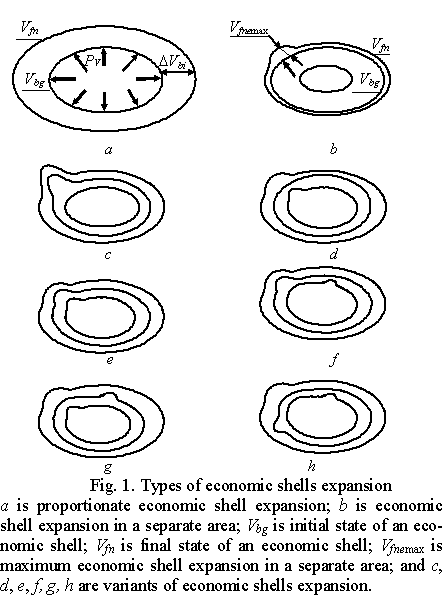
all the forces act from within (Fig. 1).
In this case there may be the following three variants:
·
all the economic shells expand in
proportion to their previous states on all the axes (Fig. 1а);
· all the economic shells expand in disproportion to their previous states
on all the axes;
·
all the economic shells expand in
one or several separate areas (Fig. 1b, 1c, 1d,
and 1e).
Fig. 1b shows two economic shells for clarity,
though in fact Vbg = Vfn. Here Vbg
is the initial state of the volume of an economic shell before influence of
external (internal) forces, unit3; Vfn is the
final state of the volume of an economic shell after influence of external
(internal) forces.
Let us view these expansions
separately:
Proportionate expansion of all the economic
shells means
that they are affected by similar internal forces equally over the whole
surface. In this case all the economic shells expand in proportion by certain
percentage. Here we need to take into account
that the forces affecting the economic shells in this case differ in value, as
it is difficult to imagine that force acting upon the economic shell of small
business may bring the same change to other economic shells percentagewise. Possible
variants of shell expansion are presented in Fig. 2.
To describe the states of the shells let us introduce
the value of relative increase (decrease) of the volume of an economic shell DVer, as it allows us to
characterize more fully the changed state of an economic cell and to compare
them at their expansion and retraction (5)
DVer = 100(Vfn
– Vbg) / Vfn, % [or DVer = (Vfn
– Vbg) / Vfn].
(5)
where: DVer is the value of a relative change of the volume of an economic shell,
unit, (%). Value DVer is better measured
in percentage terms.
The value of a relative change may naturally be over
one, as well as below one (a variant of the shell retraction), or equal to zero
(a variant of insignificant affecting forces or slow response), i.e. we can
note the following limits of existence of DVer: 0 ³ DVer ³ 1.
Now let us introduce the parameter that is the
difference of the volumes of economic shell DVe between the initial Vbg and final Vfn
states which can be noted in the following form DVe = Vfn – Vbg. (Fig. 2b)
Depending on the values of Vbg and Vfn
the parameter DVe may be positive at Vfn
> Vbg where the economic shell expands (Fig. 2), as well
as negative at Vbg > Vfn where the
economic shell retracts (Fig. 4), or equal to zero DVe = 0 (this case is
described above in the first deformation type section). Economic shell
expansion corresponds to the market activation, and its retraction means a
situation of crisis.
Let us designate the time in which an economic shell
expands (retracts) as Dte (Fig. 2d),
and it is calculated according to the formula (6)
Dte = tfn
- tbg = (tin
- tbg) + (tfn
- tin).
(6)
In order for all the three economic shells to expand
(retract) in proportion by the same percentage, let us introduce the value of
the expansion (retraction) coefficient Kec which indicates by
how much we need to increase (or decrease) the force affecting small,
medium-size or big business so that the other shells undergo similar
proportionate changes, i.e. we can note down, for example, Pmb
= Keci Psb or Pbb
= Kecj Psb. Here indications “i” and “j” of coefficients Kec
are introduced in order to differentiate them for medium-size and big business
respectively.
As in the case in question a certain number of forces
act on an economic shell, they can be presented as follows (7)

If we apply the coefficient Kex deduced
above, we can note down the universal formula (8)

In view of the fact that in the example in question we
see proportionate expansion of all the economic shells, the quantity of forces
affecting them theoretically must be the same which is presented in the formula
(8). In practice the quantity of forces affecting the economic shells may
naturally vary.
For the values of the expansion (retraction)
coefficient of an economic shell we can note down the following limits 0 > Kec
>> 1.
Based on these formulas we can suggest the following
definition for the case in question:
Knowing the values of forces acting upon one of
the economic shells and the values of expansion (retraction) coefficients Kec,
for the given forces we can calculate the value of expansion (retraction) of
other economic shells.
The formula (8) is universal and it can be regarded as
a “fundamental” law in economics, as
it is true not only for this case in question, but for all other variants
presented in the table. If we integrate the formula (8) over time we will be
able to learn when and how the economic shells will change and to have time to
react to these changes so that to minimize negative factors. Thus, we will be
able to forecast future changes in economic shells by influencing them at this
moment due to external and internal forces affecting them.
As economic shells cannot expand significantly over a
short time period, let us introduce the notion of a coefficient of maximum
single expansion Kecemax and time tecemax
within which this expansion can take place. The values of Kecemax
will be within the following limits: 0 > Kecemax
> 1. Here we must mention at once that tecemax  0. Thus, we can note down the value of a single final state of the
volume of an economic shell after internal forces affect it (9)
0. Thus, we can note down the value of a single final state of the
volume of an economic shell after internal forces affect it (9)
Vfn = Kecemax Vbg f(tecemax). (9)
Now let us introduce value DVen by which the volume
of an economic shell may increase (decrease) in case of a maximum single
expansion (retraction). It is calculated according to the formula (10)
DVen = Vfn
- Vbg. (10)
Economic shells expand in one or several
separate areas. Fig. 1b, 1c,
1d, 1e, and 1f present possible variants of
such expansion which may be the following:
· One economic shell expands in a location and two others fully expand proportionally
or disproportionally (Fig. 1b). Based on this let us introduce the value
of the maximum flexure of an economic shell Vfnemax
which shows how its volume can change so that it does not change into a higher
economic shell. This value is applicable for medium-size and small business,
but it is invalid for the case presented in Fig. 1с;
· Two economic shells expand in one location, and the third one expands
proportionally. Economic shells expansion in one location is understood to be an
expansion where the vector of forces acting on these shells is situated on one
line that is perpendicular to the points in question. In this case deformation
may take place on two neighboring shells, i.e. on the economic shells of medium-sized
and big business (Fig. 1с) or on the shells of
medium-sized and small business. Deformations of economic shells may also take
place through a shell, i.e. economic shells of small and big business expand in
certain areas (Fig. 1d), while the economic shell of medium-sized
business expands proportionally. Here we may see a variant in which during
deformation of two neighboring economic shells expansion of the smaller one
will pass through the bottom limit of the higher shell (Fig. 1с). Then the question arises if we can already attribute this company to
the new economic shell, in our example to big business. In order for us not to
face any conflict in examples like this further, let us consider a company
(companies) to have in fact changed one economic shell to another only if it
has definitely merged with or crossed another economic shell in some point or
area, i.e. in our example a company of medium-sized business will stay in it. This
example is not covered by the law where, for instance, the economic shell of medium-sized
business passes through the former bottom limit of big business while
expanding, as the limits of big business have moved towards increase together
with it. This law is also false for proportional retraction, but not for small
business, especially if there is only one person working for a company;
· All three economic shells expand in one location (Fig. 1e);
· Two economic shells expand in one location and the third one in another
location (Fig. 1f and 1g);
· Three economic shells expand in different locations (Fig. 1h).
The 3rd deformation type is
that all the three economic shells retract
In this case all the forces
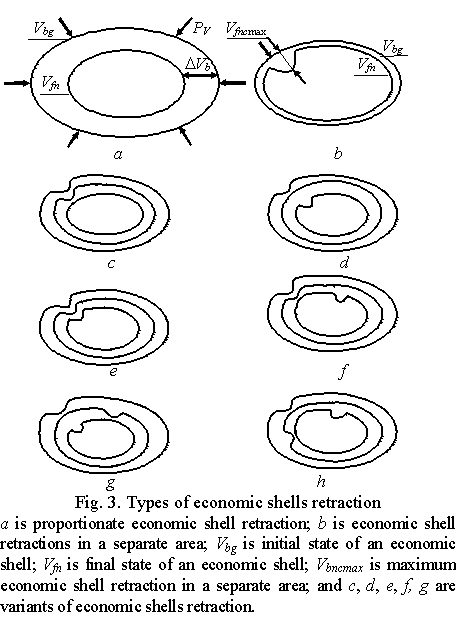
acting upon economic shells act from the outside (Fig. 3).
In such event the following three variants are
possible:
·
all the economic shells retract
in proportion to their previous states on all the axes (Fig. 3а);
·
all the economic shells retract
in disproportion to their previous states on all the axes;
·
all the economic shells retract
in one or several separate areas (Fig. 3b).
·
Fig. 3b shows two economic
shells for clarity though in fact Vbg = Vfn.
Let us view these retractions separately:
Proportionate retraction of all the economic
shells means
that they are affected by similar external forces equally over the whole
surface. In this case all the economic shells retract in proportion by certain
percentage. Here we also need to take into
account that the forces affecting the economic shells in this case differ in
value.
Similarly with the material described above let
us introduce the notion of a coefficient of
maximum single retraction Keccmax and time teccmax within which this retraction can take place.
Thus, we can note down the value of a final state of the economic shell volume
after external forces affect it (11)
Vfn = Keccmax
Vbg f(teccmax). (11)
If an economic shell moves into the area of another economic shell while
retraction, it becomes part of this shell and all the laws of this economic
shell are true for it. But this is not true for the variant shown in Fig. 3с. When small business “slips
through” its bottom limit it stops acting, i.e. goes bankrupt.
Disproportionate retraction of all the economic shells. In case similar external forces affect all the three economic shells
at once, their reaction will be different, thus, retraction of volume of these
shells will change in different ways. In this case the following equations
according to the rules must be true where the big business economic shell
retracts by the value -DBb (-DBbmax) (12)

A similar formula can also be noted down in case medium-sized business
is affected by external forces where the economic shell of medium-sized
business retracts by the value -DMb (-DMbmax) (13)

Economic shells retract in one or several separate areas. Fig. 3b, 3c, 3d, 3e,
3f, and 3h present possible variants of such
retraction which can be the following:
·
One economic shell retracts in a
location and two others fully retract proportionally or disproportionally (Fig. 3b);
·
Two economic shells retract in
one location, and the third one retracts proportionally. Economic shells retraction
in one location is understood to be a retraction where the vector of forces
acting on these shells is situated on one line that is perpendicular to the
points in question. In this case deformation may take place on two neighboring
shells, i.e. on the economic shells of medium-sized and big business (Fig. 3с), or on the shells of the small and medium-sized business. Deformations
of economic shells may also take place through a shell, i.e. economic shells of
small and big business retract in certain areas (Fig. 3d), while the
economic shell of medium-sized business fully retracts;
·
All three economic shells retract
in one location (Fig. 3e);
·
Two economic shells retract in
one location, and the third one in another location (Fig. 3f and 3g);
·
Three economic shells retract in
different locations (Fig. 3h).
The 4th deformation type is that the shells of big and medium-sized
business expand and the shell of small business retracts
This case is presented in Fig. 4.
That said there might be the following three variants:
· two economic shells expand and one retracts in proportion to their
previous states on all the axes (Fig. 4а);
·
two economic shells expand and
one retracts in disproportion to their previous states on all the axes;
·
two economic shells expand and
one retracts in one or several separate areas (Fig. 4b).
· This deformation type of economic shells where medium-sized and big
businesses expand is possible within the following variants:
· The shells of medium-sized and big business expand due to acquisition of
small business;
· The shells of medium-sized and big business expand due to laws in force
having negative effects on small business;
· The shells of medium-sized and big business expand due to acquisition of
small business and laws in force having negative effects on small business.
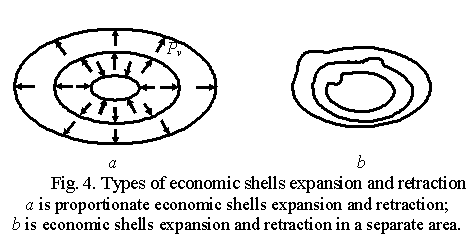
For this deformation type the descriptions made above for economic
shells expansion and retraction are applicable.
However, we must specify here that acquisition of small business will
lead to unbalanced percentage of the number of small business to medium-sized and
big business companies and, moreover, this leads to monopolization of certain
areas of the economy with all that it implies.
The 5th deformation type is that the big business shell
expands and the shells of medium-sized and small business retract
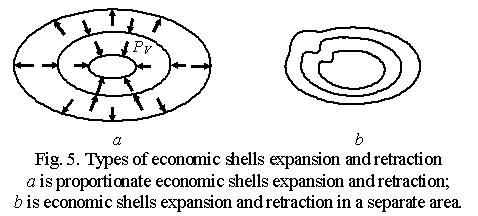
This type of economic shells deformation is presented in Fig. 5 and
similar conclusions made above are true for it.
Here three similar variants are possible:
·
one economic shell expands and
two retract in proportion to their previous states on all the axes (Fig. 5а);
·
one economic shell expands and
two retract in disproportion to their previous states on all the axes;
·
one economic shell expands and two
retract in one or several separate areas (Fig. 5b).
This case means that big business acquires medium-sized and small ones
which will lead primarily to price growth for goods and services that disappear
when small and medium-sized companies go bankrupt or are acquired by big
business.
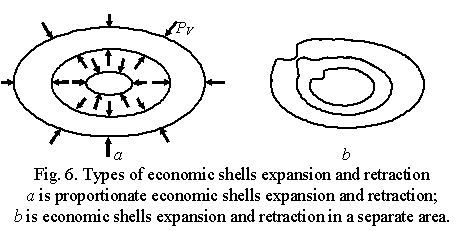
The 6th deformation type is that the shells of big and small
business retract and the medium-sized business shell expands
For this deformation type there are the following
three variants possible:
·
two economic shells expand and
one retracts in proportion to their previous states on all the axes (Fig. 6а);
·
two economic shells expand and
one retracts in disproportion to their previous states on all the axes;
·
two economic shells expand and
one retracts in one or several separate areas (Fig. 11b).
In the type of deformations in question there is an
interesting case represented in Fig. 11b where the big business shell
retracts in one location, and the medium-sized business shell expands in the
same location winning new released market outlets. When these two economic
shells intercross, a company (companies) of medium-sized business change places
with a company (companies) of big business. Let us call this process “rotation” of a company and give it the
following definition.
The process of a company (companies) moving from
a lower economic shell to a higher one due to increased production of a goods
or services in a certain market area released by a company (companies) from a
higher shell is called rotation.
Thus, one company (companies) was gradually replaced by another company
(companies).
For this deformation type there are the following
three variants possible:
·
two economic shells expand in
proportion to their previous states on all the axes (Fig. 7а);
·
two economic shells expand in
disproportion to their previous states on all the axes;
·
two economic shells expand in one
or several separate areas (Fig. 7b).
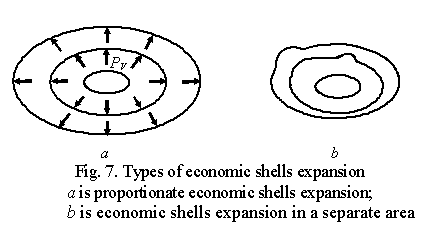
If two economic shells expand, and small business stays unchanged, thus,
either it was influenced by the country’s legislation and the population doesn’t
want to develop it, or big and medium-sized businesses have taken over the
markets and do not let small business develop.
The 8th deformation type is that the shells of big and medium-sized
business retract and the small business shell stays unchanged
For this deformation type there are the following
three variants possible:
·
two economic shells retract in
proportion to their previous states on all the axes (Fig. 8а);
·
two economic shells retract in
disproportion to their previous states on all the axes;
·
two economic shells retract in
one or several separate areas (Fig. 8b).
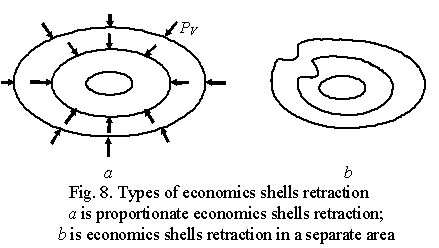
This variant shows worsening economic state of markets
for big and small business due to decreasing purchasing power of the population
which can afford mostly inexpensive goods, services and food. This will concern
employees of big and medium-sized business, as either their salaries will
decrease, or they will be excessed. As for the number of small business
employees and their salaries, they will not change, that is why their consumer
basket will stay unchanged.
As the
main economic index of any country is gross domestic product (GDP), let us
introduce the notion of theoretical GDP volume of a state VTGDP that will be constructed from the total of
theoretical volumes of economic shells of big Vtbbi, medium-sized Vtmbj and small business Vtsbz.